The decision of where to establish a solar module production facility is one of the most consequential an investor can make. The choice extends far beyond the cost of land or construction; it defines the operational efficiency, supply chain resilience, and market access of the entire business for decades. This reality is particularly critical in a market with Madagascar’s unique potential.
While the capital, Antananarivo, might seem appealing for its economic gravity and administrative convenience, the coastal city of Toamasina, with its major port, presents a compelling logistical alternative. The optimal decision, however, is rarely clear-cut and requires a detailed analysis of trade-offs aligned with a specific business strategy. This article offers a comparative framework for evaluating these two primary locations, guiding investors through the factors that will ultimately shape their success.
The Strategic Importance of Site Selection in Solar Manufacturing
Choosing a location for a solar factory is a foundational step that influences nearly every aspect of the operation. Key production inputs for solar modules—such as solar cells, tempered glass, and aluminum frames—are typically imported. A factory’s proximity to a major port, therefore, directly impacts production costs and inventory management.
The site also dictates access to a suitable labor force, reliable infrastructure for power and transport, and proximity to the target customer base. A poorly chosen location can create persistent operational bottlenecks, while a strategic one can provide a significant competitive advantage. For anyone learning how to start a solar factory, understanding these local dynamics is just as important as mastering the production technology itself.
Understanding Madagascar’s Industrial and Energy Landscape
Madagascar presents a compelling opportunity for renewable energy investment. With over 2,800 hours of annual sunshine, the country has immense solar potential. The government has signaled strong support for the sector through its Vision 2030 and the PNEJ (Plan National d’Émergence), which aim to achieve 80% renewable energy generation by 2030.
This ambition is supported by a growing economy (4.4% GDP growth in 2022) and a population of over 28 million, creating substantial underlying demand for energy. However, the country also faces infrastructure challenges, particularly in its road network, which makes logistical planning a central part of any industrial investment strategy.
Comparative Analysis: Antananarivo vs. Toamasina
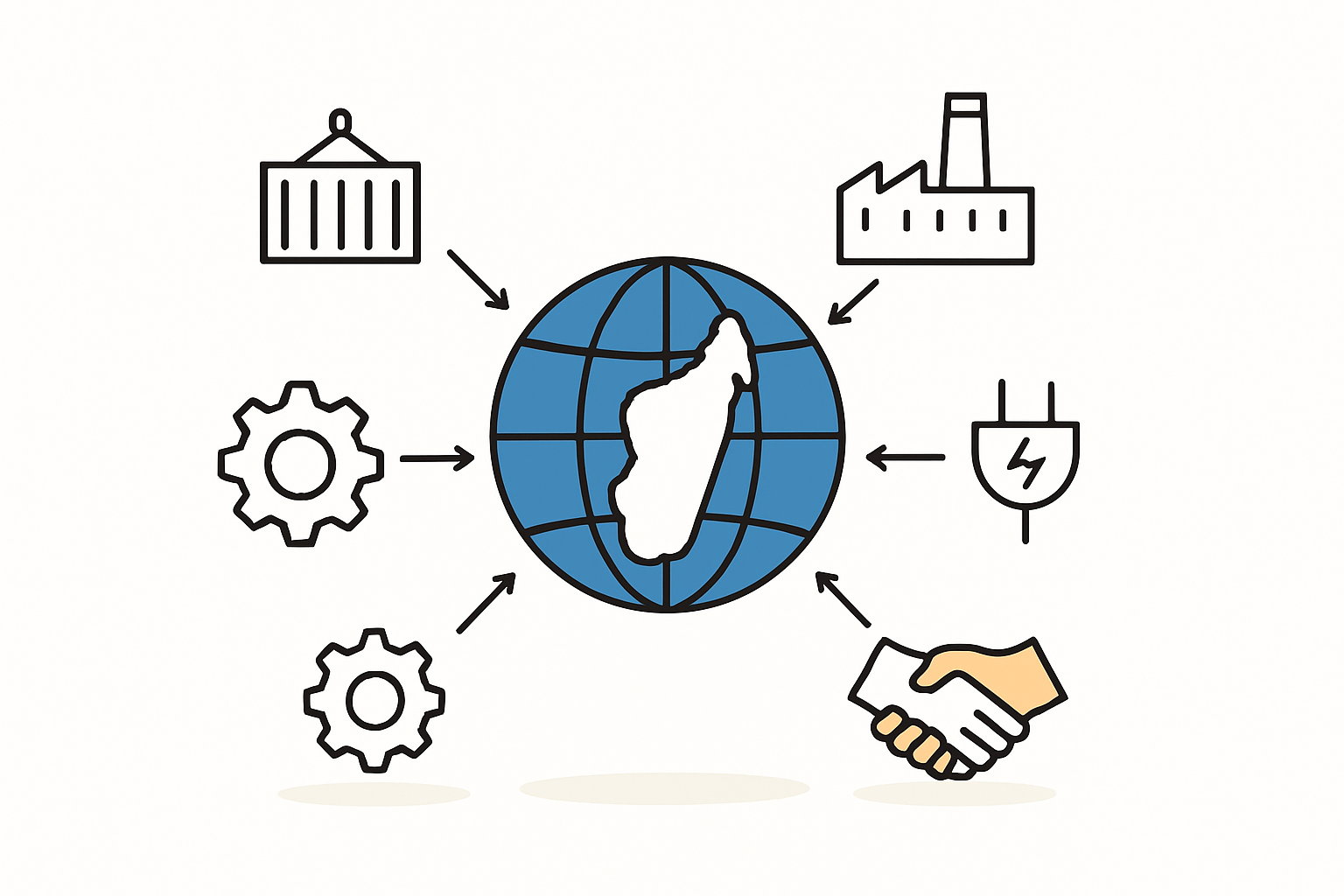
The choice between the inland capital and the main seaport involves a careful balancing of competing advantages.
Logistical and Supply Chain Considerations
A solar module assembly line is fundamentally a logistics-driven operation. The efficiency of moving raw materials in and finished products out is paramount.
Toamasina (Tamatave)
As Madagascar’s principal seaport, Toamasina offers a distinct logistical advantage for imports and exports.
Ready to make big Profits?
The solar Industry is Booming
WE HELP NEWCOMERS to the solar industry start their own solar module production line. Customers can make BIG PROFITS by selling modules and finding investors, without wasting money and time on things they don't need!
Advantages: Locating a factory in or near Toamasina dramatically reduces inland transportation costs and complexities for imported raw materials. This proximity minimizes the risk of delays and damage associated with overland transport. For a business model focused on exporting finished modules to neighboring markets like the Comoros, Mauritius, or mainland Africa, Toamasina is the natural choice.
Disadvantages: While excellent for international trade, distributing finished modules from Toamasina to inland markets, including the populous central highlands, still requires navigating the country’s road network.
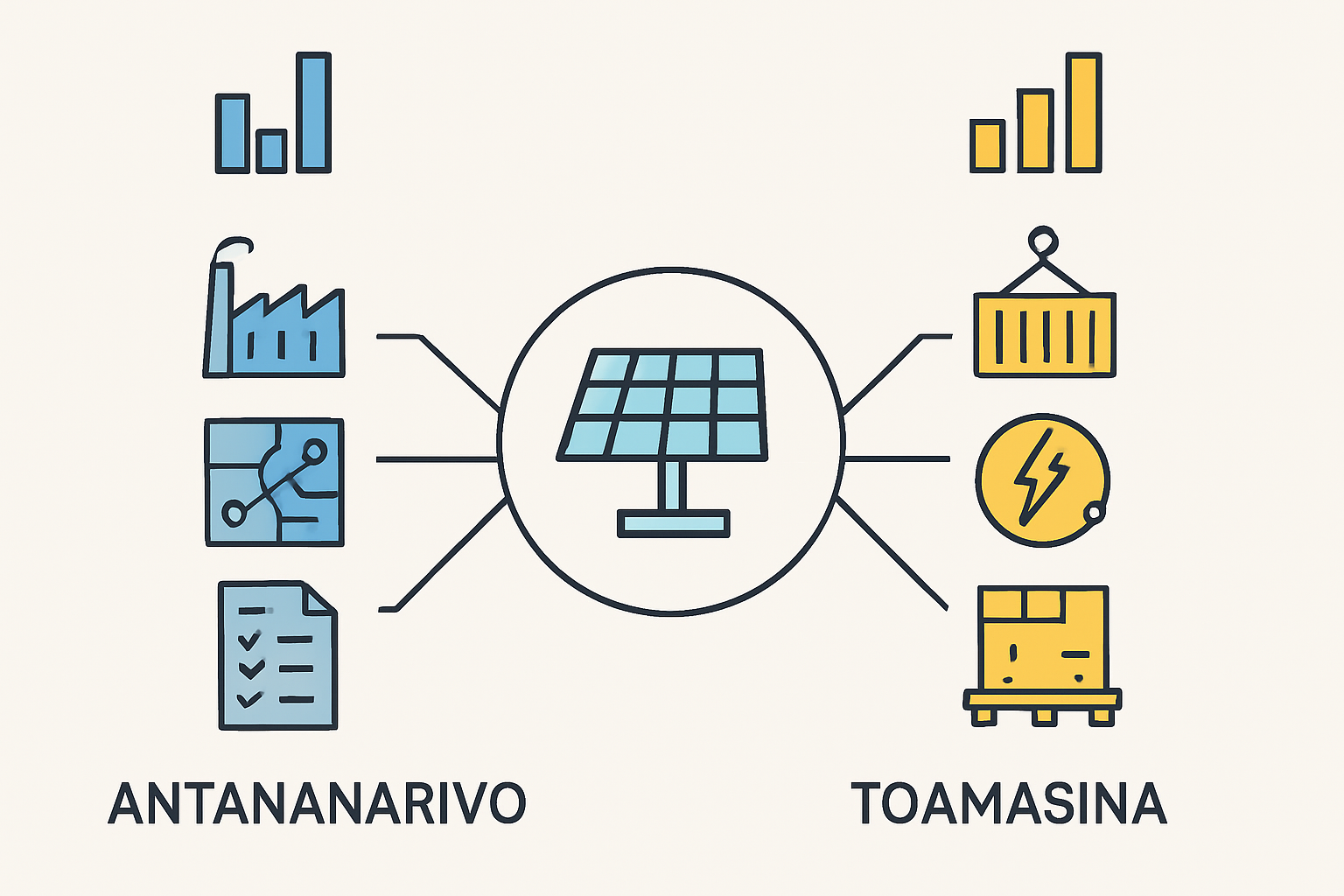
Antananarivo (Tana)
As the country’s central economic hub, Antananarivo is a natural center for nationwide distribution.
Advantages: A factory here is well-positioned to serve the largest domestic market and other major cities in the central region. The concentration of logistics companies in the capital can also offer more options for domestic transport.
Disadvantages: Its primary drawback is the need to transport all imported raw materials by road from the port of Toamasina, a 370-kilometer journey. This adds significant cost, lead time, and logistical risk to the supply chain. Analysis from past J.v.G. projects indicates that these inland transport costs can add a notable percentage to the final bill of materials for each module.
Labor and Talent Pool
The availability of skilled and semi-skilled labor is another critical factor. A typical 20–50 MW solar factory requires a workforce of 30 to 50 individuals with varying skill sets.
Antananarivo
Being the nation’s largest city and educational center, Antananarivo has the deepest and most diverse talent pool.
Advantages: Access to university graduates for technical, managerial, and administrative roles is significantly better. Finding experienced professionals in finance, logistics, and management is easier, which can accelerate the initial setup and professionalization of the business.
Disadvantages: Labor costs, particularly for skilled and administrative staff, are generally higher in the capital compared to other regions.
Toamasina
As a major industrial and port city, Toamasina has a strong base of industrial labor.
Advantages: There is a ready supply of labor experienced in logistics, warehousing, and general industrial work. Wage expectations for semi-skilled labor may be lower than in the capital.
Disadvantages: Sourcing specialized technical or senior management talent may be more challenging. An investor might need to budget for relocating key personnel or investing more heavily in local training programs.
Market Access and Proximity to Customers
The choice of location should be closely aligned with the primary target market.
Antananarivo
The capital region represents the largest and most concentrated market for commercial and industrial (C&I) solar installations.
Advantages: A factory in Antananarivo offers direct access to government ministries, international organizations, and the headquarters of major national corporations—all key potential customers. Proximity builds relationships and simplifies sales and service logistics for this high-value market segment.
Disadvantages: Serving remote or coastal regions from Antananarivo can be logistically intensive.
Toamasina
Its coastal location and port access make it a gateway to both eastern Madagascar and international markets.
Advantages: Ideal for serving the industrial and agricultural sectors along the eastern coast and is the premier location for any business with export ambitions.
Disadvantages: It is geographically removed from the country’s main economic and political center in Antananarivo, which could be a handicap if the business strategy relies heavily on government tenders or large corporate contracts based in the capital.
Making a Data-Driven Decision
The optimal choice is not universal; it depends entirely on the business model.
| Factor | Antananarivo (Inland Capital) | Toamasina (Main Seaport) |
|---|---|---|
| Inbound Logistics | Higher cost and risk (road transport from port) | Lower cost and risk (direct port access) |
| Outbound Logistics | Excellent for national distribution | Excellent for export and coastal markets |
| Skilled Labor | Stronger access to managerial/technical talent | Stronger access to industrial/port labor |
| Labor Costs | Generally higher | Generally lower |
| Market Proximity | Close to government and major C&I clients | Close to export channels and coastal industry |
| Business Ecosystem | Stronger professional services (banking, legal) | Strong logistics and industrial services |
An investor focused on securing large government contracts and serving the C&I sector around the capital would likely favor Antananarivo, accepting higher logistical costs as a trade-off for market proximity. Conversely, an entrepreneur planning an export-oriented model or prioritizing the lowest possible production cost would find Toamasina to be the more logical choice.
Frequently Asked Questions (FAQ)
What are the main raw materials that need to be imported for solar module manufacturing?
The primary imported components include solar cells, tempered front glass, backsheets or rear glass, EVA (ethylene vinyl acetate) encapsulant, and aluminum frames. The efficiency of importing these bulky and often fragile materials is a key cost driver.
Are there special economic zones or investment incentives in these locations?
The Economic Development Board of Madagascar (EDBM) is the primary agency supporting foreign investors. While incentives may be available and specific industrial zones may offer advantages, a thorough investigation into the latest regulations is a crucial part of the due diligence process.
How does the local power grid affect a manufacturing plant’s location?
Grid stability can be a concern in many regions. Both Antananarivo and Toamasina have better infrastructure than rural areas, but a manufacturing facility should plan for backup power generation to ensure uninterrupted production. This is a key part of the overall factory building requirements.
Which location is better for a smaller, start-up facility?
For a smaller facility (e.g., under 50 MW), the decision remains strategic. If the business plan is to test the domestic market, Antananarivo’s proximity to customers may be advantageous. If the plan relies on lean operations and the lowest possible input costs, Toamasina’s logistical advantage is compelling even at a small scale.
Conclusion and Next Steps
Ultimately, the choice between Antananarivo and Toamasina is a strategic one with no single correct answer. It demands a clear-eyed assessment of an investor’s intended business model, target market, and risk tolerance. By carefully weighing the trade-offs between logistics, labor, market access, and infrastructure, an entrepreneur can select a site that offers a sustainable competitive advantage.
This analysis is a critical first step. The next phase involves developing a comprehensive business plan, detailing the full scope of investment requirements, and outlining the entire process for setting up a successful operation.