The Republic of Palau, an archipelago of extraordinary natural beauty, possesses one of the world’s most valuable resources for energy production: abundant, year-round sunshine. For an entrepreneur or investor, this is a significant opportunity. However, the very elements that define this tropical paradise—the warm, humid air and salt spray from the Pacific Ocean—create one of the most challenging environments for standard solar technology.
Importing generic solar modules often leads to rapid performance decline and premature failure, a costly lesson for many projects. The solution is local or regional manufacturing of modules specifically engineered to withstand these harsh conditions. This article outlines the critical technical specifications needed to produce durable, high-performance solar modules for Palau and similar marine environments, transforming a technical challenge into a significant business advantage.

The Challenge: Why Standard Solar Modules Fail in Coastal Regions
A solar module is a sophisticated electronic device. When exposed to a high-salinity, high-humidity climate like Palau’s, where average humidity hovers around 82%, several degradation mechanisms accelerate.
Standard PV modules, designed for more temperate and dry climates, can lose up to 30% of their power output in just 5 to 7 years. This is a dramatic shortfall from their typical 25-year performance warranty.
The primary culprits are:
-
Salt Mist Corrosion: Airborne salt crystals settle on module surfaces, mix with moisture, and form a highly corrosive electrolyte. This solution attacks metal components, primarily the aluminum frame and the electrical connections inside the junction box.
-
Moisture Ingress: High humidity allows water vapor to slowly penetrate the module’s layers. This can corrode internal cell connections and accelerate other chemical degradation processes, leading to a loss of power.
-
Potential-Induced Degradation (PID): This effect, which can cause significant power loss in high-voltage solar arrays, is greatly accelerated by the presence of moisture and sodium ions from salt.
Engineering a product that can perform reliably for decades begins with understanding these failure modes.
Ready to make big Profits?
The solar Industry is Booming
WE HELP NEWCOMERS to the solar industry start their own solar module production line. Customers can make BIG PROFITS by selling modules and finding investors, without wasting money and time on things they don't need!
Engineering for Longevity: Key Specifications for Marine-Grade Modules
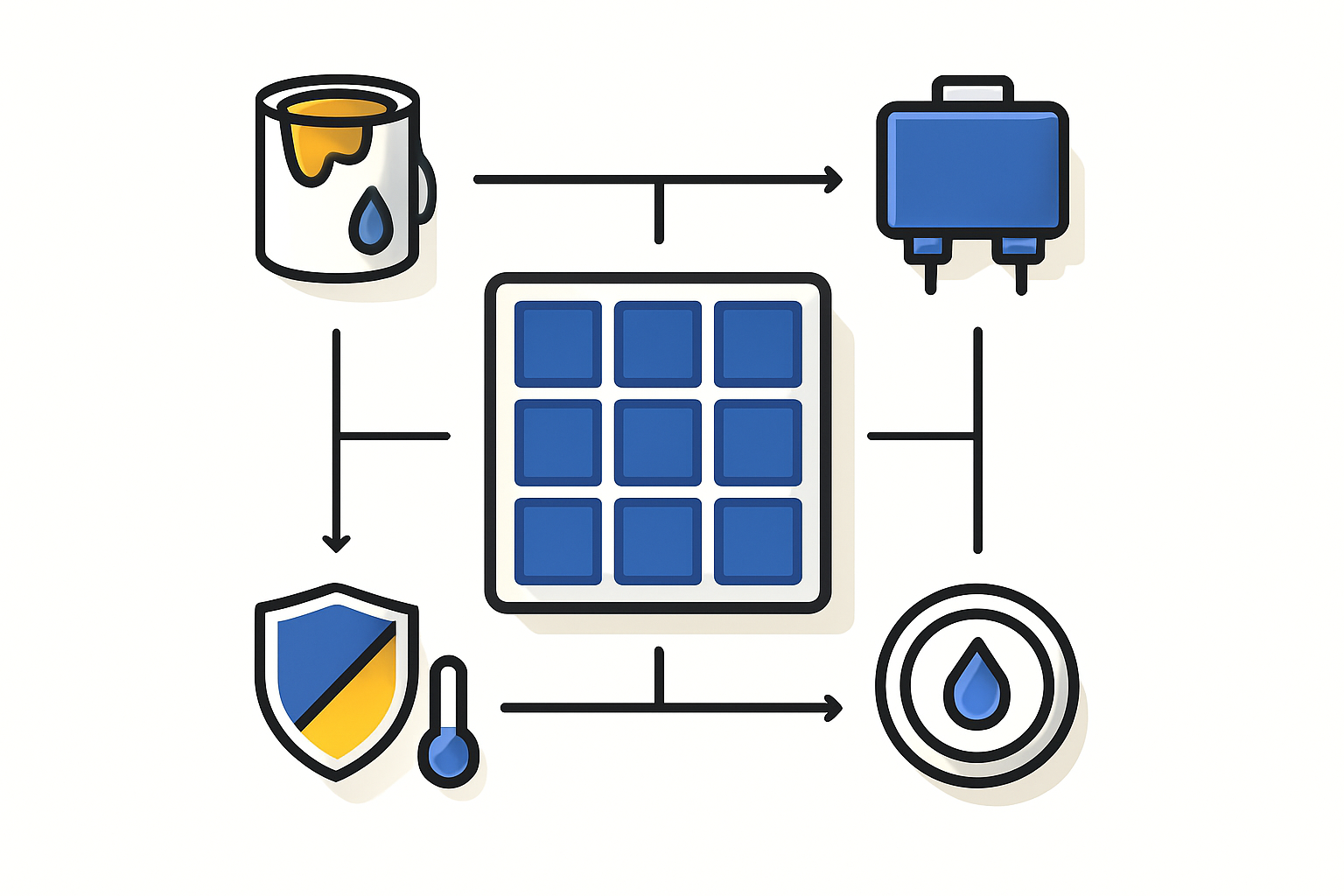
Producing a solar module capable of withstanding Palau’s climate doesn’t require entirely different machinery, but it does demand a specific, higher-quality Bill of Materials (BOM). The focus is on creating an impermeable barrier against salt and moisture.
The Module Frame: The First Line of Defense
Galvanic corrosion is a primary risk where the aluminum frame meets the glass and other components. To counter this, marine-grade modules require enhanced protection.
-
Standard: A typical frame has an anodization layer of 15 micrometers.
-
Marine-Grade: A minimum anodization thickness of 25-30 micrometers is recommended. This thicker passive layer provides substantially more resistance to salt-induced corrosion. An alternative is to use specialized, corrosion-resistant polymer frames, though this involves different assembly processes.
Encapsulation and Backsheet: Sealing Out Moisture
The encapsulant and backsheet are the most critical barriers against moisture ingress.
-
Encapsulant: Most standard modules use EVA (Ethylene Vinyl Acetate). For marine applications, POE (Polyolefin Elastomer) is the superior choice. POE has a significantly lower water vapor transmission rate (WVTR), making it far more resistant to moisture penetration and better at protecting the solar cells over the long term.
-
Backsheet: The backsheet protects the rear of the module. A standard single-layer PET sheet is insufficient; a robust, multi-layer backsheet, such as a double-layer PET or a Tedlar-based composite (TPT), is essential to provide a durable moisture barrier for 25 years or more.

The Junction Box: Protecting the Electrical Heart
The junction box is the nerve center of the solar module, housing the bypass diodes and external cable connections. It is also a common point of failure.
-
IP Rating: An IP68 rating is non-negotiable. This certifies that the junction box is fully protected against dust ingress and can withstand long periods of water immersion under pressure.
-
Potting Compound: The internal electronics must be fully encapsulated in a high-quality silicone or epoxy potting compound that resists moisture degradation and maintains its adhesive properties over time.
Glass and Coatings: Maintaining Performance
Salt crystal accumulation on the front glass can block sunlight and reduce energy output.
- Coating: An anti-reflective (AR) glass coating is standard, but for marine environments, it should also be hydrophobic. A hydrophobic surface causes water to bead up and roll off, taking salt deposits with it and facilitating a natural self-cleaning process during rainfall.
From Specification to Production: Business Considerations
Integrating these superior components into a production line has clear business implications. While the fundamental solar module manufacturing equipment remains largely the same, the focus shifts to supply chain management and quality control.
The investment for a solar production line may increase marginally due to the higher cost of these specialized materials—typically a 10-15% rise in the Bill of Materials. However, this premium is a crucial investment, allowing a manufacturer to produce a product with a verifiable technical advantage, a longer lifespan, and better energy yield. This justifies a higher price point and builds a reputation for quality and reliability in the local market. For those considering setting up a solar module factory in the region, specializing in this niche offers a powerful way to differentiate from lower-cost, lower-quality imports.
Certification and Quality Assurance: Building Trust
To formally validate a module’s resilience, international standards are essential.
- IEC 61701: Salt Mist Corrosion Testing: This certification is the key benchmark for marine applications. For a market like Palau, modules should be tested to at least Severity Level 6, which involves an intensive 8-week cycle of salt spray and humidity storage. Achieving this certification provides independent, third-party proof that the product is fit for purpose, which is critical for securing financing for large-scale projects.
Frequently Asked Questions (FAQ)
Can a standard production line be adapted to produce marine-grade modules?
Yes. The transition primarily involves changes to the Bill of Materials (BOM) and enhanced quality control protocols. The core machinery for lamination, cell stringing, and framing generally does not need to be replaced, making it an accessible upgrade for an existing or new facility.
How much more does it cost to produce a marine-grade module?
The material costs are typically 10-15% higher than for a standard module. That investment is easily recouped through the product’s significantly longer operational life, higher long-term energy production, and reduced warranty claims.
Are these specifications only relevant for Palau?
No. These technical requirements are critical for any project in a coastal, island, or offshore environment worldwide, including the Caribbean, Southeast Asia, the Middle East, and coastal regions of Africa and Latin America.
What is the main advantage of local production for such a specialized market?
Local manufacturing provides several strategic advantages: it reduces transportation costs and logistical complexities, enables faster delivery times, allows for product customization for specific local projects, and helps build a local ecosystem of technical expertise and skilled employment.
Next Steps in Your Planning Journey
The immense solar potential of Palau and similar marine markets is undeniable, but realizing it requires a shift in perspective.
Success isn’t achieved by simply deploying the cheapest available technology; it is built on producing a technically superior product engineered specifically for the local environment.
A viable and profitable solar manufacturing venture starts with understanding these technical nuances. By focusing on quality and durability, a local manufacturer can establish a commanding market position, delivering long-term value to customers and contributing sustainably to the region’s energy independence.