For any entrepreneur considering entry into Pakistan’s solar manufacturing sector, a foundational question comes first: where will the raw materials come from? The country benefits from 340-346 sunny days per year yet currently imports an estimated 89% of its solar modules. This gap represents a significant industrial opportunity. However, success hinges on building a resilient and cost-effective supply chain.
The choice between sourcing components locally and importing them is not a simple one. It involves a complex trade-off between cost, quality, logistics, and long-term strategy. This guide breaks down the practical considerations for establishing a solar module assembly line in Pakistan, weighing the advantages and challenges of each procurement path.
The Core Components: Understanding a Solar Module’s Bill of Materials
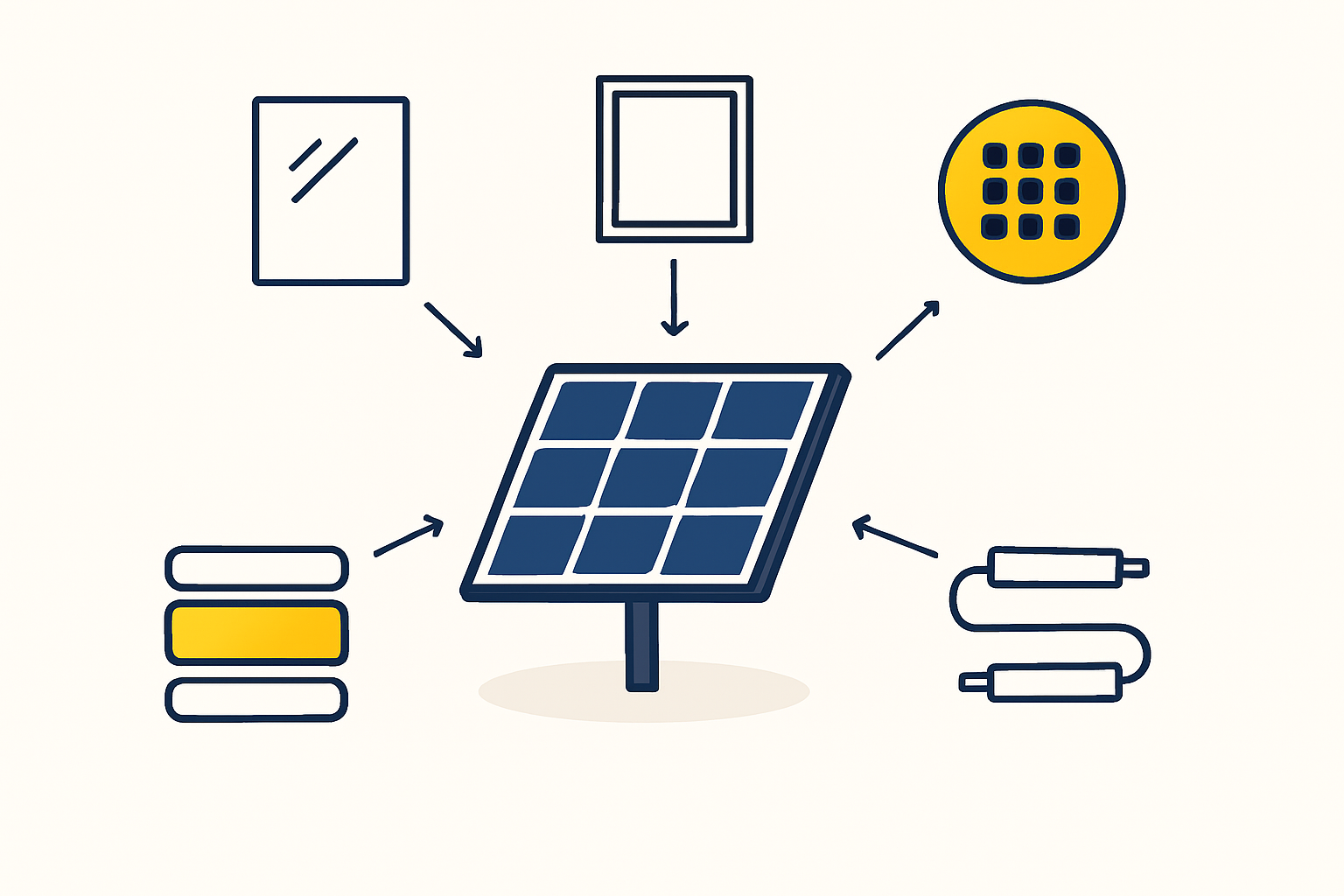
Effective supply chain evaluation begins with understanding the primary components of a solar module. The Bill of Materials (BOM) for a standard crystalline silicon module includes several key items, each with its own sourcing considerations:
- Solar Glass: The front layer that protects the cells while maximizing light transmission. It must be high-transparency, low-iron, and tempered for strength.
- Aluminum Frames: Provide structural rigidity and a means for mounting the module. Precision and anodization quality are critical for durability.
- Solar Cells: The core component that converts sunlight into electricity. This is the most technologically sensitive and highest-value part of the module.
- Encapsulant (EVA): Ethylene Vinyl Acetate is a polymer sheet used to laminate the components together, protecting the cells from moisture and impact.
- Backsheet: The rearmost layer of the module, providing mechanical protection and electrical insulation.
- Junction Box: An enclosure on the back of the module where the electrical connections are made.
The quality of each of these components directly influences the final module’s performance, lifespan, and bankability.
The Case for Local Procurement in Pakistan
Developing a local supply chain offers compelling strategic advantages for a new manufacturing venture. The government of Pakistan has actively encouraged this through policies aimed at import substitution and industrial growth.
Potential Cost Advantages and Reduced Lead Times
Sourcing bulky materials like glass and aluminum frames locally can significantly reduce costs on international freight, insurance, and import duties. Logistics are simplified, lead times can be shortened, and manufacturers are less exposed to the volatility of international shipping markets. Industrial hubs in cities like Karachi, Lahore, and Gujranwala already have capabilities in glass and aluminum extrusion that could be adapted for solar applications.
Government Support and ‘Made in Pakistan’ Incentives
To foster domestic production, the Pakistani government has introduced frameworks that include exemptions on taxes and duties for importing capital equipment and raw materials not locally available. By aligning with the ‘Made in Pakistan’ initiative, manufacturers can gain preferential access to government projects and find greater acceptance in the domestic market. This branding can be a powerful asset, signaling a commitment to national industrial development.
The Challenges of a ‘Local-First’ Strategy
While the vision of a fully localized supply chain is appealing, entrepreneurs must be pragmatic about the significant hurdles in the current industrial landscape.
Quality and Consistency Concerns
Perhaps the most critical challenge is quality and consistency. While Pakistan has producers of glass and aluminum, very few, if any, are certified to produce materials to the stringent specifications required for TIER-1 solar modules.
Ready to make big Profits?
The solar Industry is Booming
WE HELP NEWCOMERS to the solar industry start their own solar module production line. Customers can make BIG PROFITS by selling modules and finding investors, without wasting money and time on things they don't need!
For example, solar glass requires specific iron content for maximum transparency, and aluminum frames need precise dimensions and high-quality anodization to withstand decades of outdoor exposure. Inconsistent quality from local suppliers can lead to lower module efficiency, faster degradation, and a failure to meet international certification standards like those from IEC.
Limited Technical Capacity and Scale
The technical ecosystem for specialized components like solar-grade EVA, backsheets, and high-efficiency solar cells is not yet mature in Pakistan. Establishing local production for these materials would require substantial capital investment and technology transfer. For a new entrant, relying on a non-existent or unproven local supply for these critical components presents a high business risk.
The Argument for Importing Raw Materials
Given the challenges of local sourcing, most new solar manufacturing plants in Pakistan initially rely on importing a significant portion of their Bill of Materials.
Access to Certified, High-Quality Components
The global solar supply chain, largely centered in China, is mature and highly efficient. Suppliers there can provide TIER-1 certified components with proven track records of performance and reliability. Importing solar cells, EVA, and backsheets from established international manufacturers is standard practice for ensuring the final product meets global quality benchmarks. This quality assurance is critical for securing financing and customer trust. Understanding the complete solar module manufacturing process reveals just how much each high-quality component contributes to the final product’s integrity.
Established Logistics via the China-Pakistan Economic Corridor (CPEC)
CPEC has significantly improved the logistical framework between China and Pakistan. This infrastructure makes importing goods more streamlined and predictable, reducing some of the traditional shipping uncertainties. For a solar manufacturer, this corridor provides reliable access to the world’s largest hub for solar components.
Navigating the Hurdles of Importation
Importing, however, has its own set of challenges that require careful management.
Financial and Bureaucratic Complexities
One of the most frequently cited operational challenges in Pakistan is opening Letters of Credit (LCs) for imports. The process can be slow and requires a strong relationship with banking institutions. Navigating customs clearance also requires expertise and can introduce unexpected lead times if not managed properly.
Vulnerability to Global Market Dynamics
Relying on imports exposes a business to currency exchange rate fluctuations, global supply chain disruptions, and changes in international trade policies. These external factors are outside the manufacturer’s control and must be factored into any risk management strategy.
A Hybrid Strategy: The Pragmatic Approach for New Manufacturers
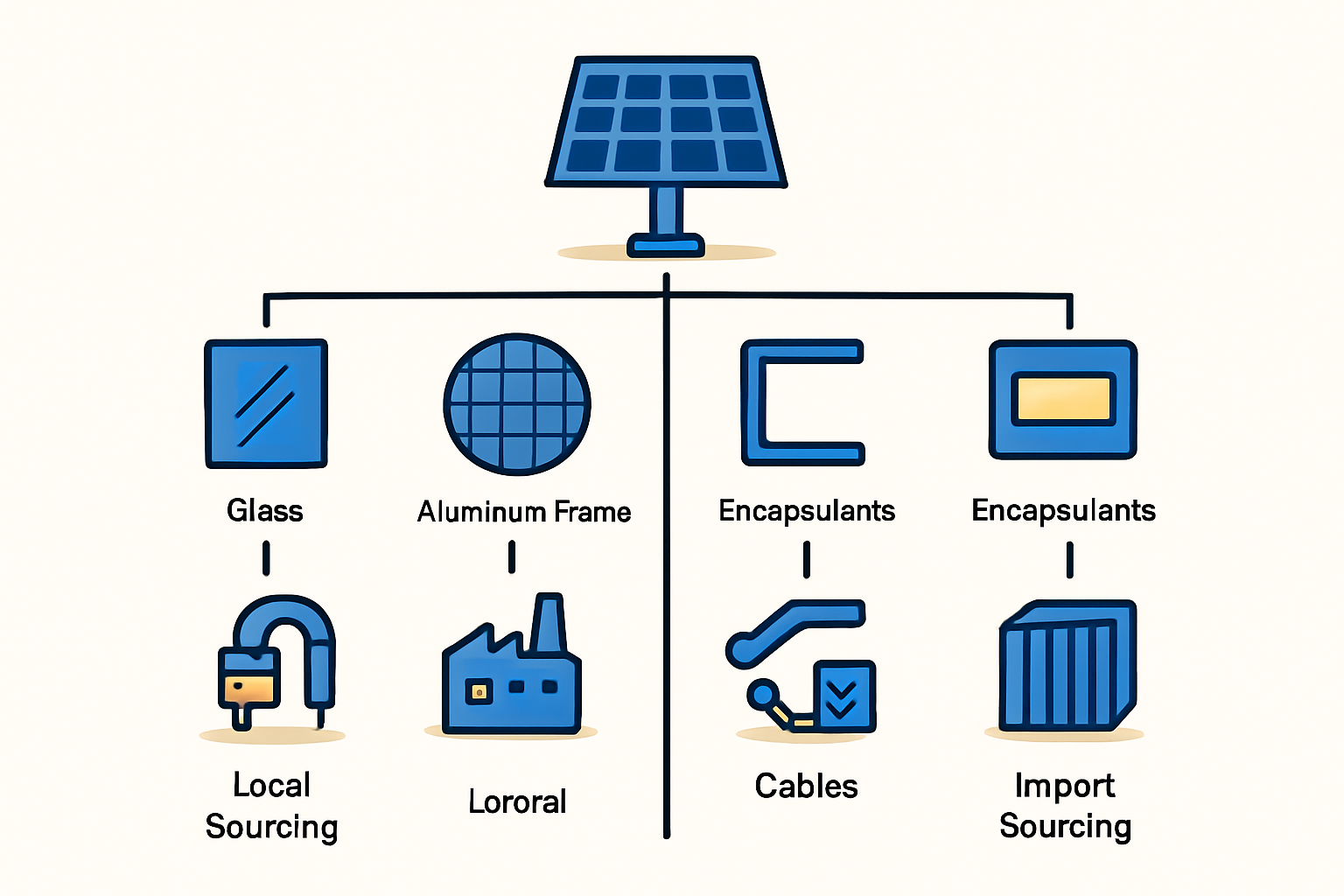
Based on experience from J.v.G. turnkey projects in emerging markets, the most successful initial approach is often a hybrid sourcing model. This strategy balances the benefits of local sourcing with the quality assurance of imported components.
A practical hybrid model could involve:
- Importing Critical Components: Source technologically sensitive and quality-critical components like solar cells, EVA, and backsheets from certified international TIER-1 suppliers.
- Developing Local Suppliers for Bulk Items: Engage with local producers for materials like aluminum frames and potentially glass. This requires a rigorous supplier qualification process, including auditing their facilities, testing material samples in certified labs, and implementing strict incoming quality control at your factory.
This strategic decision directly impacts the initial investment for a solar module factory and subsequent operational costs. By starting with a hybrid model, a manufacturer can begin operations quickly with a bankable product while gradually developing a local, cost-effective supply chain for select components.
Frequently Asked Questions (FAQ)
What are the most critical raw materials to import for a new solar factory in Pakistan?
For a new operation focused on producing a high-quality, internationally certifiable module, importing solar cells, EVA, and backsheets is essential. These components have the most significant impact on the module’s performance and long-term reliability.
Can a new solar module factory rely entirely on local materials in Pakistan?
At present, this is highly challenging. The local supply chain for solar-grade materials that meet international standards (e.g., IEC 61215, IEC 61730) is not yet fully developed. A 100% local sourcing strategy would likely compromise product quality and bankability.
How do import duties in Pakistan affect the final cost?
The government’s policies to encourage local manufacturing often include exemptions or reduced duties on imported raw materials, particularly those intended for local production and subsequent export. Consulting with local customs experts is crucial to understanding the current tariff and tax structures.
What is the first step in vetting a local supplier for aluminum frames or glass?
The first step is to request material specifications and certifications. After that, you should obtain samples and send them to a qualified third-party laboratory for testing against solar industry standards. A physical audit of the supplier’s production facility is also a mandatory step to assess their quality control processes.
Conclusion: Building a Resilient Supply Chain for Your Pakistani Solar Venture
The choice between local and imported raw materials is not binary; it is a strategic decision that will evolve with your business and the development of Pakistan’s industrial ecosystem. For the new entrepreneur, a pragmatic hybrid approach offers the best of both worlds, ensuring a high-quality, bankable product from day one while laying the groundwork for future cost reductions and supply chain localization.
Building a resilient supply chain requires diligence, rigorous quality control, and a clear understanding of the trade-offs involved. By carefully planning its procurement strategy, a new solar module manufacturer in Pakistan can position itself for sustainable, long-term success.