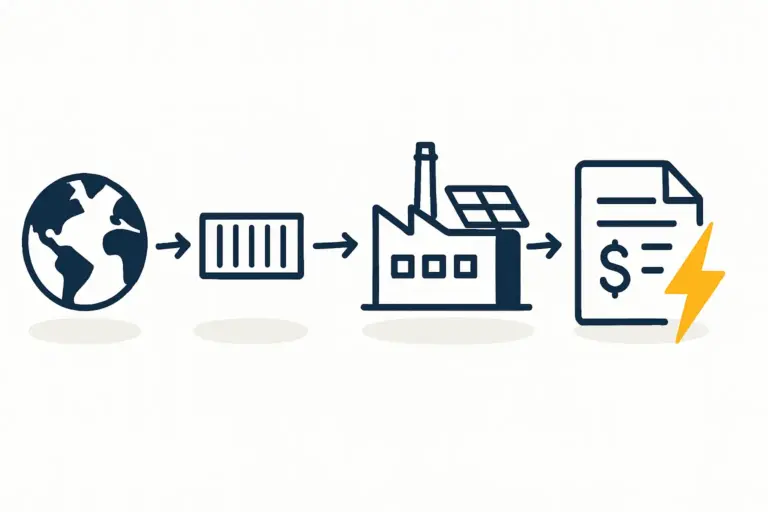
Imagine a region with some of the highest solar irradiation in the world—a perfect candidate for solar energy. Now, imagine that this same environment is so corrosive it can cause standard industrial equipment to fail in a fraction of its expected lifespan. This is the challenge and opportunity facing Nauru, a Pacific island nation with a goal of achieving 100% renewable energy by 2030.
While its average of 5-6 kWh/m² per day makes Nauru an ideal location for photovoltaic generation, its extreme marine climate creates a significant technical hurdle. Standard solar modules, designed for more benign continental climates, often face rapid degradation in these conditions.
This article explores the specific engineering considerations required to build solar modules that not only survive but thrive in high-humidity, high-salinity environments.
The Hidden Threat: Why Standard Solar Modules Fail in Marine Environments
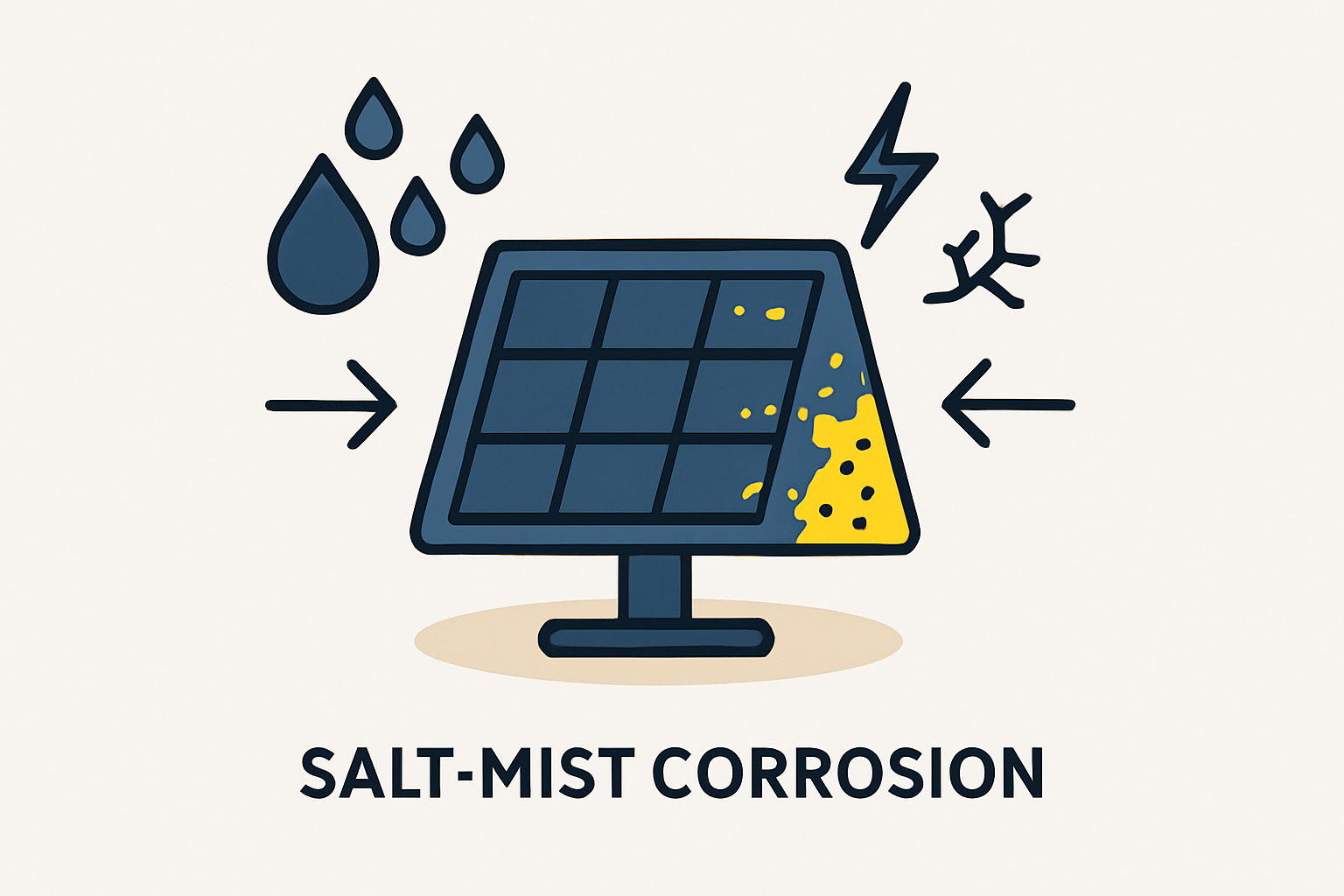
The air in coastal and island regions is saturated with microscopic salt particles and high levels of humidity. This combination creates a thin, highly conductive film of electrolyte on module surfaces—a recipe for accelerated failure in a standard solar panel.
The process, known as salt mist corrosion, attacks several key components of a solar module:
-
Aluminum Frames: The salt solution aggressively corrodes the aluminum frame, causing pitting and weakening the module’s structural integrity. This is often the most visible sign of premature ageing.
-
Junction Box and Connectors: Moisture and salt can penetrate the junction box, corroding electrical contacts. This increases resistance, leading to significant power loss and, in worst-case scenarios, creating a serious fire hazard.
-
Glass and Coatings: Salt deposits can accumulate on the glass surface, reducing the amount of light that reaches the solar cells. Over time, the corrosive environment can also damage the anti-reflective (AR) coatings designed to maximize light absorption.
-
Internal Cell Components: Most critically, moisture carrying salt ions can eventually find its way inside the module laminate. This can corrode the delicate metallic grid fingers and busbars on the solar cells themselves, permanently degrading the module’s power output.
A corroded solar panel frame in a coastal setting, showing white pitting and degradation.
Ready to make big Profits?
The solar Industry is Booming
WE HELP NEWCOMERS to the solar industry start their own solar module production line. Customers can make BIG PROFITS by selling modules and finding investors, without wasting money and time on things they don't need!
Understanding these failure modes is the first step toward engineering a solution. A module built for longevity in a place like Nauru requires a fundamentally different approach to materials and construction.
A Specialized Approach: Engineering for Longevity and Performance
Manufacturing a salt-mist resistant solar module isn’t about adding a simple protective coating; it requires re-evaluating the entire component list and assembly procedure. The solar module manufacturing process must be adapted to incorporate materials specifically chosen for their resistance to moisture and salt ingress.
The Encapsulant: Protecting the Core with POE
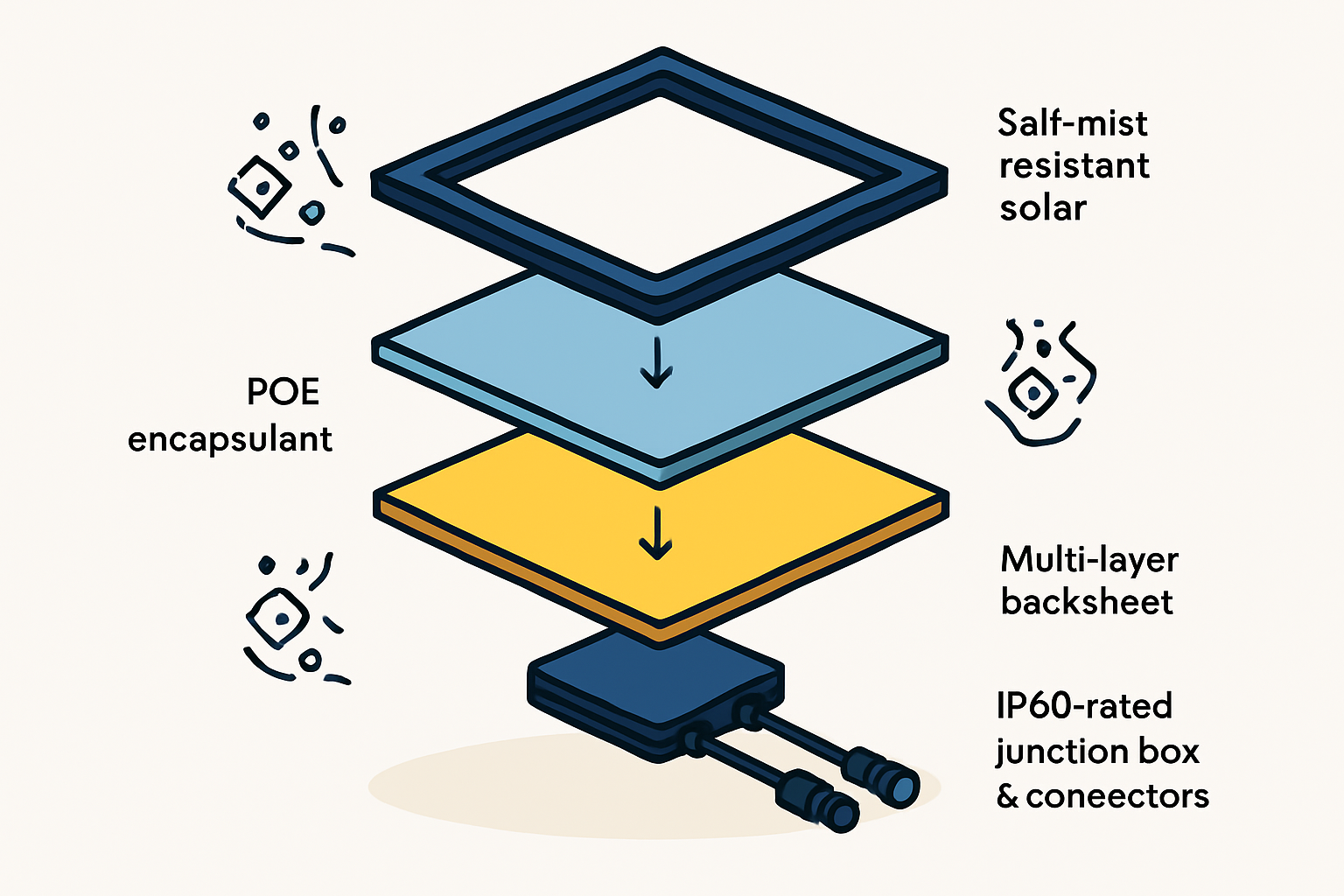
The most critical design decision for a marine environment is the choice of encapsulant—the polymer that bonds the glass, cells, and backsheet together. For decades, the industry standard has been Ethylene Vinyl Acetate (EVA). While effective in many applications, EVA has a known vulnerability: a relatively high Water Vapor Transmission Rate (WVTR), which means moisture can slowly permeate the module over time.
A superior alternative for these conditions is Polyolefin Elastomer (POE). POE has a significantly lower WVTR, making it far more resistant to moisture ingress. It also isn’t susceptible to hydrolysis, a chemical breakdown that can occur with EVA in the presence of water. That process can form acetic acid, which further accelerates corrosion inside the module.
While POE may be more expensive, its ability to protect the solar cells from moisture-induced degradation is paramount for ensuring a 25- to 30-year lifespan in a coastal setting.
A diagram comparing the layers of a standard EVA-based solar module and a salt-mist resistant POE-based module.
Fortifying the Outer Defenses
Beyond the encapsulant, several other components must be upgraded:
-
Frames: Instead of standard frames, modules for marine use should feature aluminum with a thicker anodization layer (e.g., >20 micrometers) or be constructed from corrosion-resistant polymer composites.
-
Backsheet: The backsheet, which protects the rear of the module, must be highly impermeable. Materials like double-sided Tedlar (PVF film) provide a robust barrier against moisture.
-
Junction Box: A high Ingress Protection (IP) rating is essential. An IP67 or IP68 rated junction box ensures its internal electronics are completely sealed against both dust and water, preventing corrosion of the critical electrical connections.
-
Edge Sealing: The edges of the laminate are a primary entry point for moisture. Using high-quality edge sealants and tapes with low moisture permeability adds another crucial layer of protection.
The Importance of Certification: Understanding IEC 61701
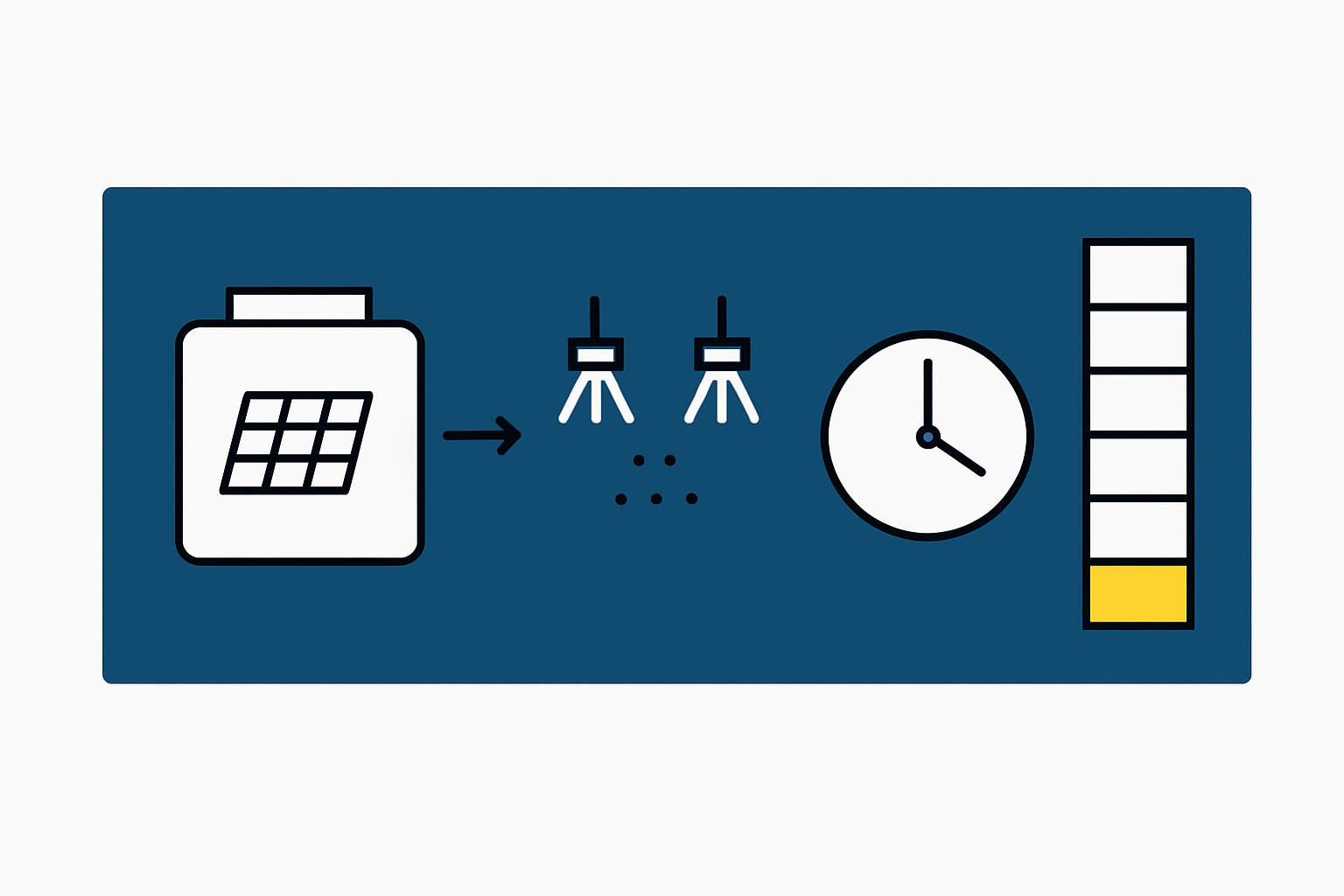
How can a buyer be certain that a module is truly designed for a corrosive environment? The answer lies in independent testing and certification. The key international standard is IEC 61701: Salt mist corrosion testing of photovoltaic (PV) modules.
This test involves placing a module in a sealed chamber and exposing it to a dense, atomized saltwater spray for an extended period. The standard defines several severity levels, from 1 (for light marine environments) to 6 (the most severe). For a project in a location like Nauru, specifying modules certified to at least severity level 6 is non-negotiable to ensure long-term project bankability.
A facility for IEC 61701 salt mist corrosion testing, showing panels in a mist chamber.
The Business Case: Upfront Cost vs. Long-Term Viability
Naturally, these specialized components increase the initial manufacturing cost. The bill of materials (BOM) for a salt-mist resistant module can be 10-20% higher than for a standard one. For anyone evaluating the investment, this may seem like a drawback.
However, the crucial metric for evaluating a solar power plant is the Levelized Cost of Energy (LCOE)—the total lifetime cost divided by the total lifetime energy production.
-
Standard Module: Low upfront cost, but rapid power degradation and potential failure after 5-10 years. The LCOE is high because the lifetime energy production is low.
-
Salt-Mist Resistant Module: Higher upfront cost, but reliable performance for 25+ years. The LCOE is significantly lower because the module generates power for its full intended lifespan.
For entrepreneurs, this presents a clear opportunity. Establishing a turnkey solar factory capable of producing modules certified to IEC 61701 severity 6 creates a high-value product well-suited for a demanding and often underserved market. It shifts the focus from competing on price alone to competing on quality, reliability, and long-term value.