An entrepreneur invests heavily to establish a state-of-the-art solar module manufacturing facility in Nigeria. The production line is running, the first high-quality modules are ready, and the market is eager for locally produced renewable energy solutions. However, a critical barrier stands between the factory floor and the customer: the product cannot be legally sold without a certificate from the Standards Organisation of Nigeria (SON).
This scenario reflects a crucial reality for anyone entering Nigeria’s solar manufacturing sector. The Standards Organisation of Nigeria Conformity Assessment Programme (SONCAP) is not a suggestion but a mandatory requirement that serves as the key to market access. Understanding this process is fundamental to any successful business plan.
This guide breaks down the SONCAP certification process for locally manufactured solar modules, covering the technical standards, procedural steps, and common challenges an investor might encounter.
What is SONCAP and Why is it Essential?
SONCAP is a regulatory framework from the Standards Organisation of Nigeria that ensures imported and locally manufactured products meet a minimum set of technical standards for quality, safety, and performance.
For the solar industry, its purpose is twofold:
-
Protecting the Consumer: It guarantees that solar modules sold in Nigeria are safe, reliable, and perform as specified, shielding end-users from substandard or hazardous products.
-
Strengthening the Local Market: By enforcing consistent quality standards, SONCAP helps build trust in locally manufactured goods, allowing Nigerian producers to compete fairly with international brands.
For a new manufacturer, SONCAP certification is the official confirmation that their products meet national requirements. It is a non-negotiable step for legal market entry and a powerful signal of quality and credibility to customers, installers, and project financiers.
The SONCAP Certification Path for Local Manufacturers
While SONCAP initially focused on imports, the process for local manufacturers is robust, verifying both the product and the production process itself. The journey involves several key stages.
Step 1: Adherence to Approved Technical Standards
The foundation of SONCAP is compliance with specific technical standards. For crystalline silicon terrestrial photovoltaic (PV) modules, the Standards Organisation of Nigeria primarily adopts internationally recognized benchmarks from the International Electrotechnical Commission (IEC):
Ready to make big Profits?
The solar Industry is Booming
WE HELP NEWCOMERS to the solar industry start their own solar module production line. Customers can make BIG PROFITS by selling modules and finding investors, without wasting money and time on things they don't need!
-
IEC 61215: This standard addresses ‘Design qualification and type approval,’ involving a series of rigorous tests that assess a module’s long-term performance under simulated climatic conditions like thermal cycling, humidity-freeze tests, and UV exposure.
-
IEC 61730: Focusing on ‘PV module safety qualification,’ this standard ensures the module is safe from electrical and mechanical hazards throughout its lifetime, covering aspects like insulation, fire safety, and protection against electric shock.
Manufacturers must design their production facilities and solar module quality control processes to consistently produce modules that meet or exceed these criteria.
Step 2: Product Testing by an Accredited Laboratory
Before certification is granted, the solar modules must undergo independent testing. The manufacturer must submit samples of the finished product to a SON-accredited laboratory, which will perform the full sequence of tests outlined in IEC 61215 and IEC 61730.
The test results form a critical part of the application dossier. A failure in any key test, such as significant power degradation after environmental stress, will require the manufacturer to adjust production processes or raw materials before resubmitting.
Step 3: The Mandatory Factory Audit
Perhaps the most significant part of the process for local producers is the factory audit. Officials from SON will visit the manufacturing facility to conduct a thorough inspection. They are interested not just in the final product, but in the entire system that produces it.
Key areas of evaluation include:
-
Quality Management System: A documented system (such as ISO 9001) for managing quality at every stage.
-
Incoming Materials Inspection: Procedures for verifying that all raw materials (glass, cells, backsheets, frames) meet specified quality standards.
-
In-Process Controls: Quality checks performed during production, such as electroluminescence (EL) testing after stringing and lamination.
-
Equipment Calibration: Proof that all manufacturing and testing equipment is regularly calibrated and maintained.
-
Record-Keeping: Meticulous documentation of production batches, quality checks, and material traceability.
Planning a turnkey solar module manufacturing line with these requirements in mind from the outset is far more efficient than attempting to retrofit processes later.

Step 4: Final Application and Issuance
Once the product has passed testing and the factory audit is successful, the manufacturer submits a formal application to SON. This package includes the test reports, the factory audit report, company registration documents, and other required forms. Upon a satisfactory review, SON issues the SONCAP certificate for the specified module types, officially permitting their sale on the Nigerian market.
Common Challenges and Strategic Preparation
Navigating the SONCAP process can be challenging for new entrants. Anticipating these issues is key to a smooth and timely certification.
Inadequate Quality Control Systems
A common reason for delays is a factory audit revealing inconsistent or undocumented quality control procedures.
Preparation: Implement a comprehensive quality management system from day one. This should be a core part of the initial factory planning, not an afterthought. Every process, from material sourcing to final packaging, must be defined and documented.
Underestimating Timelines and Costs
The entire SONCAP process, from initial testing to final certification, can take several months. The costs for testing, audits, and administrative fees must be factored into the initial business plan. These certification costs are a necessary component of the total cost to start a solar factory.
Preparation: Engage with SON or an experienced consultant early to understand the expected timeline and budget accordingly. Build a buffer into your operational launch plan to account for the certification period.
Mismatches Between Design and Production
A module may be well-designed, but if the production line cannot replicate that design consistently, it will fail certification.
Preparation: Ensure that equipment, processes, and staff training are all aligned to produce a consistent product. Based on experience from J.v.G. turnkey projects, integrating quality checkpoints directly into the production flow is essential for maintaining uniformity from the first module to the thousandth.
Frequently Asked Questions (FAQ)
Is SONCAP certification mandatory to sell solar modules in Nigeria?
Yes. It is a legal requirement for both imported and locally manufactured solar modules sold on the Nigerian market. Operating without it can lead to product seizures and penalties.
How long is a SONCAP certificate valid?
A SONCAP certificate is typically valid for one year. It requires renewal, which often involves a surveillance audit of the factory to ensure quality standards are being maintained.
Can international test reports be used for the application?
In many cases, yes. Test reports from internationally recognized and accredited laboratories (e.g., in Europe or Asia) may be accepted by SON, which can save time. However, it is crucial to confirm a specific laboratory’s acceptance with SON beforehand.
What is the main difference between SONCAP for an importer versus a local manufacturer?
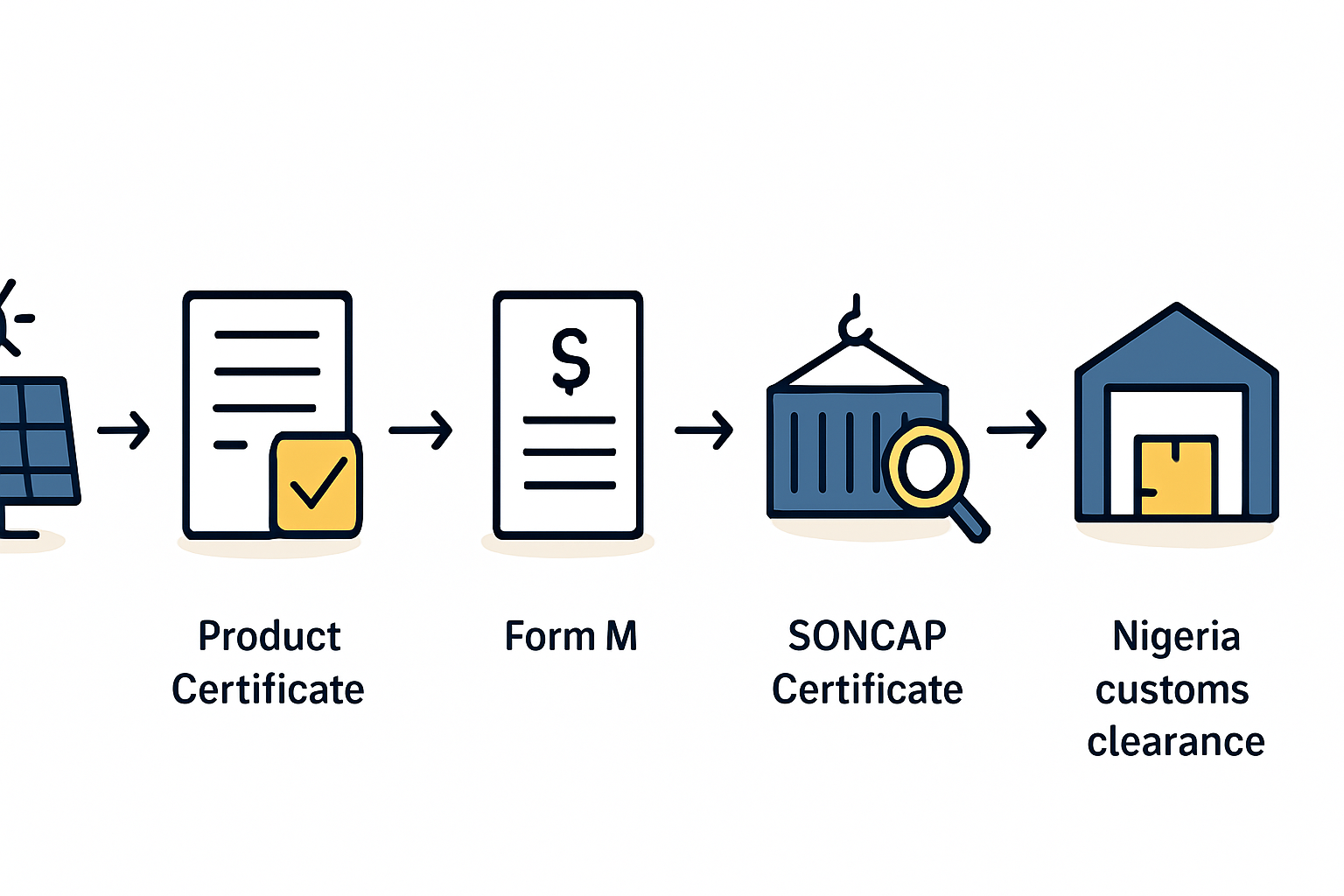
For importers, the focus is primarily on confirming that the imported product (Product Certificate) and the shipment (SONCAP Certificate) meet requirements. For local manufacturers, the process is more in-depth and includes a mandatory audit of the actual production facility to verify in-country quality assurance systems.
Conclusion: Certification as a Strategic Milestone
Achieving SONCAP certification should be viewed not as a bureaucratic hurdle, but as a fundamental business milestone. It validates a manufacturer’s commitment to quality and unlocks the full potential of the Nigerian market.
For entrepreneurs and investors new to the solar industry, the process can seem daunting. However, by integrating SONCAP requirements into the initial factory design, equipment selection, and operational planning, the path to compliance becomes clear and manageable. A production line built with quality and traceability at its core is designed for success in any regulated market.