An investor considering a new solar panel factory often focuses first on machinery, financing, and location. Yet, experience from countless turnkey projects shows that human capital is one of the most critical success factors. In a market like Tanzania, with its vast potential for solar energy, the question is not whether a market exists, but whether a skilled workforce can be assembled to serve it.
The common assumption is that investors must find technicians with prior experience in solar manufacturing. This perspective often leads to the conclusion that the local labor pool is inadequate.
The reality, however, is more nuanced—and far more optimistic. The challenge isn’t an absence of talent, but the need for a structured framework to turn educated individuals into highly skilled solar manufacturing professionals.
This article outlines a practical approach for assessing, recruiting, and training a local workforce in Tanzania, turning the perceived obstacle of skilled labor into a strategic advantage.
Understanding Tanzania’s Labor Landscape
Tanzania offers a compelling environment for solar manufacturing. A significant portion of its population lacks reliable access to electricity, creating sustained demand. The government’s ‘Renewable Energy Development Strategy’ further encourages investment in the sector. For entrepreneurs exploring how to start a solar panel manufacturing business, this alignment of market need and policy support is a strong foundation.
Key industrial hubs such as Dar es Salaam, Arusha, and Mwanza are natural centers for recruitment. These cities are home to a growing number of graduates from technical institutions. The country’s educational framework, governed by the Vocational Education and Training Authority (VETA) and the National Council for Technical Education (NACTE), produces graduates with solid theoretical foundations.
Institutions like the Arusha Technical College (ATC) and the Dar es Salaam Institute of Technology (DIT) regularly graduate students with diplomas and degrees in mechanical, electrical, and industrial engineering—the ideal feeder pool for a solar module factory.
The Core Challenge: Bridging the ‘Experience Gap’
The primary hurdle for investors in Tanzania is not a lack of educated candidates, but a gap between academic knowledge and the specific, hands-on skills required to operate a modern solar production line. Investors are highly unlikely to find a significant number of technicians with direct experience operating a specific brand of laminator or tabber-stringer.
This realization is a critical ‘aha moment’ for any project planner. The objective must shift from finding experienced personnel to systematically creating them. The local talent pool already has the foundational knowledge of engineering principles; what’s missing is the applied, process-specific training. This is a far more manageable challenge.
Ready to make big Profits?
The solar Industry is Booming
WE HELP NEWCOMERS to the solar industry start their own solar module production line. Customers can make BIG PROFITS by selling modules and finding investors, without wasting money and time on things they don't need!
A Practical Recruitment Strategy
A successful recruitment strategy focuses on potential and aptitude rather than existing, specialized experience. The ideal candidate profile is not a seasoned solar technician but a recent graduate or young professional with a relevant technical qualification.
Key Recruitment Criteria:
-
Educational Background: A diploma or degree in Electrical, Mechanical, or Industrial Engineering provides the necessary theoretical foundation.
-
Technical Aptitude: Candidates should demonstrate a strong understanding of technical drawings, process flows, and basic machinery principles.
-
Problem-Solving Skills: The ability to think logically and approach challenges methodically is more valuable than pre-existing knowledge of the solar industry.
-
Work Ethic: A commitment to precision, quality control, and safety protocols is essential in a manufacturing environment.
Recruiting directly from institutions like DIT and ATC, or advertising in industrial centers, will yield a strong pool of qualified applicants. This approach to human resources is a fundamental component of a comprehensive business plan for solar panel manufacturing.
The Structured Training Framework: Building Expertise from the Ground Up
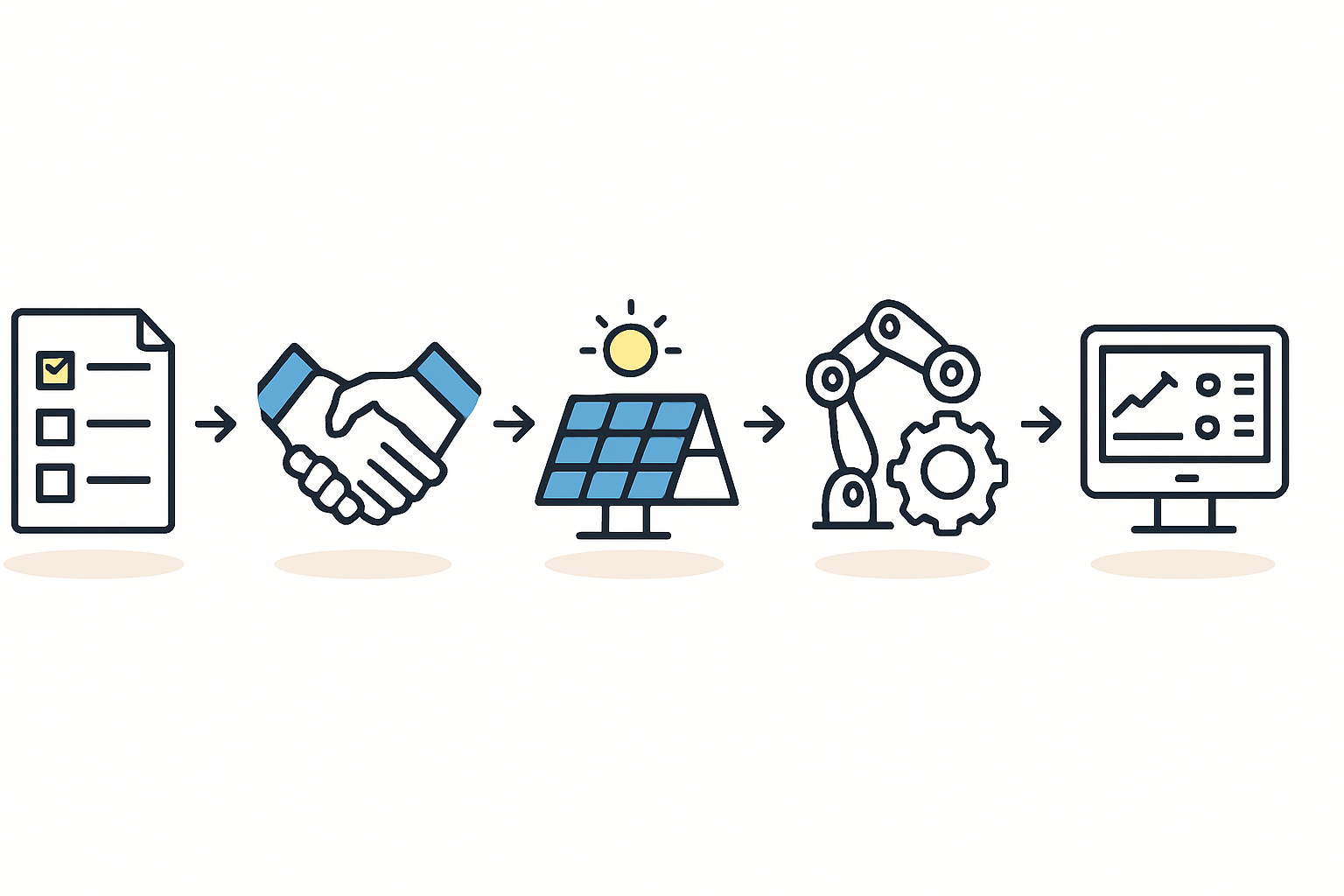
Once a core team is recruited, a multi-phase training program is the most effective way to build operational excellence. This framework systematically transfers knowledge, moving new hires from general principles to machine-specific mastery.
Phase 1: Foundational Solar and Safety Training
This initial phase covers the fundamentals, including basic photovoltaic principles, workplace safety standards, material handling, and an overview of the entire solar panel manufacturing process. This ensures all team members share a common vocabulary and understanding of the production goals.
Phase 2: Machine-Specific Operator Training
This is the most hands-on part of the program. Each operator is trained on a specific piece of the solar panel manufacturing machine they will be responsible for, such as the tabber-stringer, lay-up station, or laminator. This training is often conducted by an experienced engineer from the machine supplier, who instills factory-best practices from day one.
Phase 3: Operational Process and Quality Control
After mastering individual machines, the team learns how the full production line functions as an integrated system. This phase focuses on workflow, production targets, material logistics between stations, and, most importantly, quality control checkpoints at every stage of assembly.
Phase 4: Advanced Maintenance and Troubleshooting
The final phase empowers the local team to become self-sufficient. Key personnel are trained in routine maintenance, diagnostics, and troubleshooting for common issues. The goal is to minimize downtime and reduce reliance on external support for daily operational challenges.
The Role of Expatriate Expertise in Knowledge Transfer
For the initial setup and training phases, one or two expatriate engineers are invaluable. Experience from numerous J.v.G. turnkey projects shows this model is both standard and highly effective.
These experts aren’t there to run the factory long-term, but to serve as trainers and mentors. They oversee the training framework, ensure production standards are met, and methodically transfer their operational knowledge to the local management and technical team.
Their primary objective is to make themselves redundant by cultivating a capable and autonomous local workforce. This structured knowledge transfer is a key de-risking strategy for the investment.
Business-Relevant Metrics and Expectations
A clear understanding of typical staffing levels and timelines is essential for planning.
-
Staffing: A semi-automated 20–50 MW production line typically requires a core team of 20–30 employees, including operators, quality control staff, maintenance technicians, and supervisors.
-
Training Timeline: The initial intensive training period (Phases 1-3) can be completed within 3 to 6 months. Within this timeframe, a newly recruited team can achieve the proficiency needed to run stable production shifts.
-
Investment in Labor: While the solar panel manufacturing plant cost is heavily weighted towards equipment, budgeting for a structured training program and initial expatriate support is a critical investment in long-term operational success.

Frequently Asked Questions (FAQ)
Do I need to hire people with prior solar factory experience in Tanzania?
No. In fact, it’s more effective to hire individuals with strong foundational engineering qualifications and train them through a structured program. Their adaptability and technical aptitude are more valuable than specific experience, which is scarce in the local market.
Which qualifications are most important for new hires?
Look for diplomas or degrees in electrical, mechanical, or industrial engineering from reputable Tanzanian technical colleges or universities. These provide the essential theoretical knowledge to build upon.
How long does it take to train a local team to operate the factory independently?
A core team can be trained to operate the production line proficiently within 3 to 6 months. Achieving full autonomy, including advanced maintenance and process optimization, is an ongoing process that typically develops over the first 12–18 months of operation.
Is it difficult to find suitable candidates in Tanzania?
No, provided the recruitment strategy focuses on technical aptitude rather than specific solar experience. Graduates from institutions in Dar es Salaam, Arusha, and other urban centers represent a rich pool of potential talent for a new manufacturing facility.
Next Steps in Your Planning Journey
The challenge of building a skilled workforce in Tanzania is not an insurmountable barrier but a manageable process that requires a strategic approach. By focusing on recruiting for aptitude and implementing a rigorous, phased training program, an investor can develop a highly capable, local team that becomes a long-term asset for the business.
This structured approach to human capital is a cornerstone of a successful manufacturing venture. To see how this fits into the broader picture, explore the complete framework of how to start a solar panel manufacturing business.