When selecting a location for a new solar module factory, entrepreneurs often prioritize factors like labor costs, logistics, and local tax incentives. While these are critical, a less obvious consideration can offer a decisive competitive edge: regional trade agreements. For an investor considering the Caribbean, setting up a manufacturing facility in Saint Lucia opens a strategic gateway to more than a dozen neighboring markets, largely shielded from outside competition.
Saint Lucia’s membership in two key economic blocs makes this possible: the Caribbean Community (CARICOM) and the Organisation of Eastern Caribbean States (OECS). Leveraging these agreements is fundamental to building a successful business case for solar manufacturing in the region.
Understanding the Caribbean Trade Landscape
Grasping the full opportunity means distinguishing between the two primary trade organizations shaping commerce in the region.
The Caribbean Community (CARICOM)
CARICOM is an economic and political community of 15 member states and five associate members. Its primary objective is to promote economic integration and cooperation among its members. For a manufacturer, the most significant aspect of CARICOM is the CARICOM Single Market and Economy (CSME), which allows for the free movement of goods, services, capital, and skilled labor across most member states.
Key CARICOM markets for a Saint Lucia-based exporter would include:
- Jamaica
- Trinidad and Tobago
- Barbados
- Guyana
- The Bahamas
The Organisation of Eastern Caribbean States (OECS)
The OECS is a smaller, more deeply integrated sub-regional group within CARICOM. It includes Saint Lucia and its closest neighbors, such as Grenada, Dominica, and St. Vincent and the Grenadines. The OECS has its own economic union, with a single currency (the Eastern Caribbean Dollar) and harmonized commercial laws that make trade among its members even more seamless.
For a solar panel factory in Saint Lucia, these agreements are not merely bureaucratic frameworks; they are powerful commercial tools that create a protected, preferential market.

The Core Advantage: Duty-Free Market Access
The most direct benefit of manufacturing within CARICOM is preferential access to member markets through the Common External Tariff (CET).
The CET is a harmonized tariff, or import tax, that all CARICOM members apply to goods imported from outside the community. While rates vary by product, this tariff effectively raises the cost for international competitors like China, the United States, or Europe.
Ready to make big Profits?
The solar Industry is Booming
WE HELP NEWCOMERS to the solar industry start their own solar module production line. Customers can make BIG PROFITS by selling modules and finding investors, without wasting money and time on things they don't need!
However, goods certified as originating from a CARICOM member state—such as solar panels manufactured in Saint Lucia—can be traded among member states duty-free.
A Practical Example:
Consider a shipment of solar panels to Jamaica.
Scenario A: Imported from outside CARICOM. A 40-foot container of panels from an Asian manufacturer would be subject to Jamaica’s CET upon arrival. If the CET on solar panels is 15%, the importer must pay an additional 15% of the goods’ value, a cost ultimately passed on to the end customer.
Scenario B: Imported from Saint Lucia. The same container of panels, having qualified under the Rules of Origin, would enter Jamaica duty-free. This gives the Saint Lucian product an immediate 15% price advantage over its international competitor, even before factoring in potentially lower shipping costs and faster delivery times.
This tariff shield allows a new regional manufacturer to compete on more than just price, creating an advantage through local accessibility and cost-effectiveness. A comprehensive business plan for a solar factory should treat this advantage as a cornerstone of its revenue projections.
Meeting the ‘Rules of Origin’: What It Takes to Qualify
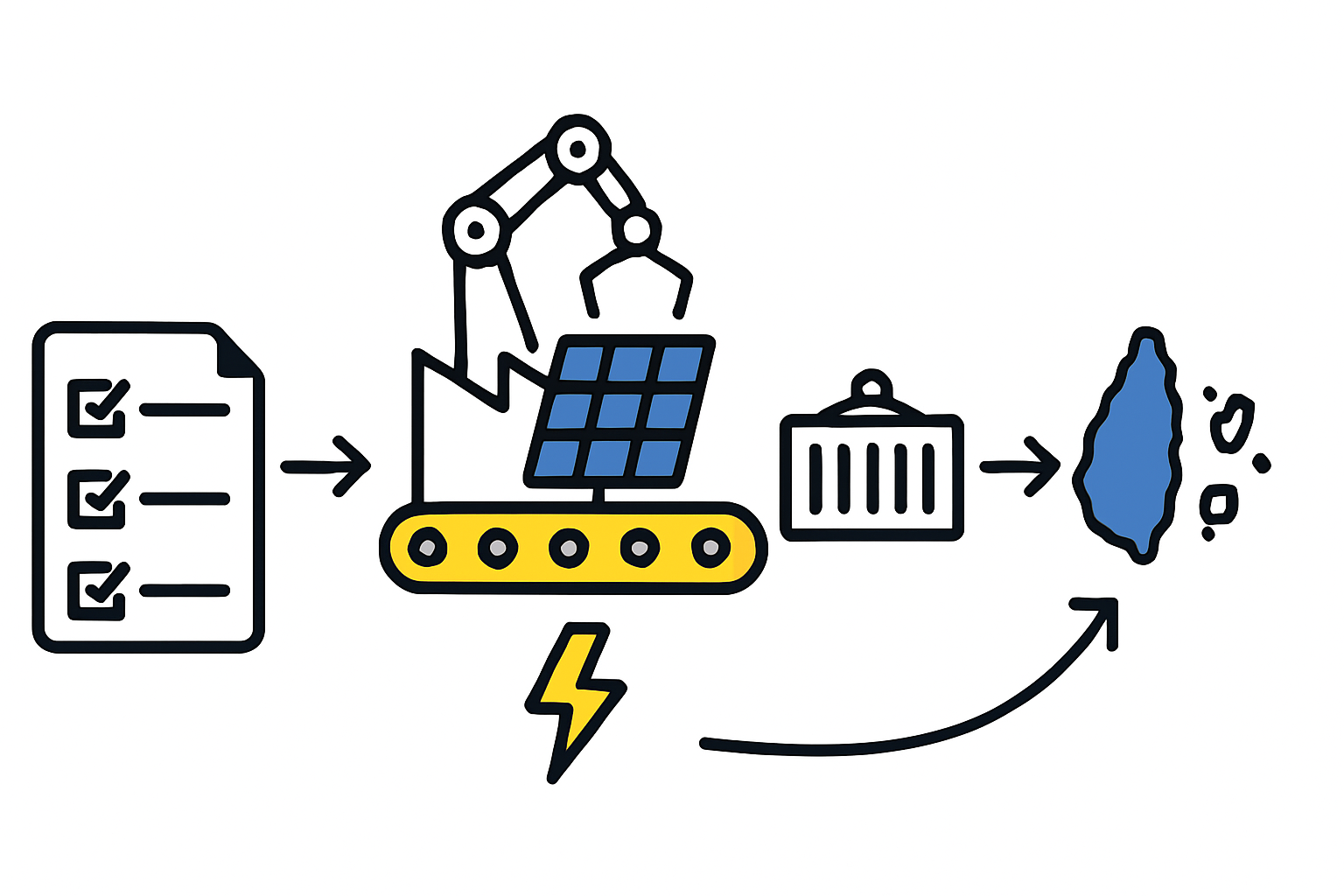
The benefits of duty-free trade are not automatic. To prevent simple transshipment—where goods are imported and re-exported with minimal change—CARICOM enforces strict ‘Rules of Origin.’ For a product to be certified as ‘Made in CARICOM,’ it must have undergone ‘substantial transformation’ within a member state.
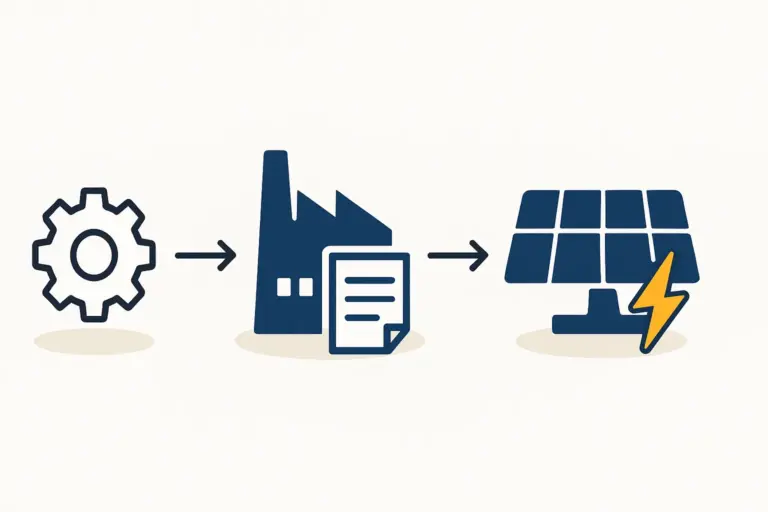
For solar panel manufacturing, this means merely importing finished panels and rebranding them would not qualify. Instead, the factory must perform core assembly and value-adding steps. The typical solar panel manufacturing process includes several stages that help meet this requirement:
- Cell Tabbing and Stringing: Soldering individual solar cells together to form strings.
- Layup and Bussing: Arranging the cell strings on glass and EVA film.
- Lamination: Fusing the layers together under heat and pressure to create a durable, weatherproof module.
- Framing and Junction Box Installation: Finishing the module with an aluminum frame and electrical components.
A factory in Saint Lucia performing these steps transforms imported raw materials (solar cells, glass, aluminum) into a new, distinct product. This process satisfies the substantial transformation rule and qualifies the panels for a Certificate of Origin.
The Regional Market Opportunity
Demand for renewable energy across the Caribbean is strong and growing. Many island nations depend heavily on imported fossil fuels for power generation, resulting in some of the highest electricity costs in the world. This creates a strong economic incentive for governments, businesses, and homeowners to adopt solar energy.
Many CARICOM states have also established ambitious renewable energy targets as part of their national development and climate resilience strategies. A local manufacturing presence can help these countries achieve their goals more efficiently and with greater energy security. A Saint Lucia-based factory is in a prime position to serve this captive market, which is actively seeking alternatives to expensive and volatile energy imports.
Experience from J.v.G. Technology GmbH turnkey projects shows that a detailed market analysis is a crucial first step. This analysis validates the business case by confirming regional demand and identifying key target markets within the CARICOM bloc before any significant investment is made.
Frequently Asked Questions (FAQ)
What is the main difference between CARICOM and the OECS for a manufacturer?
Think of the OECS as a smaller club with deeper integration inside the larger CARICOM club. For a Saint Lucian manufacturer, trading with OECS members like Dominica or Grenada is often simpler due to the shared currency and harmonized regulations. CARICOM provides access to the larger, more populous markets like Jamaica and Trinidad, which hold greater potential for sales volume.
Do all CARICOM countries apply the same Common External Tariff (CET)?
While the CET is intended to be uniform, there can be national variations and exceptions. Some countries may apply different rates or have lists of specific items that are exempt. A thorough market entry strategy requires verifying the exact tariff schedule for solar modules and related components in each target country.
How difficult is it to get a CARICOM Certificate of Origin?
The process is administrative but straightforward, provided the manufacturing operation is legitimate. It requires meticulous documentation of the production process and the origin of raw materials. National authorities in Saint Lucia, such as the Ministry of Commerce, would be responsible for auditing the process and issuing the certificate. Planning for this documentation from the outset is essential when setting up the factory’s operational procedures.
Is the regional market large enough to sustain a 20-50 MW solar factory?
The collective demand across the 15 CARICOM member states is substantial. High electricity prices and government mandates for renewable energy create a consistent demand base. While no single island may absorb the full capacity of a larger factory, the ability to aggregate demand from more than a dozen protected markets makes a mid-sized factory viable. The business model is based on serving the entire region, not just the host country.
Establishing a solar panel factory in Saint Lucia is a strategic decision with implications that extend far beyond its shores. The true potential lies in leveraging the country’s membership in CARICOM and the OECS to gain preferential, duty-free access to a captive regional market. For an entrepreneur or investor, understanding these trade dynamics is the first step toward building a resilient and profitable manufacturing enterprise in the heart of the Caribbean.