Starting a solar module factory is a significant undertaking. While technology and financing rightly command attention, a plant’s long-term success often hinges on a less visible factor: its supply chain.
For an entrepreneur in a landlocked country like Zimbabwe, the logistical strategy for importing equipment and raw materials is not just an operational detail—it is a cornerstone of the entire business plan. The choice of a port corridor can directly influence production costs, timelines, and ultimately, profitability.
This article weighs the critical decision between the Beira corridor through Mozambique and the Durban corridor through South Africa. We explore the practical implications of each route for a new solar manufacturing facility in Harare and offer a framework for this strategic choice.
The Landlocked Challenge: A Critical Factor in Your Business Plan
A solar module factory is fundamentally an assembly operation. It relies on a consistent, predictable flow of imported components, from heavy machinery for the initial setup to recurring shipments of solar cells, glass, and encapsulants.
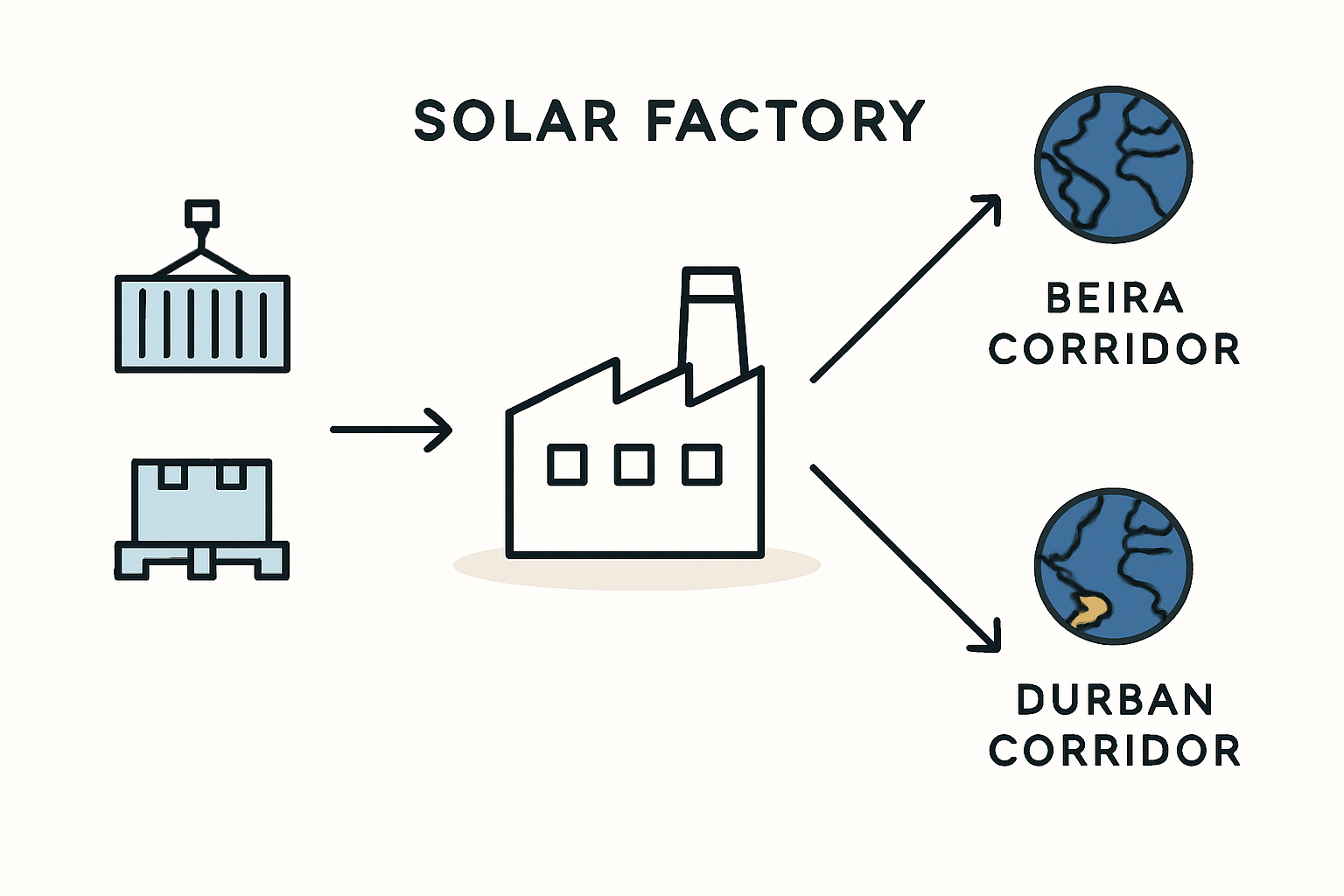
Being landlocked introduces layers of complexity, cost, and potential delays that coastal operations simply don’t face. Every container must be offloaded at a foreign port, cleared through customs, and transported hundreds of kilometers overland, often across at least one international border. A well-researched supply chain strategy is therefore a non-negotiable prerequisite for success. For a factory in Harare, the two most viable corridors run through the Port of Beira in Mozambique and the Port of Durban in South Africa.
Analyzing the Port Corridors: Beira vs. Durban
The choice between these two ports is a classic business trade-off between distance, cost, and reliability. A common oversight in initial planning is equating the shortest route with the most efficient one. As experience from J.v.G. turnkey projects demonstrates, the optimal choice depends on a detailed analysis of multiple factors.
The Beira Corridor (Mozambique)
At approximately 598 kilometers from Harare, the Port of Beira offers the most direct sea access for Zimbabwe. This proximity is its primary advantage.
Cost Advantage: The shorter distance translates directly into lower inland transportation costs. Estimates suggest that using the Beira corridor can be 15–20% cheaper for freight forwarding compared to the Durban route. For an operation importing hundreds of containers annually, these savings are substantial.
Potential Challenges: Despite being geographically closer, the Beira corridor has historically faced challenges with port congestion and infrastructure limitations. Although significant investments have improved efficiency, processing times can be less predictable than at larger ports. Any delays at the port or the Forbes-Machipanda border crossing can erode the time advantage gained from the shorter distance.
Ready to make big Profits?
The solar Industry is Booming
WE HELP NEWCOMERS to the solar industry start their own solar module production line. Customers can make BIG PROFITS by selling modules and finding investors, without wasting money and time on things they don't need!
The Durban Corridor (South Africa)
The Port of Durban is one of Africa’s largest and most technologically advanced container terminals. It offers a different value proposition based on efficiency and predictability.
Infrastructure and Reliability: As a world-class port, Durban is served by a vast network of global shipping lines, offering greater flexibility in scheduling and more reliable vessel arrival and offloading times. Its highly developed road and rail infrastructure is another major asset.
Distance and Cost: The route from Durban to Harare is significantly longer, at roughly 1,700 kilometers, which naturally results in higher inland transport costs. All cargo must also pass through the Beitbridge border post, notorious for congestion that can add significant delays and extend transit times to between 7 and 14 days.
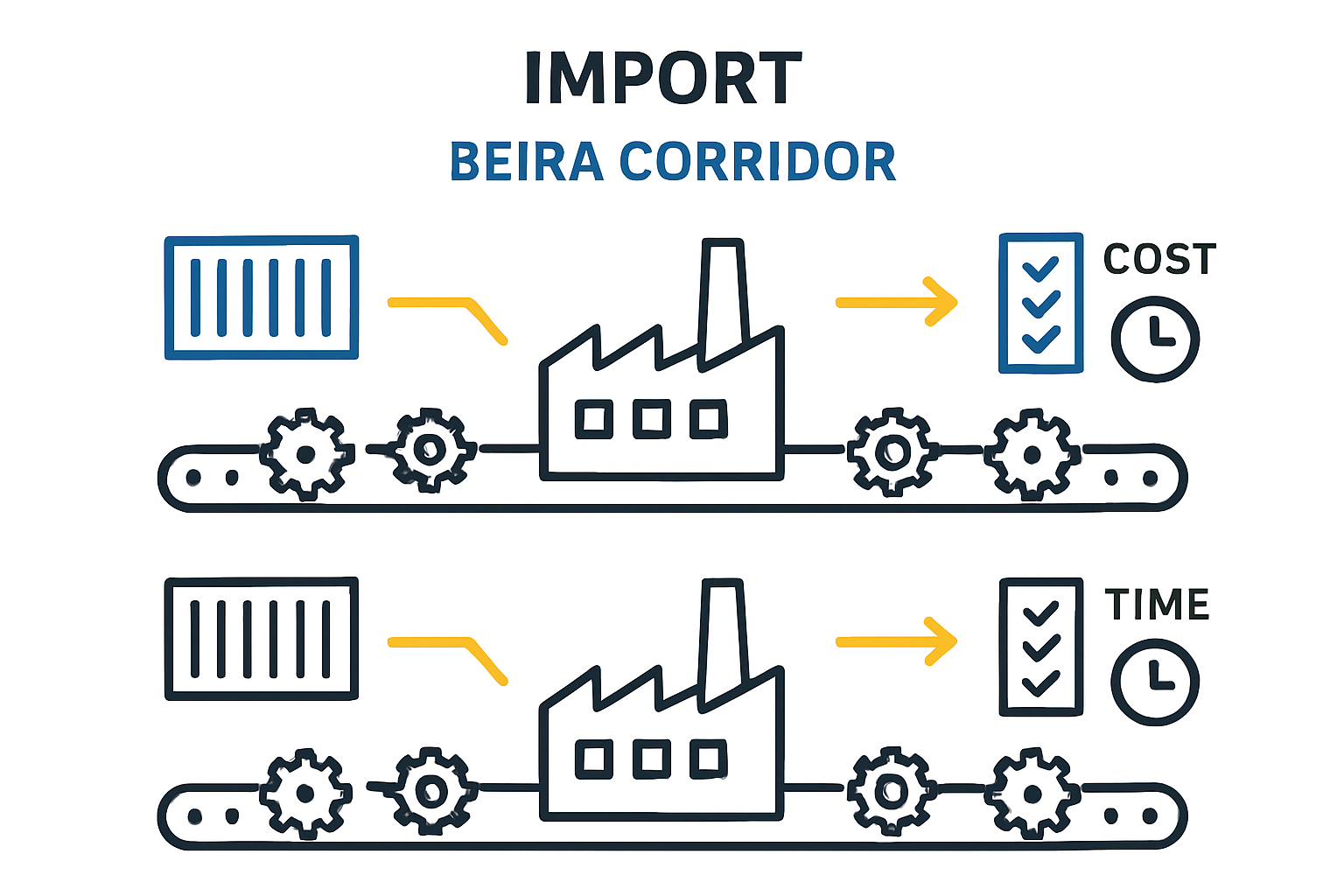
A Comparative Summary
Beira Corridor (Mozambique)
- Distance to Harare: Approx. 598 km
- Estimated Cost: Lower (15-20% cheaper)
- Port Efficiency: Improving, but can be variable
- Shipping Options: Fewer global shipping lines
- Key Bottleneck: Port congestion, road quality
Durban Corridor (South Africa)
- Distance to Harare: Approx. 1,700 km
- Estimated Cost: Higher
- Port Efficiency: High and predictable
- Shipping Options: Extensive network
- Key Bottleneck: Beitbridge border crossing
Beyond the Port: Key Logistical Considerations
The port decision is just one piece of the puzzle. A resilient supply chain requires a holistic approach that accounts for the entire journey from the global supplier to the factory floor.
Initial Equipment Import vs. Ongoing Raw Material Supply
The logistical needs of a factory evolve. The initial shipment of a turnkey solar module production line is a one-time, high-value, mission-critical event. For this, the reliability and advanced handling capabilities of the Durban port might be preferable, even at a higher cost, to minimize the risk of damage or delays.
Conversely, for the recurring, cost-sensitive shipments of raw materials for solar panels, the cost savings offered by the Beira corridor may be more attractive. An effective strategy could involve a hybrid approach: Durban for the initial plant setup and Beira for ongoing operations, with contingency plans for both.
Customs, Tariffs, and Clearing Agents
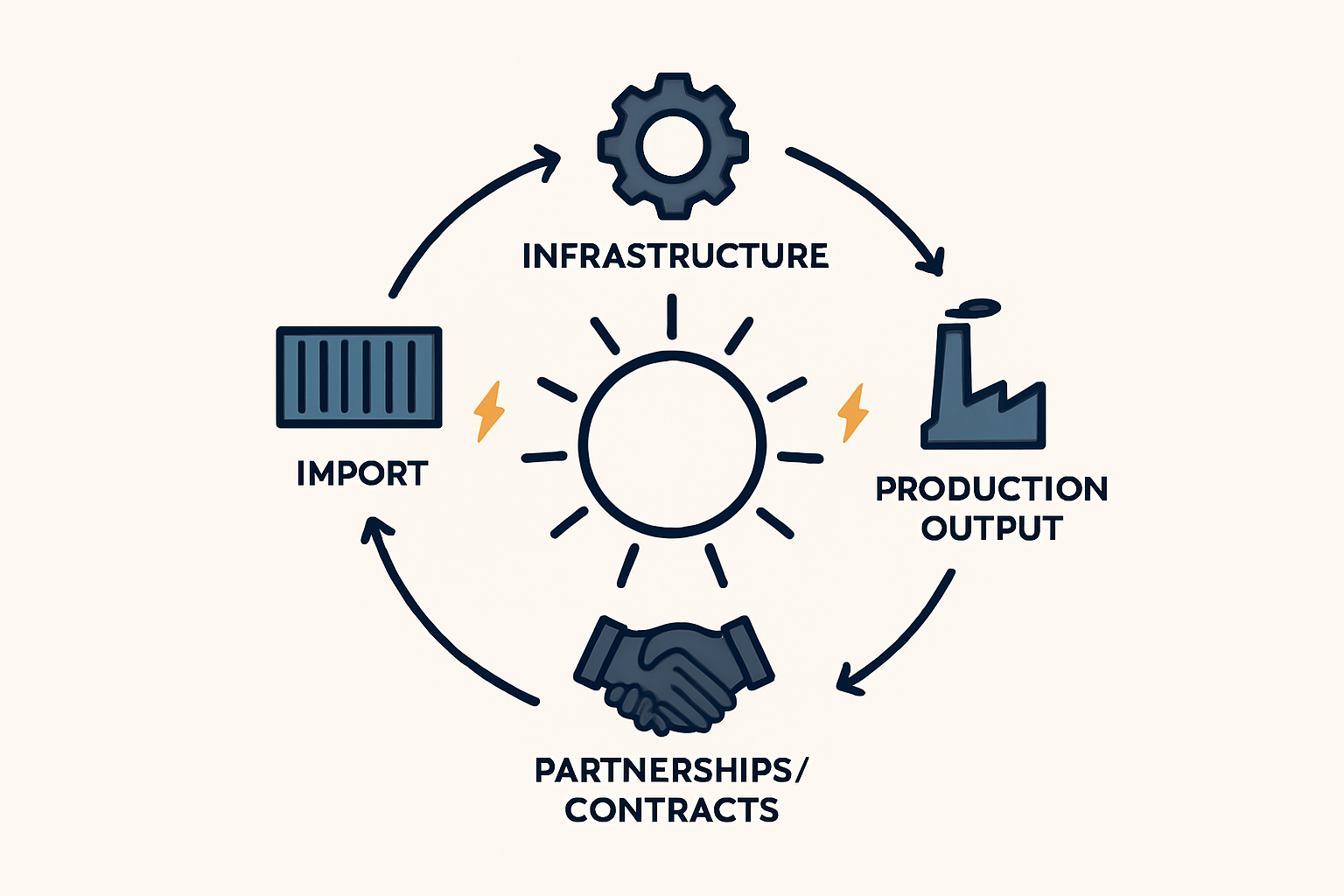
Navigating customs procedures at the port and the border is a specialized task. Partnering with experienced and reputable clearing agents in both Mozambique/South Africa and Zimbabwe is essential to avoid costly delays. Entrepreneurs should also investigate government incentives, such as Zimbabwe’s Special Economic Zones (SEZs), which can provide exemptions or reductions on import duties for manufacturing equipment and raw materials.
Warehousing and Inventory Management
Given the potential for delays on either corridor, a factory in Zimbabwe cannot rely on a just-in-time inventory model. Instead, a larger-than-usual buffer stock of critical components must be maintained on-site. This requirement directly impacts the business plan, demanding higher working capital to fund the inventory—a crucial consideration for the initial investment requirements for a solar factory.
Frequently Asked Questions (FAQ)
What is the typical road transit time from Durban to Harare?
While the driving time is around 24-30 hours, the total transit time for a container ranges from 7 to 14 days, accounting for port processing, loading, and significant potential delays at the Beitbridge border crossing.
Is rail a viable alternative to road transport?
Rail is an option, particularly on the Beira corridor (the Beira-Harare railway). However, road freight often provides greater door-to-door flexibility and is generally the more common choice for transporting containerized goods to industrial sites in Harare.
How do political or economic conditions affect these routes?
Supply chain stability is linked to regional stability. Factors such as changes in trade policies, customs regulations, border disputes, or infrastructure maintenance in South Africa, Mozambique, and Zimbabwe can all affect transit times and costs. A thorough risk assessment should monitor these factors.
Can a factory use both ports simultaneously?
Yes, and this is an excellent risk mitigation strategy. Relying on a single corridor makes the factory vulnerable to disruptions on that route. Having established relationships with logistics providers on both the Beira and Durban corridors provides crucial flexibility.
Conclusion: Building a Resilient Supply Chain
For an entrepreneur planning a solar module factory in Zimbabwe, logistics is a strategic function, not a back-office task. The choice between the Beira and Durban corridors is not a simple matter of cost versus distance but a complex decision that must balance cost, speed, reliability, and risk.
The optimal strategy may involve a hybrid approach tailored to different types of cargo. Successful ventures will conduct thorough due diligence, build strong relationships with local logistics partners, and design a supply chain resilient enough to withstand the inevitable challenges of operating in a landlocked environment. Getting this right from the outset is a critical step toward building a sustainable and profitable manufacturing business.