Disclaimer: This case study represents a composite example derived from real-world
consulting work by J.v.G. Technology GmbH in solar module production and factory optimization. All data points are realistic but simplified for clarity and educational purposes.
For entrepreneurs exploring new industrial ventures, the West African market offers immense potential, though its complexity can be intimidating. The region’s rapid economic growth is fueling an unprecedented demand for energy, yet the path to establishing a local manufacturing presence can seem daunting. This is especially true in the solar industry, where technical expertise is often seen as a significant barrier to entry.
Yet a powerful combination of supportive government policies, modern infrastructure, and proven implementation models is creating a uniquely accessible opportunity. This analysis outlines a detailed framework for establishing a solar module factory in Senegal’s Diamniadio Industrial Park through a turnkey solution designed for business professionals new to the sector. It shows how a structured approach can transform a complex industrial project into a manageable and profitable venture.
The Strategic Advantage of Senegal
Before examining a specific factory model, it’s worth understanding the stability and strategic vision that make Senegal a premier investment destination. With economic growth projected at 8.3% for 2024, the nation is a pillar of political and economic stability in West Africa. This growth is underpinned by the government’s ‘Plan Sénégal Émergent’ (PSE), a comprehensive development strategy focused on industrialization and energy independence.
For the solar industry, these policies create tangible advantages:
- Abundant Natural Resources: Senegal boasts over 3,000 hours of sunshine annually, providing one of the most reliable solar resources in the world.
- Clear Government Commitment: The country has set an ambitious goal to increase the share of renewable energy in its electricity mix to 42% by 2035, creating a strong, state-supported domestic market.
- Regional Market Access: As a member of the West African Economic and Monetary Union (UEMOA) and the Economic Community of West African States (ECOWAS), Senegal offers duty-free access to a regional market of over 300 million people.
These factors create fertile ground for local manufacturing, ensuring both domestic demand and significant export potential.
Diamniadio Industrial Park: A Gateway to West African Markets
At the heart of Senegal’s industrial strategy lies the Diamniadio Industrial Park (DIP), a Special Economic Zone (SEZ) managed by the national agency APROSI. An SEZ is an area where economic laws are more business-friendly than a country’s national regulations. For an investor, this environment is designed to remove common barriers to entry and operation.
Key benefits of establishing a factory in the Diamniadio SEZ include:
Ready to make big Profits?
The solar Industry is Booming
WE HELP NEWCOMERS to the solar industry start their own solar module production line. Customers can make BIG PROFITS by selling modules and finding investors, without wasting money and time on things they don't need!
- Comprehensive Tax Exemptions: Businesses operating within the SEZ enjoy significant tax relief for up to 25 years, including exemptions on corporate tax, income tax, and Value-Added Tax (VAT).
- Duty-Free Imports: Critical machinery, equipment, and raw materials required for manufacturing can be imported without customs duties, directly reducing initial investment costs.
- Streamlined Administration: The park features a ‘one-stop shop’ administrative system, simplifying procedures for permits, licenses, and other regulatory requirements.
- World-Class Infrastructure: Investors gain access to reliable, high-quality infrastructure, including stable electricity, treated water, and high-speed fiber optic connectivity—essentials that can be challenging to secure elsewhere.
- Logistical Proximity: The park is strategically located near Dakar’s deep-water port and Blaise Diagne International Airport, simplifying the import of raw materials and export of finished solar modules.
This combination of fiscal incentives and robust infrastructure de-risks the investment and allows business owners to focus on production and market growth.
A Phased Approach to Market Entry: The 20 MW Starter Factory
For entrepreneurs new to the solar sector, a common question is how to launch a manufacturing business without an overwhelming capital commitment. A phased approach is the most prudent strategy. Based on extensive experience in emerging markets, a 20 MW semi-automated production line is an ideal entry point.
Phase 1: 20 MW Semi-Automated Line
This initial phase focuses on establishing a lean, efficient, and profitable operation with a manageable investment.
Capacity: 20 Megawatts (MW) per year.
Technology: A semi-automated line, which balances modern machinery for critical processes with manual handling for others. This approach reduces the initial capital outlay while ensuring high-quality output.
Building Requirement: Approximately 1,500 m² for production, warehousing, and offices.
Staffing: A focused team of 25-30 employees, including operators, technicians, and administrative staff.
Estimated Timeline: The factory can be fully operational within 9 to 12 months of project commencement.
This ‘starter factory’ model is designed to generate positive cash flow quickly, building a solid foundation and operational expertise before scaling up to a larger, more automated facility in Phase 2.
The Turnkey Execution Plan of an EU-Based Photovoltaic Manufacturing Solution Partner
A turnkey solution provider manages every aspect of the project, from initial design to full operational handover. This model is particularly effective for investors who have strong business acumen but lack specialized technical knowledge in photovoltaics, ensuring every detail is handled by experienced engineers according to international standards.
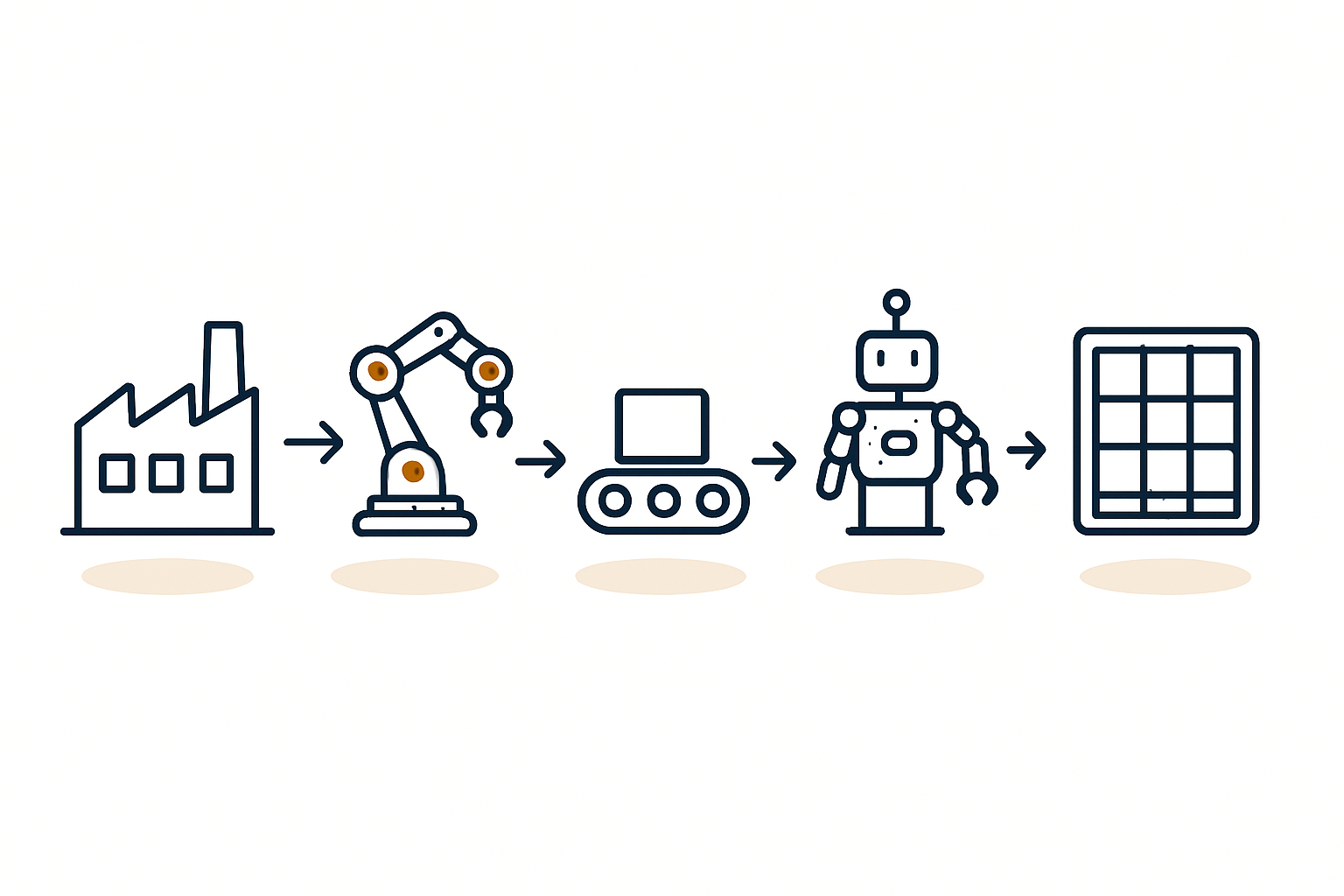
The turnkey process follows a structured, five-step path:
-
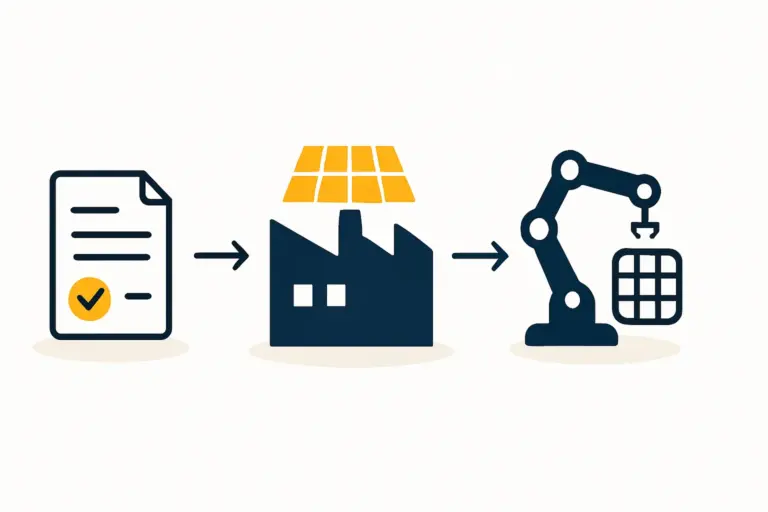
Factory Planning and Layout Design: The process begins with a detailed design of the factory floor, optimizing the flow of materials and personnel for maximum efficiency. This includes layouts for all machinery, workstations, and storage areas.
-
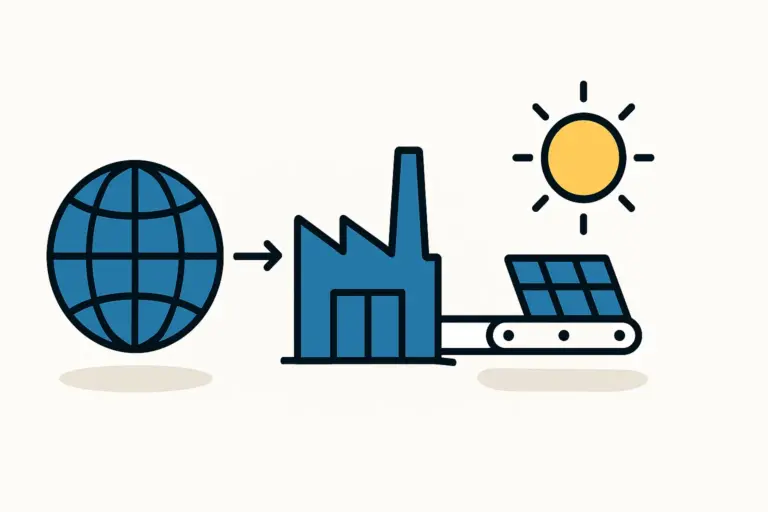
Machine Procurement and Logistics: We manage the selection, sourcing, and procurement of all necessary equipment from reliable global suppliers, then handle all international shipping, customs clearance, and delivery to the Diamniadio site.
-
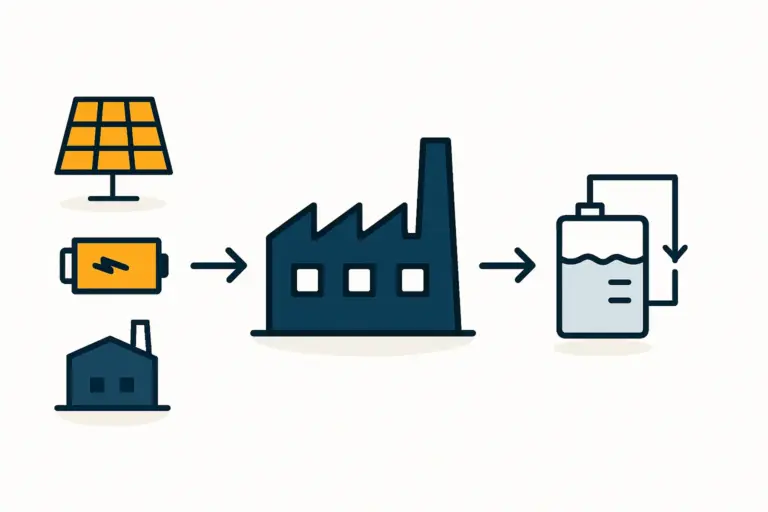
Installation and Commissioning: A team of specialized engineers oversees the on-site installation of the entire production line. They then commission each machine, ensuring it functions correctly and integrates seamlessly into the manufacturing process.
-
Operator Training and Production Ramp-Up: The process includes comprehensive training for local staff on equipment operation, quality control protocols, and safety procedures. Our team remains on-site to supervise initial production runs, fine-tuning processes until the factory is running at its target capacity and quality level.
-
Raw Material Sourcing and Certification Support: A reliable supply chain is critical to success. The plan includes establishing initial sourcing channels for key materials. Guidance is also provided to help the new factory prepare for and achieve essential international quality certifications.
This end-to-end management ensures the facility is not just built, but is fully prepared for sustainable, high-quality production from day one.
Financial Modeling and Investment Outlook
A clear understanding of the financial requirements and potential returns is essential. The estimated cost for a 20 MW semi-automated turnkey line in Diamniadio is approximately €2.5 million. This investment covers all machinery, installation, training, and initial raw material stock.
Here is a simplified breakdown of the project’s financial profile:
Initial Investment: ~€2.5 Million
Annual Production Capacity: 20 MW
Projected Annual Revenue: ~€5 Million (assuming a conservative average sales price of €0.25 per Watt-peak).
Production Cost Structure:
- Bill of Materials (BOM): 75-80%
- Labor: 5-7%
- Energy and Overhead: 10-15%
Profitability: With the SEZ’s tax benefits and efficient operation, a project of this scale is expected to achieve a positive Internal Rate of Return (IRR) within 3 to 5 years.
These figures demonstrate a robust business case, made even stronger by the fiscal advantages offered within the Diamniadio Industrial Park.

Navigating Quality and Certification
To compete in both domestic and international markets, modules must meet globally recognized quality standards. The most important certifications for photovoltaic modules are IEC 61215 (performance) and IEC 61730 (safety). Achieving these is non-negotiable for building a reputable brand.
The turnkey service includes preparing the factory’s quality management system and production processes for the rigorous audits required by certification bodies like TÜV. This support is crucial, as it ensures the finished product is bankable, reliable, and eligible for use in large-scale solar projects.
Frequently Asked Questions (FAQ)
Do I need a technical background to start a solar factory?
No. The turnkey model is specifically designed for business leaders and entrepreneurs. The technical partner provides the engineering expertise, process knowledge, and operational training, allowing the owner to focus on business strategy, finance, and market development.
How long does it take to become operational?
For a 20 MW semi-automated line, the typical timeline from project agreement to the first certified module coming off the line is between 9 and 12 months. This includes factory layout, machine manufacturing, shipping, installation, and training.
What are the biggest challenges in sourcing raw materials?
The primary challenges are typically price volatility and logistics. A key part of the setup process involves establishing relationships with multiple qualified global suppliers to mitigate risk and ensure competitive pricing for materials like solar cells, glass, and encapsulants.
Is a 20 MW factory large enough to be profitable?
Yes. At this scale, a semi-automated line can be highly profitable, especially within the favorable fiscal environment of an SEZ. It strikes an optimal balance between initial investment and production volume, allowing for a faster path to profitability than a much larger, fully automated facility.
Conclusion and Path Forward
The opportunity to establish a solar module factory in Senegal’s Diamniadio Industrial Park represents a rare convergence of positive factors: a stable and growing economy, strong government support for renewable energy, a world-class SEZ with powerful incentives, and a proven, de-risked path to market entry.
The turnkey model effectively removes the barrier of technical expertise, transforming a complex industrial undertaking into a structured, step-by-step process. For the strategic entrepreneur, this is not just an investment in a factory; it is an investment in West Africa’s energy future, positioned for success through a prime location, sound economics, and expert execution.
The next step for any interested party is to move from general understanding to detailed planning, exploring how this framework can be tailored to specific business objectives.
Download: Senegal Solar Module Factory Case Study [PDF]
Author: This case study was prepared by the
turnkey solar module production specialists at J.V.G. Technology GmbH
It is based on real data and consulting experience from J.v.G. projects
worldwide, including installations ranging from 20 MW to 500 MW capacity.