Disclaimer: This case study represents a composite example derived from real-world
consulting work by J.v.G. Technology GmbH in solar module production and factory optimization. All data points are realistic but simplified for clarity and educational purposes.
For decades, the economic prosperity of many resource-rich nations has been tied to the price of a barrel of oil. As the global energy landscape shifts, visionary entrepreneurs are looking to a different source of power: the sun.
This shift creates a unique opportunity to transform a strategic coastal location into a hub for renewable energy manufacturing. It’s a chance to forge a powerful, non-oil revenue stream with direct access to the world’s most lucrative markets.
This business plan outlines a strategy for establishing a turnkey solar module factory in the Misrata Free Zone, Libya. It explores the unique advantages of this location, details the technical requirements for a high-efficiency production line, and analyzes the market dynamics that make this a compelling venture for investors looking to serve both North African and European energy needs.
The Strategic Advantage: Why Misrata Free Zone?
A Free Zone is a designated geographical area where goods can be imported, handled, manufactured, and re-exported under specific customs regulations, typically without being subject to the usual tariffs and duties. For an export-oriented business, this framework creates a highly efficient and cost-effective operational environment.
The Misrata Free Zone (MFZ) offers a potent combination of geography and policy, making it an ideal base for a solar manufacturing operation:
Prime Geographic Location
Situated directly on the Mediterranean coast, Misrata serves as a natural gateway between Africa and Europe. This proximity dramatically reduces shipping times and logistics costs compared to suppliers from Asia.
World-Class Port Infrastructure
The Port of Misrata is one of the most active and well-equipped in the region, capable of handling the global import of raw materials and the efficient export of finished solar modules.
Ready to make big Profits?
The solar Industry is Booming
WE HELP NEWCOMERS to the solar industry start their own solar module production line. Customers can make BIG PROFITS by selling modules and finding investors, without wasting money and time on things they don't need!

Favorable Regulatory Framework
The MFZ provides significant financial incentives, including exemptions from taxes and customs duties, streamlined administrative procedures, and the possibility of 100% foreign ownership. This framework is designed to attract international investment and foster export-led growth.
These factors combine to create a powerful platform for building a business that can not only compete on a regional level but also challenge established players on the global stage.
Market Opportunity: Serving Europe and North Africa
A manufacturing hub is only as valuable as the markets it can serve. A Misrata-based factory is uniquely positioned to cater to two distinct, high-demand regions.
The European Market
Europe is aggressively pursuing its renewable energy goals, driven by initiatives like the REPowerEU plan. This has created immense demand for high-quality solar modules. European buyers are increasingly looking to diversify their supply chains, reducing reliance on distant manufacturing centers in Asia.
A Libyan producer offers a compelling ‘nearshoring’ alternative with shorter delivery times, greater supply chain resilience, and freedom from certain geopolitical tariffs. This unique positioning allows a Libyan manufacturer to compete effectively, provided they meet the necessary quality standards.
The North African Market
The North African region itself is a sleeping giant in terms of solar potential. With some of the highest solar irradiation levels in the world, the economic case for solar power here is undeniable.
As the region’s economies grow, so does the demand for electricity. A local manufacturing presence can supply burgeoning domestic projects in Libya and neighboring countries like Tunisia, Algeria, and Egypt. This, in turn, fosters regional energy independence and economic development.
The Turnkey Factory Model: A Blueprint for Success
For an entrepreneur or investor without a deep background in photovoltaic technology, entering the manufacturing space can seem daunting. A turnkey project model removes this barrier by providing a complete, ready-to-operate solution.
This solution includes all machinery, installation, staff training, and process know-how, allowing the business owner to focus on strategic management while a technical partner ensures the factory is built to international standards. This model significantly de-risks market entry.
Production Line and Technology
The heart of the factory is its production line. A modern, export-oriented facility should be equipped to produce high-efficiency modules using technologies such as PERC, TOPCon, or HJT. These advanced technologies ensure that the modules generate more power per square meter, making them more valuable to the end customer.
A typical semi-automated 50 MW production line, for example, can produce approximately 150,000 to 200,000 modules per year. The choice of solar cell technology is a strategic decision that depends on the target market and the desired balance between production cost and module performance.
Essential Certifications for Export
Access to premium markets, particularly in Europe, requires demonstrating that your products meet stringent international standards for safety, performance, and durability. The most critical certifications are issued by the International Electrotechnical Commission (IEC):
-
IEC 61215 (Performance): This standard tests for thermal performance, UV resistance, and resilience to environmental stressors like hail.
-
IEC 61730 (Safety): This standard ensures the module is safe from electrical and fire hazards throughout its lifespan.
A key component of a turnkey solution is the guidance and support needed to navigate this complex testing and documentation process. Achieving these certifications is a non-negotiable step toward building a reputable, export-focused brand.
Logistics and Supply Chain
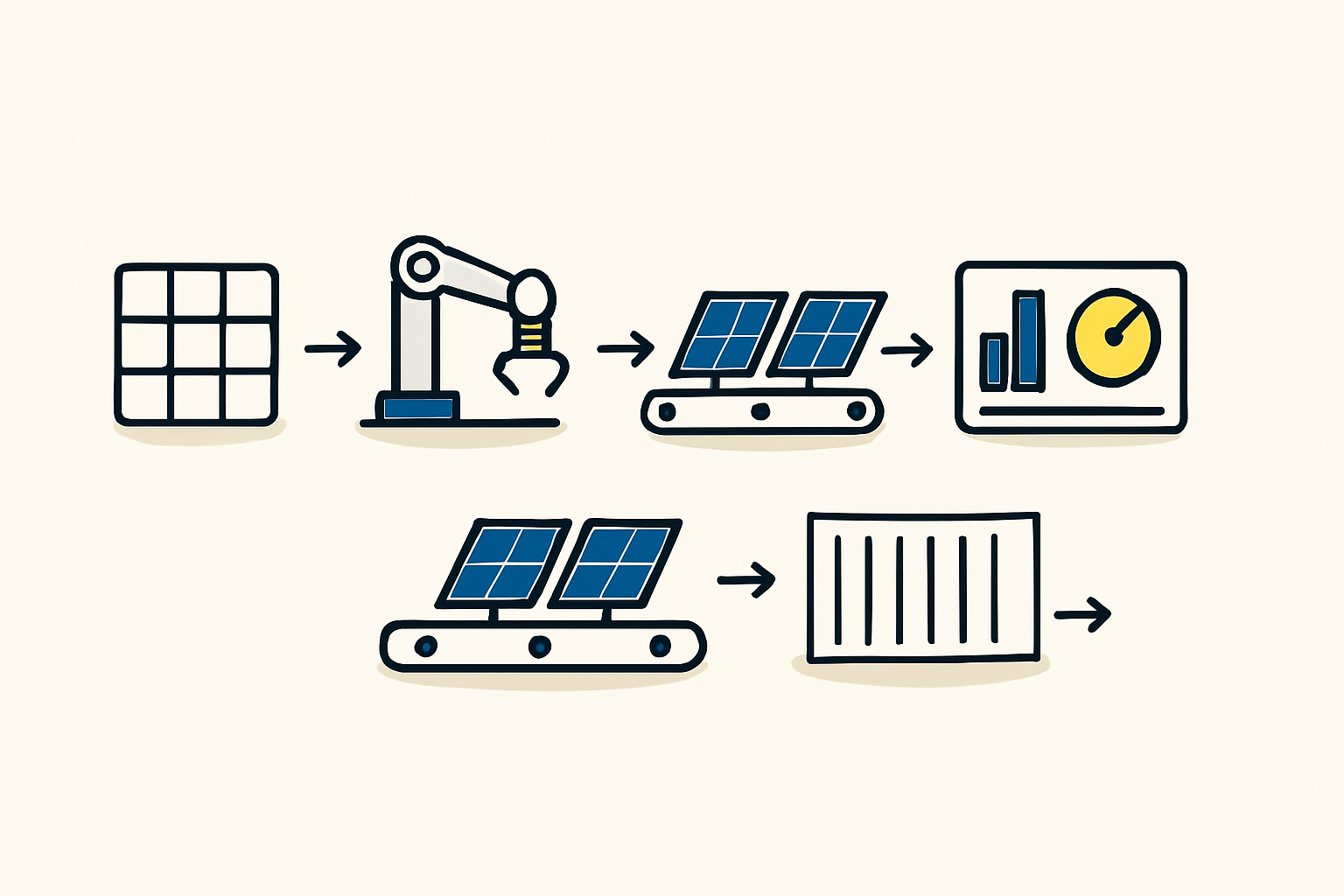
A solar module factory is fundamentally an assembly operation. It imports specialized components—solar cells, tempered glass, EVA foil, and aluminum frames—and assembles them into a high-value finished product.
A turnkey partner helps establish a robust and cost-effective supply chain for these raw materials. Given Misrata’s port facilities, managing both inbound and outbound logistics becomes a streamlined and efficient process.
Investment and Operational Framework
A credible business plan must be grounded in realistic financial and operational projections. While precise figures depend on project scale and technology choices, a general framework can be outlined.
Typical Investment Requirements
For a 20 MW to 50 MW turnkey production line, investors should anticipate an initial investment to cover machinery, installation, technology transfer, and initial raw material stocks. This investment provides the foundation for producing high-quality, certified modules capable of competing in international markets.
Human Resources and Training
A semi-automated 50 MW line typically requires a workforce of 25 to 40 employees per shift, including operators, technicians, and quality control staff. Comprehensive on-site training is a crucial part of the turnkey package. This empowers the local team with the technical skills needed to operate and maintain the machinery independently, ensuring long-term operational excellence.

Project Timeline
With proper planning and an experienced technical partner, a solar module factory can become operational in a surprisingly short time. A typical project timeline, from signing the contract to producing the first certified module, is approximately 9 to 12 months.
This timeline includes factory layout planning, machinery manufacturing and shipping, on-site installation, and the commissioning phase where production is fine-tuned for optimal efficiency.
Building a Competitive Edge: Quality and Reliability
In the global solar market, competing solely on price is a challenging strategy. The sustainable competitive advantage for a Misrata-based factory will come from a combination of key factors:
-
Geographic Proximity: Faster and cheaper logistics to Europe and North Africa.
-
Quality Assurance: Adherence to strict IEC standards, often rooted in German engineering principles for precision and reliability.
-
Supply Chain Security: Offering a stable alternative to complex Asian supply chains.
An investor from a non-technical background, such as logistics or construction, can leverage their existing business acumen while relying on a technical partner to ensure the product quality and process efficiency needed to succeed.
Frequently Asked Questions (FAQ)
What is a ‘turnkey’ production line?
A turnkey solution is a comprehensive package where a single provider supplies and installs a fully operational production line. This includes all machinery, software, training, and processes needed to begin manufacturing immediately after the project is complete.
Do I need a technical background to start a solar factory?
No. The turnkey model is specifically designed for entrepreneurs and investors who are strong in business but are not solar technology experts. The technical partner provides all the necessary engineering, process knowledge, and training.
What are the main raw materials needed?
The primary components are solar cells, tempered front glass, a backsheet or back glass, EVA encapsulant film, aluminum frames, and a junction box with cables.
How difficult is it to get IEC certification?
The process is rigorous and detail-oriented, but it is a standard procedure. A good turnkey partner designs the production line and processes with certification in mind and guides your team through the entire application and testing process with a certifying body like TÜV.
Why not just import modules from Asia?
While Asian modules are prevalent, a local manufacturing hub in Misrata offers key advantages: insulation from shipping volatility and tariffs, significantly faster delivery to regional customers, the flexibility of customized product runs, and the creation of local jobs and technical expertise.
Conclusion: Your Next Steps in Planning
The Misrata Free Zone presents a unique and timely opportunity to build a profitable, export-oriented solar module manufacturing business. Its strategic location, favorable regulations, and direct access to high-growth markets create a compelling foundation for success.
By leveraging a turnkey factory model, investors can overcome technical barriers and focus on building a resilient, high-quality manufacturing brand.
The initial step for any serious investor is to develop a detailed feasibility study and business plan tailored to specific goals. This foundational work is critical for securing financing and ensuring smooth project execution. Starting with reliable resources and templates can provide a structured path for this essential planning phase.
Download: Misrata Free Zone Solar Module Factory Case Study [PDF]
Author: This case study was prepared by the
turnkey solar module production specialists at J.V.G. Technology GmbH
It is based on real data and consulting experience from J.v.G. projects
worldwide, including installations ranging from 20 MW to 500 MW capacity.