
This article examines how a framing machine places the frame on a solar module and how these renewable energy panels are packed and sorted before they’re shipped to customers.
Overview Of Solar Panel Production
A solar panel begins as a collection of raw materials. The primary material in a production line is solar cells, which are typically made from silicon. The cells are wired together using a stringer. Then, glass, wiring, a backsheet, and a frame are added to complete the solar energy module.
Once the panel is assembled, it is tested for efficiency, performance, and safety. Sorting machines then separate the modules into different categories based on their specifications.
The last step in manufacturing is packaging the solar modules into boxes or other containers for shipment.
How Solar Module Framing Machines Work
The frame of a solar panel equipment serves a dual purpose: it provides structural support for the module against wind and snow, and it protects the module’s components from the elements.
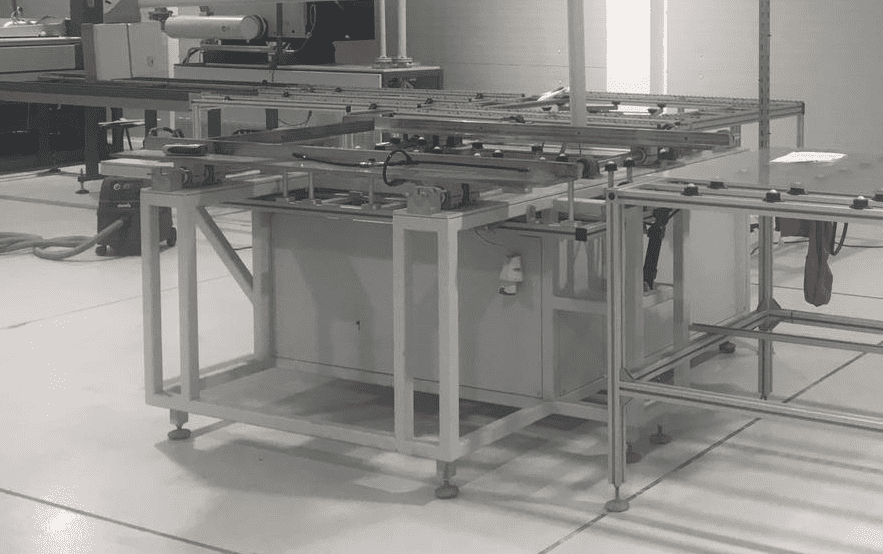
Framing machines assemble the frame for a solar PV module and then place the module inside it. The process begins on a frame assembly table, where the frame is constructed. The module is then placed into the frame on a separate module assembly table.
Once assembled, clamping systems secure the frame and module in place. Alignment systems then ensure both the frame and the module within it are positioned correctly.
Types Of Framing Machines
Manual: The most common type is the manual machine, which requires a human operator. These machines are typically used for small to medium-sized projects.
Semi-automated: A semi-automated machine is also operated by a person but includes some automated features. This type is generally used for larger production lines and is more complex to operate.
Fully automated: A fully automated machine is operated entirely by a computer system. This type, used for large-scale production lines, is the most complex to operate.
Automated VS Manual PV Framing Machines
While automation can make the panel production process more expensive, it also offers significant improvements. Just like stringers, framing machines can be automated.
Automatic solar framing machines are faster than manual machines, which reduces the time required to complete the assembly process.
Automatic solar framing machines are also more accurate, producing panels with properly aligned frames and modules. This precision reduces manufacturing waste, which in turn can lower the overall cost of solar plants.
Automated PV machines are much safer to operate than manual ones, as they come equipped with safety features like emergency stop buttons and protective guards. This helps reduce the risk of injury to the operator.
Tips For Choosing The Right Solar Module Framing Machine
Several factors should be considered when choosing a framing machine.
Size of the project: For small to medium-sized projects, a manual machine is likely the best option. Larger projects may be better suited for a semi-automated or fully automated machine.
Module type: A manual machine may be sufficient for single-cell modules. However, multi-cell modules often require a semi-automated or fully automated machine.
Budget: Manual PV machines are typically much less expensive than their semi-automated or fully automated counterparts. If budget is a concern, a manual machine is often the best option.
Packing And Sorting
As part of a multi-stage PV production process, sorting and packing are the final steps in module manufacturing.
Sorting machines are used in a variety of industries to grade the finished product. In photovoltaic module production, they quickly and accurately separate solar modules into different categories based on their specifications. This helps ensure the modules meet the quality standards required for consumer use.
Sorting machines are typically made up of a series of conveyor belts, sensors, and robotic arms. The conveyor belts move the solar modules from one station to the next, while sensors detect the specifications of each module.
The robotic arms then move the modules to the appropriate sorting bins. These machines can be programmed to recognize the different specifications of each module and sort them accordingly.
Manual VS Automated Sorting Machines
Just like framing, sorting and packing can be manual, semi-automated, or fully automated. Manual solar panel machines are the least expensive and are typically suited for small-scale operations, while semi- and fully-automated machines are better for medium to large-scale manufacturing.
Automated sorting machines offer numerous benefits, most notably the speed and accuracy with which they can sort modules. This helps manufacturers quickly identify and separate solar modules that do not meet quality standards.
Sorting machines also reduce the need for manual labor. Since the process is automated, fewer employees are required to oversee it, leading to cost savings for manufacturers.
Finally, automated sorting is more efficient than manual sorting. The increased speed leads to higher production rates and quicker delivery times.
Automating The Packing Process
Automation can help ensure that modules are packed quickly and accurately. To automate the packing process, manufacturers must first create a packing plan.
This plan should outline:1. The number of panels that need to be packed.2. The size and weight of the boxes.3. The type of packing material to be used.4. Special requirements for the packing process.
Once the packing plan is created, manufacturers can use software to automate the packing process.
Conclusion
Framing, sorting, and packing are crucial steps in the production of solar panels. Automation helps prevent errors and makes these processes more efficient.
Once manufacturing is complete, the next steps are marketing and distribution. We have previously covered strategies for finding customers for solar panels.
If you haven’t already, be sure to check out that article for ideas on marketing strategies you can use to grow your solar module production business.
So interested you lesson because of in solar production line, framing, sorting, packing.. crucial step….I am happy