The Right Size for an Inverter Factory
Why Factory Size is a Critical Decision
When planning a new inverter factory, one of the earliest and most critical decisions is determining its size. This choice extends far beyond the building’s physical dimensions, shaping the project’s capital investment, operational complexity, and overall risk profile.
Experience from real-world projects shows that many promising ventures fail not because of flawed technology, but because their factories are oversized for their actual market. A larger factory is far more challenging to manage, demands a substantial and stable sales pipeline, and offers no guarantee of higher profitability. An oversized facility with idle capacity can quickly become a financial drain, consuming capital better used for market development or operational improvements.
The goal is to align production capacity with realistic market demand, creating an operation that is manageable and positioned for sustainable growth.
What “Factory Size” Means in Practice
In inverter manufacturing, “factory size” refers to the plant’s total productive capacity and operational scale, defined by several interconnected factors:
- Production Volume: The approximate number of inverter units the factory is designed to produce per year. This is the primary indicator of size.
- Assembly & Testing Stations: The number and configuration of workstations required to meet the intended production volume.
- Staffing Level: The size and skill mix of operators, technicians, engineers, and administrative staff required for stable operation.
- Level of Automation: The extent to which processes are automated rather than manual, which typically increases with higher volumes.
These elements are interdependent. Increasing production volume directly affects staffing needs, testing capacity, and automation requirements. For this reason, factory size decisions influence nearly every later operational and financial choice.
Small Inverter Factory: The Market Entry Level
A small inverter factory is designed for controlled market entry, usually serving local or regional demand. Its main advantages are flexibility and lower initial risk.
Typical Characteristics:
- Production Volume: Often in the range of several thousand to a few tens of thousands of units per year, depending on product type and organization.
- Operations: Simple assembly and testing structures, often manual or semi-automated, with strong focus on process understanding and quality.
- Product Range: Limited to a small number of product variants relevant to the target market.
- Staffing: A compact, multi-skilled team covering production and basic administrative functions.
This scale allows a company to learn the market, build distribution relationships, and establish operational routines without excessive financial exposure.
Medium Inverter Factory: The Professional Operation
A medium-sized factory is typically chosen once stable demand has been confirmed in the local market or through reliable export channels. Operations become more structured and standardized.
Typical Characteristics:
Ready to make big Profits?
The solar Industry is Booming
WE HELP NEWCOMERS to the solar industry start their own solar module production line. Customers can make BIG PROFITS by selling modules and finding investors, without wasting money and time on things they don't need!
- Production Volume: Commonly in the range of several tens of thousands to over one hundred thousand units per year, depending on product complexity.
- Operations: Defined assembly and testing processes with clear quality checkpoints.
- Automation: A balanced mix of automated and manual processes, especially for repetitive or safety-critical steps.
- Staffing: A more specialized workforce, including dedicated quality, maintenance, and supervisory roles.
This size supports economies of scale while remaining operationally manageable.
Large Inverter Factory: The Industrial Scale
A large inverter factory is an industrial-scale operation intended for high-volume production. It is suitable only for companies with secure and predictable market access.
Typical Characteristics:
- Production Volume: Significantly above medium-scale production, potentially reaching very high annual volumes in specific market situations.
- Operations: High levels of automation are required to achieve throughput and consistency. Logistics and supply chain coordination become complex.
- Dependency: Strong dependence on continuous, high-volume sales. Demand fluctuations can have severe financial impact due to high fixed costs.
- Staffing: A large, structured organization with specialized roles in engineering, quality, logistics, and plant management.
Building such a factory without confirmed, long-term demand represents a very high financial risk for new entrants.
The Most Common Investor Mistake: Ambition Over Analysis
A frequent and costly mistake is sizing a factory based on ambition rather than conservative market analysis. Investors may see large theoretical market potential and plan capacity accordingly from the beginning.
This approach often ignores the reality of idle capacity. A factory designed for high output but operating far below capacity still carries full fixed costs. Building size, equipment depreciation, and staffing expenses remain largely unchanged, creating sustained negative cash flow.
Many successful manufacturers started with smaller facilities, stabilized their operations, and expanded only once demand consistently exceeded capacity.
How Factory Size Connects to Automation and Investment
Factory size directly influences the level of automation required and the associated investment.
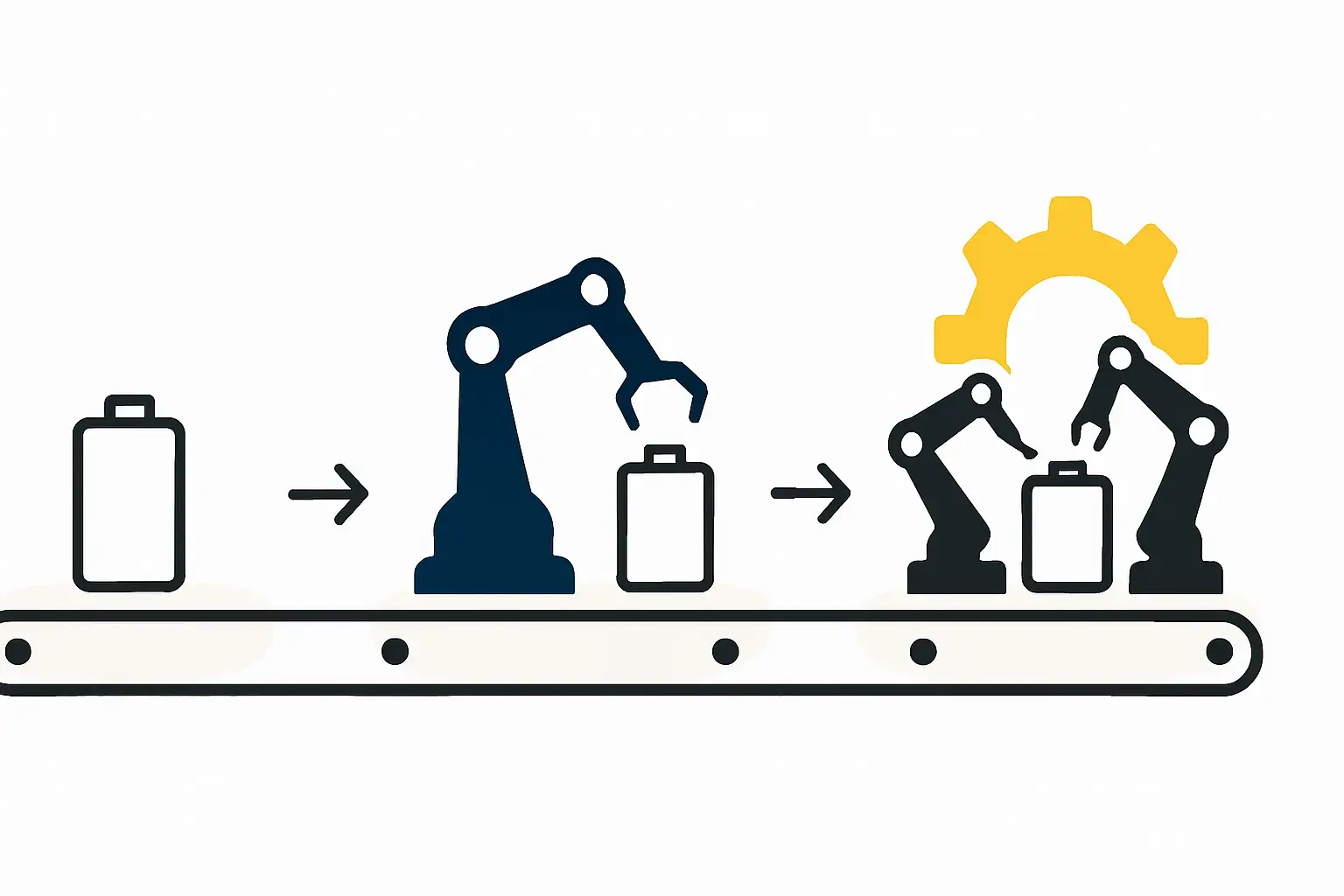
Small factories can function effectively with limited automation. As production volume increases, manual processes become constraints. To maintain quality and throughput, investment in automated assembly support, conveying, testing, and packaging becomes necessary.
Choosing a larger factory therefore implies higher automation and substantially higher upfront investment. Understanding this relationship is essential before committing capital.
Next Step: Financial Planning
Once a realistic factory size has been defined based on market demand and strategy, attention shifts to financial planning. Evaluating total investment needs, operating costs, and cash flow requirements is the next critical step in assessing project viability.