What a Solar Recycling Factory Is—and What It Is Not
1. Introduction – Why Solar Recycling Is Often Misunderstood
When business professionals first explore solar panel recycling, they tend to picture one of two extremes: a small workshop where workers dismantle modules piece by piece, or a highly advanced laboratory where complex chemical processes dissolve panels into pure elements.
This misconception often surfaces early in the planning stages of real-world projects. In reality, an industrial-scale solar recycling factory is neither of these. It’s a volume-driven industrial plant designed for efficiency and throughput, much like any other facility that processes raw materials.
Starting with the wrong mental model leads to poor investment decisions. A plan based on manual work will inevitably fail to handle industrial volumes, while one banking on unproven laboratory technology may never become commercially viable. Understanding the true nature of a recycling factory is the first step toward a realistic business plan.
2. What a Solar Recycling Factory IS
An industrial solar recycling factory is a facility designed to process a large, continuous volume of end-of-life solar modules. Its primary goal is to efficiently separate the modules back into their core material components.
It operates on three key principles:
- It processes large volumes: The facility is built to handle thousands of tons of solar modules per year. Success is measured by throughput and operational uptime.
- It follows repeatable process steps: Every module goes through a standardized, engineered sequence of treatments to ensure consistent output quality.
- It is designed for continuous operation: Like any serious industrial plant, it is meant to run consistently, day after day, to meet production targets.
In simple terms, the process breaks down into four main stages:
- Incoming Logistics: End-of-life solar modules arrive at the factory, typically by truck. They are registered, weighed, and stored in a designated area before processing.
- Pre-processing and Size Reduction: The modules first enter a stage where components like aluminum frames and junction boxes are removed. The main body of the module is then broken down into smaller, more manageable pieces.
- Material Separation: This is the core of the factory. Here, a series of mechanical and physical separation machines sorts the broken pieces into different material streams. For example, glass is separated from metals, and metals are separated from plastics.
- Output Fractions: The factory produces several streams of recovered materials, often called fractions. These are typically high-purity glass, aluminum, copper, and a mix of other materials. These fractions are then ready to be sold to other industries as raw materials.
The entire system functions as a logical, sequential production line optimized to separate materials at an industrial scale.
3. What a Solar Recycling Factory Is NOT
To clarify the concept, it’s also useful to understand what a solar recycling factory is not.
It is NOT a small manual dismantling workshop. While some manual steps may be involved, the core process relies on automated machinery to handle the required volume. A business model based purely on manual labor cannot compete at an industrial scale.
It is NOT a research or laboratory environment. An industrial factory uses proven, reliable technologies. It is not a place for daily experiments with new chemical processes. The focus is on operational stability and consistent output, not scientific discovery.
Ready to make big Profits?
The solar Industry is Booming
WE HELP NEWCOMERS to the solar industry start their own solar module production line. Customers can make BIG PROFITS by selling modules and finding investors, without wasting money and time on things they don't need!
It is NOT a flexible custom-processing operation. The factory is highly specialized to process one type of input: silicon-based photovoltaic modules. It cannot efficiently handle other types of electronic waste or different solar panel technologies without significant changes. Industrial recycling requires standardization; its strength comes from doing one job very well, repeatedly.
4. Factory Logic Comes Before Technology
A common mistake investors make is focusing on a specific recycling technology first. Experience from industrial projects shows this is the wrong approach. The correct starting point is factory logic.
The entire facility is designed around one central question: What is the expected input volume of end-of-life modules per year?
This single parameter—the available tonnage—defines everything else.
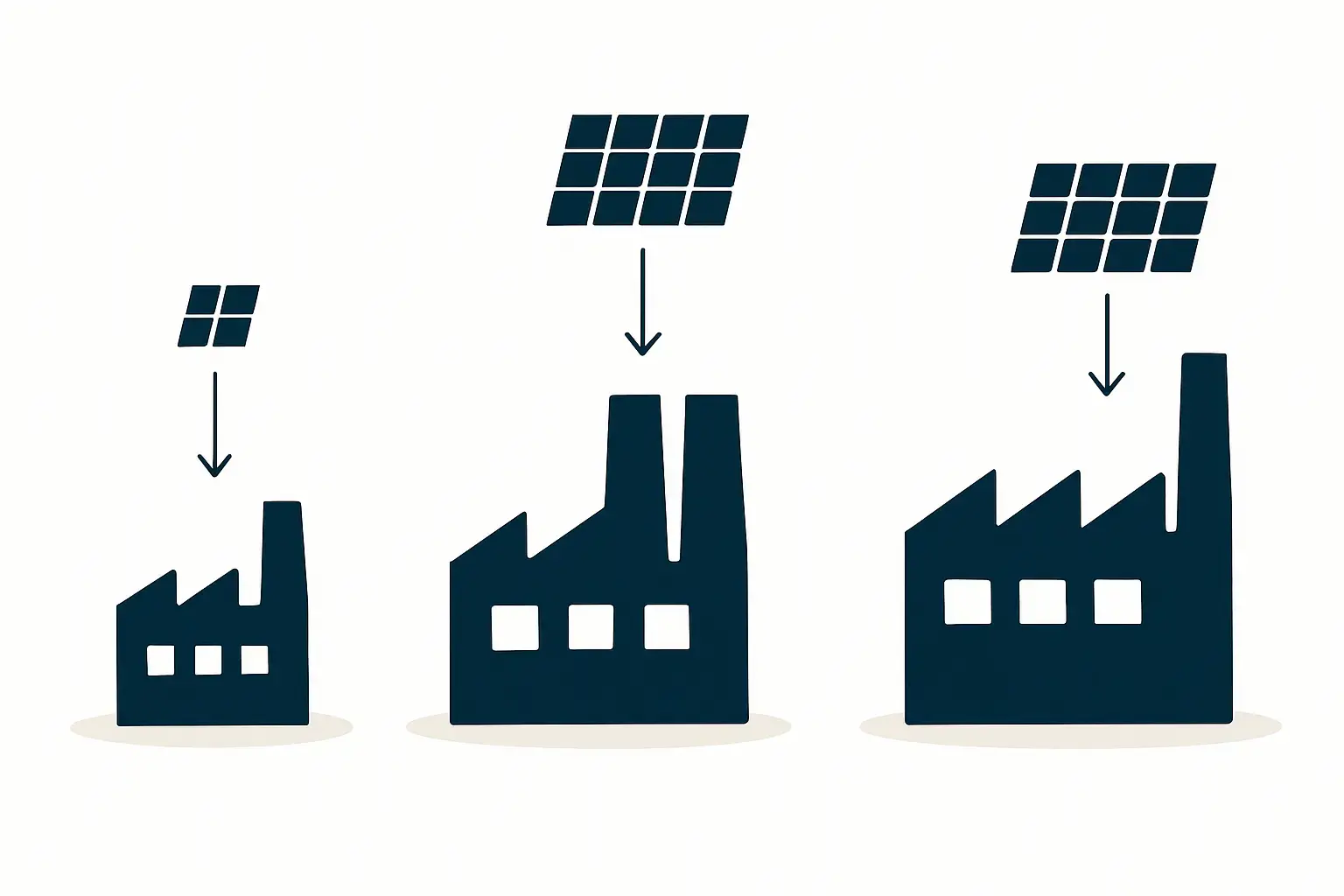
- Throughput defines the layout: The amount of material that must be processed per hour determines the size and number of machines.
- Layout defines the automation level: A high-volume plant requires more automation to maintain efficiency and safety than a low-volume one.
- Automation level defines the workforce: The number of employees and their required skills depend directly on the level of automation.
Technology is selected only after these fundamental questions are answered. The “best” technology is simply the one that reliably supports the factory’s required throughput with minimal downtime. Technology alone does not make a project successful; a secure supply of input material and a correctly scaled factory are the true foundations of a viable business.
5. The Role of Regulation and Input Material
An industrial recycling factory is entirely dependent on a reliable, predictable stream of input material. Without a constant supply of end-of-life solar modules, the machines sit idle, and the business fails.
This is where government regulation becomes critical. In most markets, regulations create the conditions necessary for a stable recycling industry. They often mandate the collection and recycling of old solar panels, generating the supply a factory needs.
Planning a solar recycling factory, then, is not just a technical exercise but also a strategic assessment of the local market. A successful project requires well-organized logistics and collection systems to bring modules from the field to the factory gate. The existence of—or a clear path toward—supportive regulation is a key indicator of project feasibility.
6. Strategic Takeaway
Understanding the fundamental concept of a solar recycling plant is the essential first step. Before analyzing specific machines or financial models, it is crucial to remember these key points:
- Solar recycling is an industrial infrastructure business, not a small workshop or a research project.
- Scale and operational stability are more important for success than any single piece of advanced technology.
- The first step in any decision-making process must be to understand and apply factory logic, starting with the available volume of input material.
7. Transition to the Next Lesson
Now that the basic concept of an industrial recycling factory is clear, the next logical step is to examine the practical implications of scale. The next lesson will explain typical plant sizes, their corresponding throughput levels, and the investment ranges associated with each.