Disclaimer: This case study represents a composite example derived from real-world
consulting work by J.v.G. Technology GmbH in solar module production and factory optimization. All data points are realistic but simplified for clarity and educational purposes.
For international entrepreneurs exploring new industrial ventures, few locations offer the unique mix of opportunity and complexity found in Brazil’s Manaus Free Trade Zone (ZFM). While its remote Amazonian setting presents clear logistical challenges, the zone’s powerful tax incentives create a compelling business case for solar module manufacturing—especially given Brazil’s rising energy costs and growing demand for photovoltaic solutions.
This article outlines a practical investment scenario for establishing a solar module factory in the ZFM. We examine the interplay of tax benefits, local content requirements, and logistical planning, showing how a strategic partnership can turn this challenging environment into a significant competitive advantage.
The Brazilian Solar Market: A Unique Opportunity
Brazil’s industrial and residential sectors face some of the highest electricity costs in the region. This economic pressure, combined with abundant solar irradiation, has fueled a dynamic, fast-growing market for solar energy. Yet, a significant portion of the solar modules installed in the country are imported, leaving a strategic opening for local manufacturers who can provide competitive pricing and a reliable domestic supply.
A local manufacturing presence enables a company to serve this growing demand directly, reduce reliance on international supply chains, and build a brand synonymous with Brazilian industry. The key is choosing a location that provides a decisive economic edge—and that is precisely the advantage offered by the Manaus Free Trade Zone.
Understanding the Manaus Free Trade Zone (ZFM) Advantage
The ZFM is an economic development area established by the Brazilian government to stimulate industrial growth in the Amazon region. To that end, it offers some of the most attractive tax incentives in the country. For a solar module manufacturer, two benefits are particularly significant:
IPI (Tax on Industrialized Products) Reduction
The IPI is a federal value-added tax applied to industrial goods. Within the ZFM, approved manufacturing projects can receive a reduction of between 80% and 100% on this tax. For a capital-intensive product like a solar module, this exemption provides a substantial cost advantage over competitors manufacturing in other parts of Brazil or importing finished goods.
ICMS (State-level VAT) Credits
The ICMS is a state-level tax on the circulation of goods and services. The ZFM provides a mechanism for ICMS credits, effectively reducing the tax burden on both the purchase of raw materials and the sale of finished modules. This benefit significantly improves the financial viability of operating within the zone.
These combined incentives can fundamentally alter the final cost structure of a solar module, enabling a Manaus-based factory to compete aggressively in the national market.

The Local Content Mandate: Processo Produtivo Básico (PPB)
To qualify for these tax benefits, a manufacturer must adhere to the Processo Produtivo Básico (PPB), or Basic Production Process. This federal mandate defines the minimum stages of production that must be carried out locally.
For solar modules, the PPB typically requires that key steps of the solar module manufacturing process be performed in the Brazilian factory. This includes:
- Cell stringing and bussing
- Lamination
- Framing
- Junction box assembly
- Quality control and testing (e.g., flash testing)
Compliance is not merely a bureaucratic step—it is the legal foundation of the ZFM business model. The entire production line and operational workflow must be designed from the outset to meet and document these PPB requirements.
Navigating the Logistical Realities of the Amazon
The primary challenge of a Manaus operation is its geography. Situated deep within the Amazon rainforest, the city relies almost exclusively on river and sea freight for the transport of industrial goods.
This reality directly impacts several areas of business planning:
- Inbound Logistics: Raw materials such as solar cells, glass, and aluminum frames must be shipped from international or national ports to Manaus, a journey that can take several weeks.
- Outbound Logistics: Finished solar modules must be transported via barges down the Amazon River to coastal ports like Santos or Belém for distribution to the rest of Brazil.
- Inventory Management: Longer lead times necessitate a more robust inventory strategy for both raw materials and finished goods to avoid production stoppages or delivery delays.
While these logistical costs are higher than in a coastal location, they are often more than offset by the substantial tax savings. Success depends on precise planning and strong local partnerships to manage the complexities of the Amazonian supply chain.
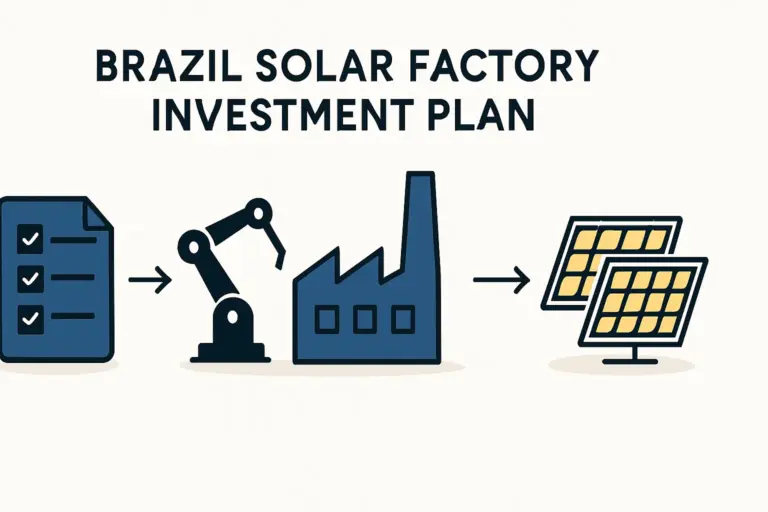
A Practical Investment Scenario: A 100 MW Factory in Manaus
To illustrate how these elements come together, consider a hypothetical 100 MW per year solar module factory. A venture of this scale requires a comprehensive approach, one that integrates German engineering with local operational excellence.
The Partnership Model:
A proven model for such a project involves a collaboration between an international technology provider and a local operational partner. For instance, an EU-based photovoltaic manufacturing solutions partner drawing on its decades of experience, can engineer and deliver a turnkey solar factory solution designed specifically to meet PPB standards.
This is complemented by the on-the-ground expertise of a partner like the an established European industrial solutions provider, who manage the complexities of Brazilian logistics, labor, and regulatory navigation. This dual approach mitigates risk for investors unfamiliar with the region.
Key Investment Parameters:
- Capacity: 100 MW per annum, scalable.
- Technology: A semi-automated production line optimized for efficiency and PPB compliance.
- Initial Investment: While the overall solar panel production line cost and setup for a facility of this size represents a significant capital expenditure, the return is structured around long-term tax advantages.
- Operational Strategy: The plan must include a detailed logistics framework for managing inbound components and outbound modules, a quality assurance system that meets international standards (like IEC), and a workforce training program.
Based on experience from gained from European PV manufacturers’ turnkey projects, such a factory can become operational within 12 to 18 months, from initial planning to the first certified module leaving the production line.

Frequently Asked Questions (FAQ)
What is the primary benefit of Manaus over other locations in Brazil?
The overwhelming advantage is financial. The combined IPI and ICMS tax incentives create a cost structure that is difficult to achieve anywhere else in the country, allowing for highly competitive pricing in the domestic market.
How complex is it to comply with the PPB?
PPB compliance is a strict, rules-based process. While it requires careful planning and documentation, the production steps are standardized. A well-designed production line and clear operational procedures make compliance a manageable, systematic part of operations.
What are the biggest operational risks in Manaus?
The most significant risks are logistical. Delays in river transport due to weather or other factors can impact production schedules. Political risk is another key consideration, as tax incentives are subject to government policy. However, the ZFM has been a cornerstone of regional policy for over 50 years, giving it a strong precedent of stability.
Is local expertise essential for a foreign technology partner?
Absolutely. While a company like experienced European turnkey engineering team can provide world-class engineering and machinery, navigating the specifics of Brazilian customs, labor laws, and Amazonian logistics requires deep local knowledge. A successful project depends on the seamless integration of international technology and local operational management.
Conclusion: Balancing Incentives with Operational Strategy
Establishing a solar module factory in the Manaus Free Trade Zone is a strategic decision that trades logistical complexity for exceptional financial incentives. It is not a venture for the unprepared, but for discerning entrepreneurs who recognize the value of a well-structured plan.
The opportunity in Brazil is clear, driven by fundamental economic pressures and energy needs. By leveraging the ZFM’s unique advantages and partnering with experienced technical and operational teams, an investor can build a highly competitive manufacturing business positioned for long-term success in one of the world’s most promising solar markets.
Download the Manaus Solar Factory Investment Case Study (PDF)
Author: This case study was prepared by the
turnkey solar module production specialists at J.V.G. Technology GmbH
It is based on real data and consulting experience from J.v.G. projects
worldwide, including installations ranging from 20 MW to 500 MW capacity.