Disclaimer: This case study represents a composite example derived from real-world
consulting work by J.v.G. Technology GmbH in solar module production and factory optimization. All data points are realistic but simplified for clarity and educational purposes.
Imagine a region with some of the highest solar irradiation levels in the world, a growing demand for renewable energy, and a government framework designed to encourage large-scale power generation. It’s an opportunity that awaits in Northeast Brazil.
For entrepreneurs and investors, the challenge is not whether the market exists, but how to enter it competitively. The answer lies in a manufacturing facility engineered to supply utility-scale projects at the lowest possible cost per watt.
This article outlines a strategic investment plan for a facility designed for regions like Bahia or Ceará. The proposed model leverages German engineering for production efficiency and capitalizes on regional fiscal incentives like SUDENE. Its entire structure is designed to compete in Brazil’s government-backed energy auctions.
The Strategic Advantage: Competing in Brazilian Energy Auctions
Brazil’s energy sector relies heavily on a system of energy auctions (Leilões de Energia) to contract new power generation capacity. During these auctions, developers bid to supply electricity at a specific price over a long-term contract, typically 15–20 years.
For a solar module manufacturer, this system presents a unique opportunity. By supplying the large-scale projects that win these auctions, a factory can secure high-volume, predictable demand.
Success, however, hinges on one critical metric: the final cost of energy. The modules must therefore offer the lowest possible cost per watt, making the factory’s efficiency and technology paramount. A well-structured solar panel manufacturing business plan is not just about production; it’s about aligning every aspect of the operation with the demands of this competitive auction environment.
Why Northeast Brazil?
-
High Solar Irradiation: States like Bahia, Ceará, and Pernambuco offer world-class solar resources, which makes solar projects in this region highly productive and economically attractive for developers.
-
SUDENE Fiscal Incentives: The Superintendency for the Development of the Northeast (SUDENE) offers significant tax incentives for industrial projects located in the region. This can include a reduction of up to 75% on corporate income tax for ten years, which dramatically improves the financial viability of a new factory.
-
Proximity to Demand: Establishing a factory in the Northeast places it close to the locations of many new utility-scale solar farms, reducing logistics costs and simplifying supply chains for project developers.
Facility Design: Engineering for the Lowest Cost per Watt
To compete effectively, a factory cannot simply assemble standard modules. It must be a highly optimized facility, designed from the ground up to produce large volumes of high-efficiency modules at minimal cost. The right engineering and technology selection are critical.
Based on experience gained from European PV manufacturers’ turnkey projects, a facility targeting the utility-scale market should have a capacity of at least 500 MW, with the potential to scale to over 1 GW. The design philosophy centers on two key areas:
- Advanced Module Technology
Utility-scale projects prioritize performance and longevity. The production line must be capable of manufacturing modules with the latest cell technologies, such as TOPCon (Tunnel Oxide Passivated Contact) or HJT (Heterojunction). These technologies deliver higher efficiency rates—generating more power from the same area—a key factor in a solar farm’s overall cost.
The line should also be designed for large-format modules (e.g., using M10 or G12 wafers), which are preferred in utility-scale installations for reducing installation and balance-of-system costs.
- High Degree of Automation
Achieving the lowest production cost requires optimizing labor and guaranteeing process consistency, and a high degree of automation is essential to do this. A modern turnkey solar panel production line designed for this purpose would integrate robotics for cell handling, stringing, bussing, and final assembly.
Automation not only reduces operational expenses but also minimizes the risk of human error, which leads to higher product quality and yield. This meticulous approach to the manufacturing process is fundamental to producing modules that meet the stringent requirements of 20-year power purchase agreements.
Breakdown of the Investment Plan
A comprehensive financial model is essential for securing funding and guiding the project. The total investment required to start a solar panel manufacturing plant of this scale is substantial, with the majority allocated to production equipment.
Here is a typical allocation of capital for a 500 MW to 1 GW facility:
-
Production Machinery (65–75% of Total Investment)
This is the largest single expense. It includes all equipment from the beginning to the end of the production line: glass loaders, laser scribers, automated stringers, laminators, framing machines, and advanced testing equipment like Sun Simulators and EL testers. Sourcing a fully integrated, high-automation line from an experienced German engineering partner like expert-led European solar project architecture and modeling firm ensures all components work together seamlessly for maximum throughput and efficiency. -
Building and Infrastructure (15–20%)
This includes the purchase or long-term lease of land and the construction of a suitable factory building (typically 10,000–15,000 square meters for a 500 MW line). The facility requires a controlled environment with specific climate control and cleanroom conditions, as well as robust utility connections for electricity, water, and compressed air. -
Working Capital and Raw Materials (10–15%)
Before the first module is sold, significant capital is needed to procure the initial inventory of raw materials. This includes solar cells, glass, EVA encapsulant, backsheets, and aluminum frames. This working capital also covers operational expenses during the ramp-up phase. -
Certifications and Licensing (1–2%)
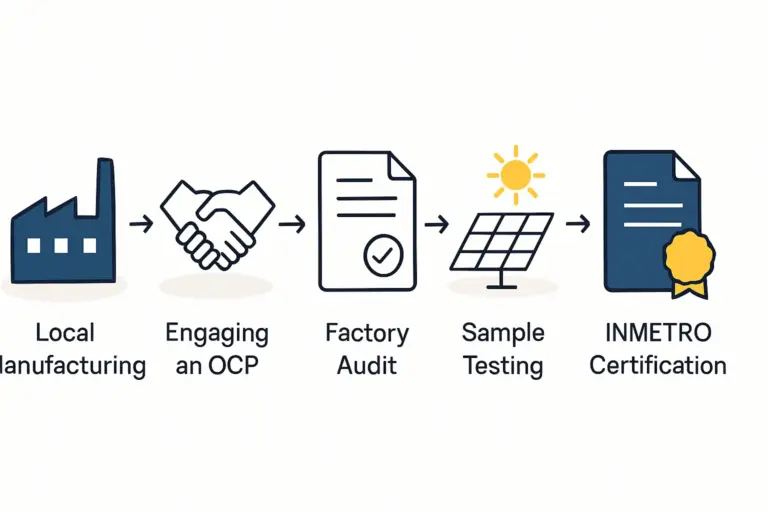
For the Brazilian market, obtaining INMETRO certification is mandatory. At the same time, achieving international certifications such as IEC 61215 and IEC 61730 is crucial for bankability and securing contracts with international project developers and financiers.
Frequently Asked Questions (FAQ)
What exactly are Brazilian energy auctions?
Energy auctions are a procurement mechanism used by the Brazilian government to contract new energy generation. Power producers (including solar farm developers) submit bids, and the government awards long-term power purchase agreements (PPAs) to the projects offering the lowest energy price. This provides a stable revenue stream for the winning projects.
How do SUDENE incentives work?
SUDENE offers a federal tax incentive for new industrial projects in the Northeast of Brazil. Approved projects can receive a 75% reduction in their IRPJ (Corporate Income Tax). This is a powerful tool for improving a project’s Internal Rate of Return (IRR) and shortening the payback period. The application is a formal process that should be integrated into the initial business plan.
What is the typical timeline for setting up such a factory?
From initial planning to full production, the timeline is typically 12 to 18 months. This includes:
- 3–4 months: Business planning, securing financing, and site selection.
- 6–8 months: Equipment manufacturing and delivery.
- 3–4 months: Building construction, equipment installation, and commissioning.
- 2–3 months: Staff training, production ramp-up, and certification processes.
Why is German engineering a key factor?
German engineering is globally recognized for its precision, reliability, and focus on efficiency. For a high-volume solar factory, this translates to production lines that are robust, highly automated, and optimized for maximum yield and minimum downtime. This reliability is essential when production targets are tied to large-scale infrastructure projects with strict delivery schedules.

Conclusion: A Strategic Entry into a Growing Market
Establishing a high-volume solar module factory in Northeast Brazil is a capital-intensive but strategically sound venture. By aligning the business model with the structure of the national energy auctions, investors can tap into a predictable, long-term demand stream.
Success will depend on a holistic approach: leveraging the region’s geographic and fiscal advantages, investing in highly automated and efficient production technology, and building a business case centered on delivering the lowest possible cost per watt. With a carefully engineered plan, such a facility can become a key supplier to Brazil’s renewable energy future.
Download the Northeast Brazil Solar Investment Blueprint (PDF)
Author: This case study was prepared by the
turnkey solar module production specialists at J.V.G. Technology GmbH
It is based on real data and consulting experience from J.v.G. projects
worldwide, including installations ranging from 20 MW to 500 MW capacity.