When considering a new venture, an entrepreneur’s focus often lands on the visible, high-value components: the machinery, the technology, the building itself. For a 50 MW solar module factory, this means gathering quotations for laminators and stringers.
But a successful business plan isn’t built on international equipment costs alone. In a market like the Democratic Republic of Congo (DRC), the project’s long-term profitability and viability are ultimately determined by a different set of numbers: the local operational costs.
Understanding these variables is what separates a theoretical plan from a resilient, real-world enterprise. This guide provides a framework for estimating the key local costs—from land and labor to utilities and logistics—that will shape the financial foundation of a solar factory in the DRC.
Table of Contents
Beyond the Bill of Materials: Why Local Costs Define Profitability
While the capital expenditure (CAPEX) for manufacturing equipment is relatively standard across the globe, operational expenditure (OPEX) is intensely local. These recurring monthly costs dictate a factory’s cash flow and are highly sensitive to the specific business environment.
For an investor in the DRC, accurately forecasting these costs is paramount. The country presents a unique combination of vast opportunity—high solar irradiation and immense energy demand—with significant operational challenges. A financial model that overlooks or miscalculates these local factors isn’t just incomplete; it’s unreliable. Based on experience from J.v.G. turnkey projects, a detailed analysis of the local cost structure is the most critical step after the initial market assessment.
Key Local Cost Variables for a Congolese Solar Factory
A robust financial model must dissect the primary categories of local expenditure. For a 50 MW facility, which typically requires a footprint of 5,000 to 7,000 square meters, these are the most significant considerations.
Land Acquisition and Development
The choice of location impacts nearly every other cost, from logistics to labor availability. In the DRC, securing land requires navigating a specific administrative process. According to the World Bank’s “Doing Business 2020” report, registering property involves roughly 10 procedures and can take around 79 days.
Key Considerations:
- Location Strategy: Proximity to major economic hubs like Kinshasa or port cities like Matadi is crucial for minimizing transport costs, both for imported raw materials and for distributing finished goods.
- Zoning and Permits: Working with the National Agency for the Promotion of Investments (ANAPI) can streamline the process. Industrial zones may offer pre-approved plots with better infrastructure, though often at a higher cost.
- Cost Estimation: Land costs vary dramatically. Your business plan should model scenarios for leasing versus purchasing, comparing prices in established industrial parks against the cost of developing a new site. The initial site preparation—grading, security fencing, and utility connections—must also be factored into the total investment.
Labor and Workforce Costs
The DRC has a large, available workforce, but a solar factory needs semi-skilled and skilled operators capable of managing sophisticated machinery. A realistic solar factory business plan must account for both initial and ongoing staff training.
Key Financial Inputs:
- Wages: While the official minimum wage (SMIG) is around 168,000 Congolese Francs (CDF) per month, competitive salaries for operators and technicians will be significantly higher to attract and retain qualified personnel. Budgeting for wages that reflect the required skill level is essential.
- Social Contributions: The legal framework, guided by OHADA (Organization for the Harmonization of Business Law in Africa), mandates employer contributions for social security and other benefits, adding roughly 13.5% or more to the gross salary cost.
- Training Investment: A significant initial budget must be allocated for training. This often involves bringing in external experts to prepare the first cohort of team leaders and machine operators, ensuring production quality and efficiency from day one. This is a direct investment in protecting the high value of the machinery.
Utilities: Electricity and Water
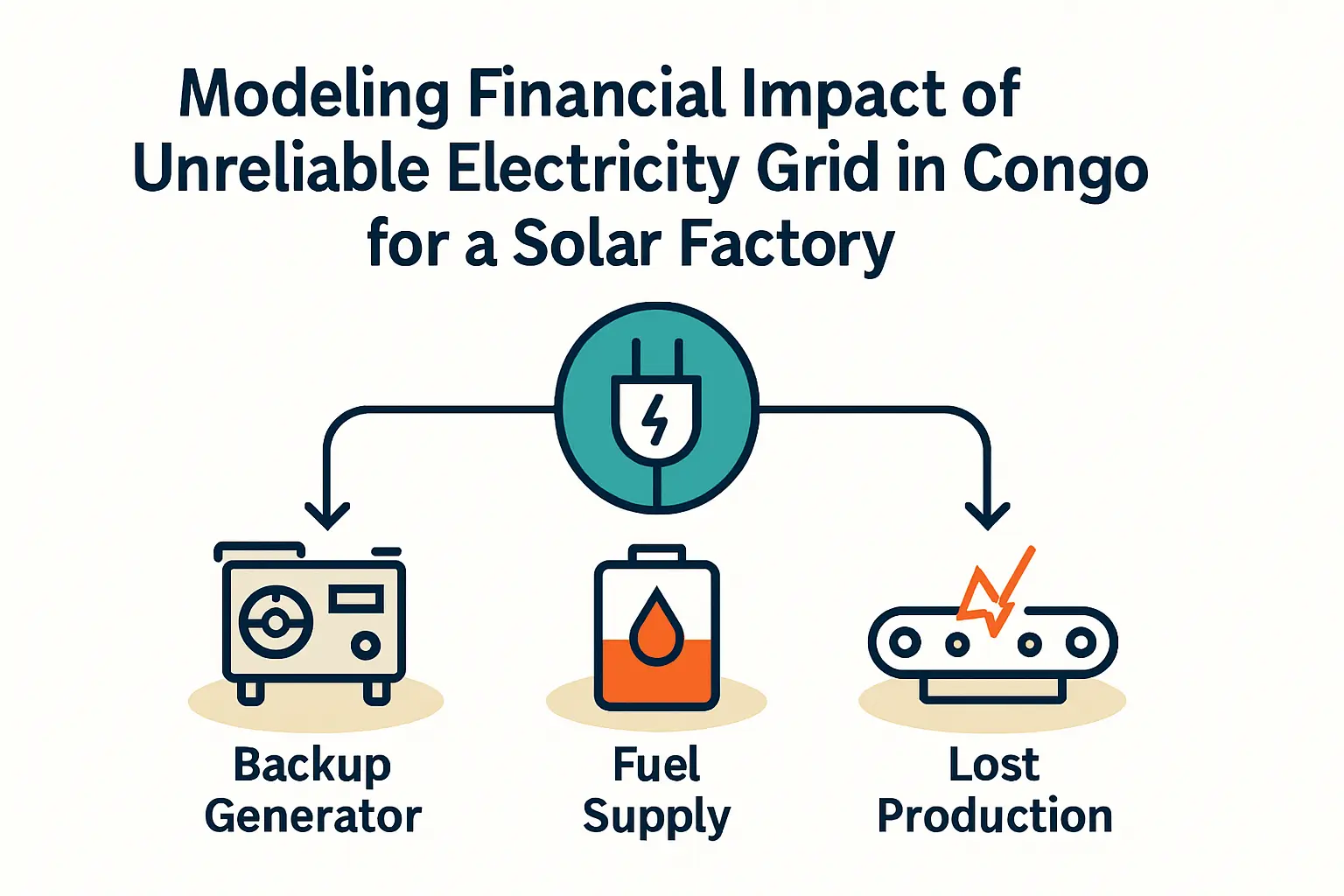
Perhaps the most critical operational challenge in the DRC is its energy infrastructure. The national utility, SNEL, faces considerable hurdles; the World Bank reports that only 41% of the urban population has access to electricity. A modern manufacturing facility simply cannot tolerate intermittent power.
Key Planning Points:
- Energy Redundancy: The factory’s financial model must assume the need for a fully independent power source. Grid power, where available, should be treated as a backup, not the primary supply.
- Cost of Self-Generation: The main options are large diesel generators or, fittingly, a dedicated solar-plus-storage system. While diesel entails a recurring fuel cost, a captive solar plant requires a higher initial CAPEX but provides predictable, low-cost energy for decades. This decision will have a profound impact on long-term OPEX.
- Water Supply: Consistent water access for cleaning and cooling processes must also be secured, potentially through boreholes and on-site storage if municipal services prove unreliable.
Logistics and Transportation
The DRC’s vast size and developing infrastructure make logistics a major operational cost center. The national road network is extensive, but with only around 10% paved, transit times and costs can escalate quickly.
Key Logistical Costs:
- Inbound Logistics: Raw materials like solar glass, EVA foil, and solar cells will be imported, likely through the port of Matadi. The costs of customs clearance, port handling, and inland freight to the factory site must be precisely calculated. A single 40-foot container from Matadi to Kinshasa represents a significant expense.
- Outbound Logistics: The cost of distributing finished solar modules to customers across the country will be a key component of the final product pricing.
- Equipment Impact: The choice of solar manufacturing equipment also influences logistics. The size and weight of machinery affect initial transport and installation costs, while the material efficiency of the chosen technology impacts the volume of raw materials to be managed each month.
Synthesizing the Data: Building a Preliminary Financial Model
By researching and estimating these local variables, you can begin to construct a preliminary monthly OPEX model. The following is a simplified, illustrative example for a 50 MW factory in the DRC:
- Land & Building (Lease/Amortization): $15,000 – $25,000 USD.
- Labor (60 employees, including salaries & social charges): $30,000 – $50,000 USD.
- Utilities (Diesel for generators / Backup Grid): $20,000 – $40,000 USD.
- Local Logistics & Transport (Inbound/Outbound): $10,000 – $20,000 USD.
- Other (Local Taxes, Security, Maintenance): $10,000 – $15,000 USD.
Estimated Total Monthly Local OPEX: $85,000 – $150,000 USD.
This range illustrates that local costs can easily exceed $1 million USD annually. These figures are fundamental to calculating the production cost per watt and determining the factory’s competitiveness in the market.
Frequently Asked Questions (FAQ)
What are the main challenges when investing in Congo’s manufacturing sector?
The primary challenges relate to infrastructure, particularly unreliable electricity and underdeveloped transportation networks. Navigating the administrative and bureaucratic procedures for permits and registration also requires careful planning and local expertise.
How does the government support foreign investment?
The DRC’s Investment Code offers various incentives for strategic sectors like manufacturing. ANAPI is the primary government body responsible for assisting investors, and potential benefits can include tax exemptions on imported equipment and other fiscal advantages for a specified period.
Can a 50 MW factory be profitable in this environment?
Yes, profitability is achievable if the business plan is grounded in realistic projections. Success depends on accurately modeling local operational costs, securing a reliable power supply, establishing efficient supply chains, and targeting the right market segments, such as the rapidly growing commercial and industrial off-grid sector.
What is a realistic timeline from planning to production?
While ordering and receiving machinery may take 6-8 months, local factors often dictate the overall timeline. Securing land, obtaining building permits, constructing the facility, and clearing equipment through customs can add several months. A realistic project timeline from the initial decision to the first module output is typically 12 to 18 months. A detailed understanding of the solar panel manufacturing process is essential for accurate project scheduling.
Next Steps in Your Investment Journey
This guide provides a foundational framework for understanding the critical local cost drivers for a solar factory in the Democratic Republic of Congo. For any serious entrepreneur, the next step is to move from general estimates to precise, verifiable data.
This requires conducting a detailed feasibility study, including on-the-ground research to obtain firm quotations for land, construction, and transportation. Engaging with local business consultants and legal experts is essential for navigating the administrative landscape effectively.
To transform your ambitious vision into a bankable project, explore the structured courses and resources on pvknowhow.com. We are here to guide you through this complex planning phase.