Imagine a newly commissioned solar module factory in Kinshasa, equipped with modern machinery and a trained workforce, ready to begin production. Suddenly, the entire facility goes dark. A power outage—a common occurrence in the city—brings the lamination process to an abrupt halt, ruining an entire batch of modules and idling dozens of employees. This scenario highlights a critical paradox: a factory built to advance renewable energy can be crippled by an unreliable power supply.
For any entrepreneur planning to establish a solar module manufacturing facility in the Democratic Republic of Congo, addressing the power supply isn’t a secondary consideration—it’s a foundational pillar of the business plan. This guide breaks down the energy challenges specific to Kinshasa and evaluates the most viable solutions for ensuring the 24/7 operational continuity that high-tech manufacturing demands.
The Non-Negotiable Need for 24/7 Power in Solar Manufacturing
Unlike many other industries where production can pause and restart with minimal losses, a modern solar module manufacturing plant relies on processes that are highly sensitive to interruption.
Key production stages such as cell stringing, bussing, and especially lamination require a continuous, stable supply of electricity. An outage during the lamination cycle, for example, can lead to improperly cured modules that must be discarded. The result is direct material losses, decreased output, and significant financial setbacks. Ultimately, maintaining production quality, meeting output targets, and ensuring the venture’s profitability all hinge on a consistent power supply.
The Kinshasa Grid: An Assessment for Industrial Use
The scale of the challenge becomes clear when examining the public electricity infrastructure. While the DRC possesses an estimated 100,000 MW of hydropower potential, less than 3% of this is currently developed. The national utility, Société Nationale d’Électricité (SNEL), manages an aging grid that struggles to meet existing demand.
According to a 2021 World Bank Group report, grid access in Kinshasa stands at approximately 44%, but even for connected customers, service is unreliable. The report cites ‘frequent and prolonged power outages, load shedding, and voltage fluctuations’ as systemic issues rooted in decades of underinvestment and infrastructure decay.
For a manufacturing operation requiring several hundred kilowatts of stable power, relying solely on the SNEL grid is not a viable strategy. The frequency and unpredictability of outages pose an unacceptable operational risk.
Evaluating Power Supply Alternatives
Given the limitations of the public grid, prospective factory owners must engineer a private power solution. The decision comes down to three primary models, each with distinct operational and financial implications.
Option 1: Grid-Only Supply
This option is the simplest but also the least viable. While SNEL’s tariffs may be economically attractive, the unreliability of the supply makes it unsuitable for continuous manufacturing. The financial losses from a single day of forced downtime would quickly negate any savings on electricity costs.
Conclusion: Not recommended for industrial manufacturing.
Option 2: Diesel Generator as the Primary Source
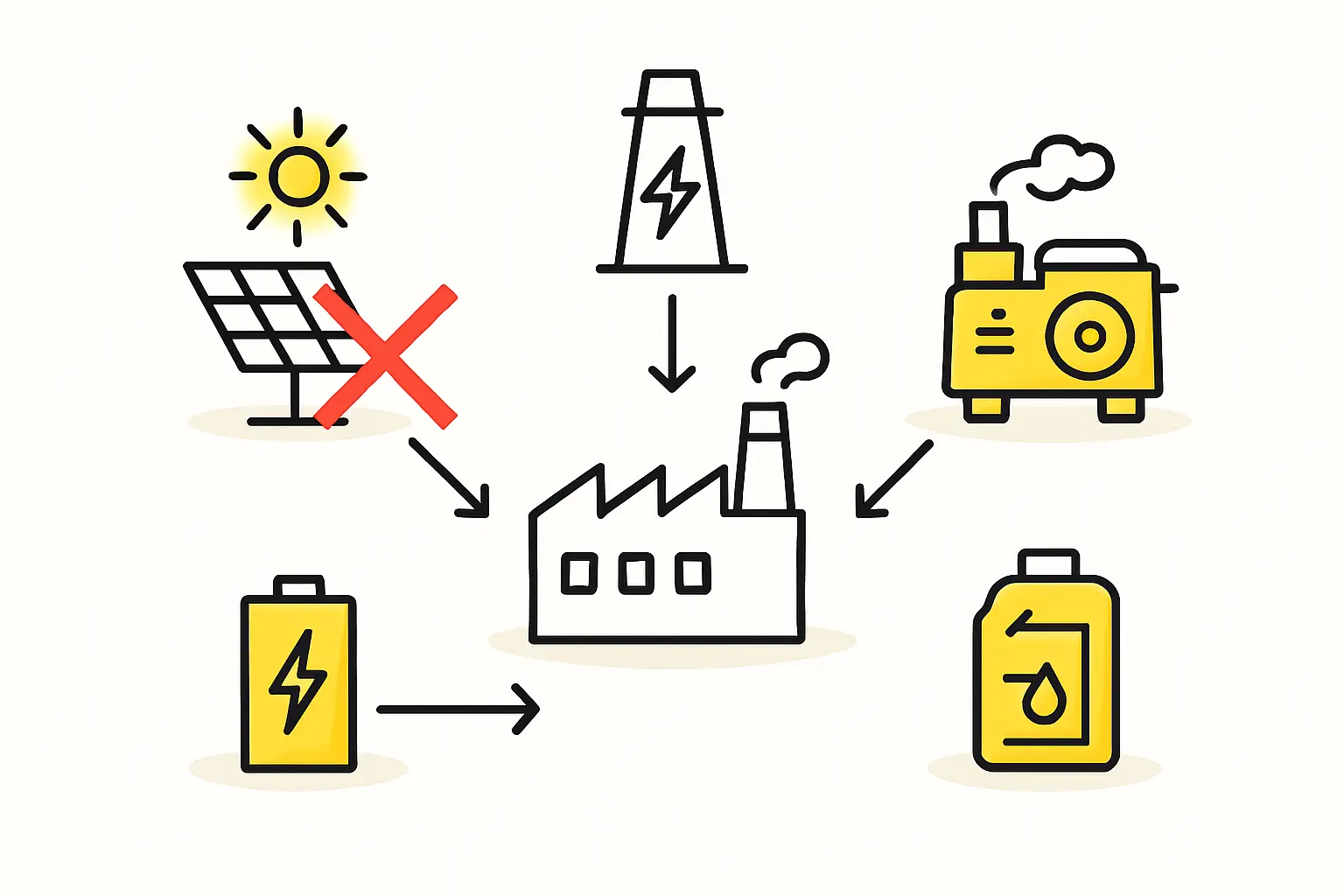
The most common solution for businesses across Kinshasa is the use of on-site diesel generators, or groupes électrogènes. This approach provides complete independence from the grid, guaranteeing power as long as fuel is available.
Advantages:
- Reliability: A well-maintained generator set can provide 100% uptime.
- Control: The factory has full control over its power supply.
Disadvantages:
- High Operational Cost: Diesel fuel is a major and volatile expense that directly impacts the cost per module produced.
- Logistics: Requires a reliable fuel supply chain, on-site storage tanks, and robust logistics management.
- Maintenance: Generators require regular, specialized maintenance, adding to operational complexity and cost.
While a diesel generator is an essential component for backup power, relying on it as the primary source can make the factory’s products less competitive due to high energy costs. This expense must be carefully factored into the initial investment and long-term financial projections.
Option 3: A Hybrid Power System (Grid, Diesel, and Solar)
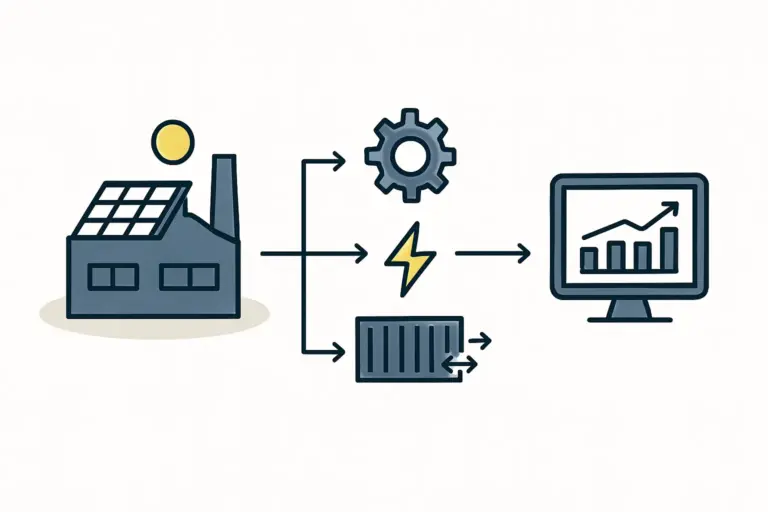
A hybrid system offers the most resilient, cost-effective, and strategic solution for a solar factory in Kinshasa. It intelligently combines three power sources to optimize reliability and cost.
 solar PV inputs feeding into a factory, highlighting the role of a central power management system.” />
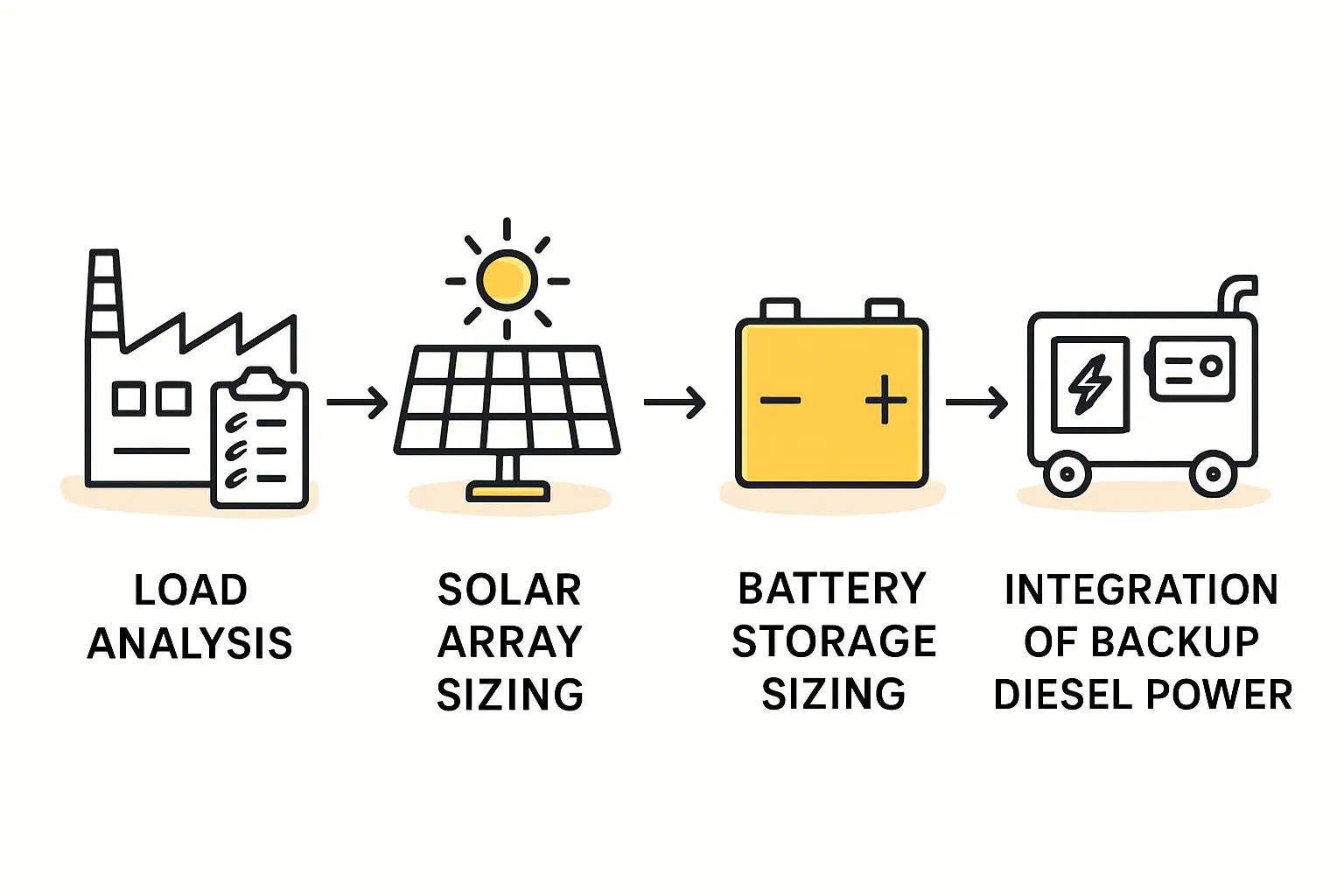
This integrated model operates on a clear logic:
- Grid Power: Use the grid as the primary source when it is available and stable, as it is usually the lowest-cost option.
- Captive Solar PV System: Generate a significant portion of the factory’s energy needs during daylight hours with a solar installation on the factory’s roof or adjacent land. This directly reduces consumption from the grid and the diesel generator.
- Diesel Generator: Rely on the generator as the ultimate backup, automatically engaging during grid outages at night or on overcast days to ensure uninterrupted operation.
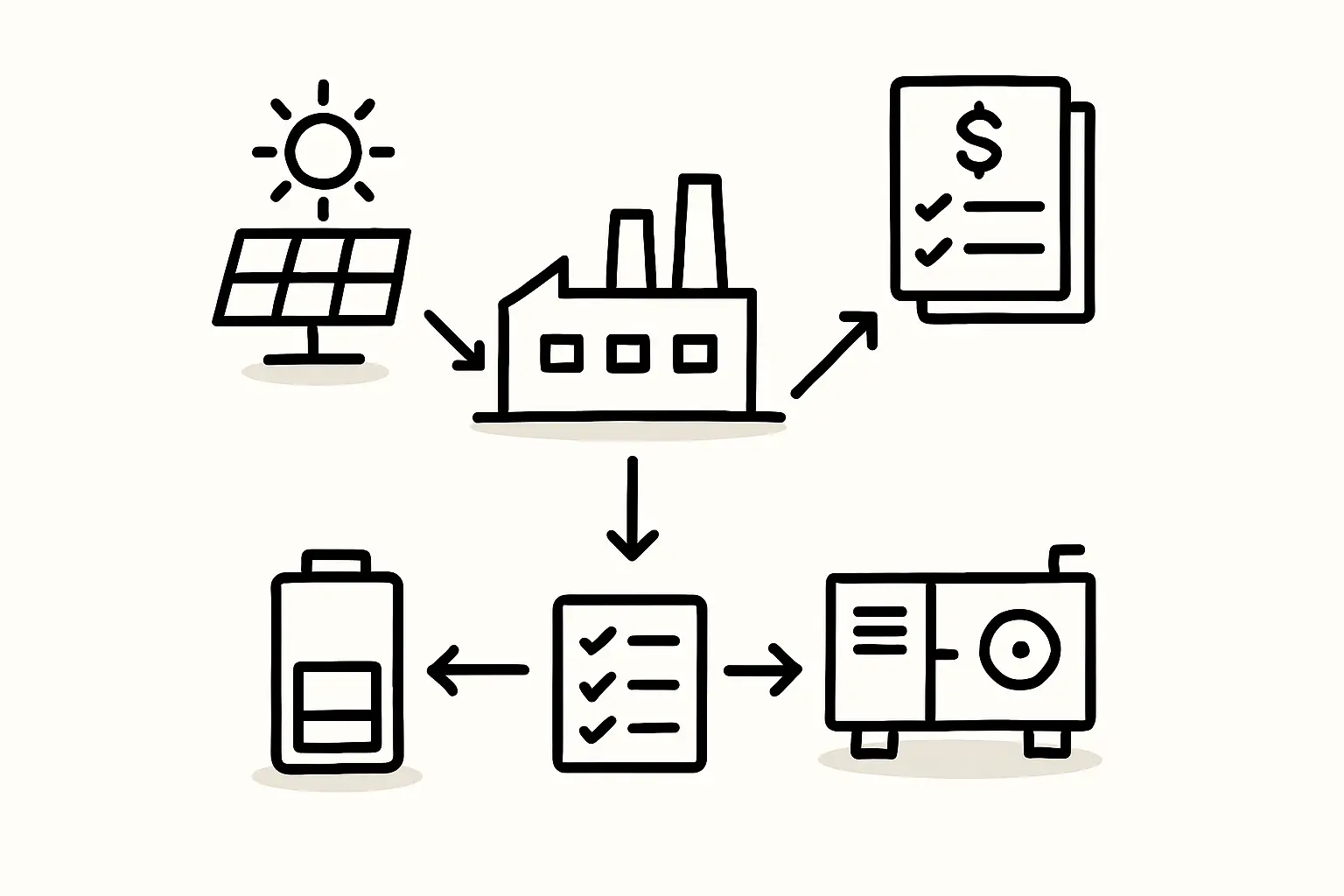
This hybrid approach turns the factory into a showcase for its own products—using solar power to manufacture solar panels. It also drastically cuts diesel consumption, reduces energy cost volatility, and provides a powerful marketing and sustainability narrative.
Planning Your Factory’s Power Infrastructure
The design and implementation of a robust power system should be integrated into the earliest stages of planning the factory building and infrastructure. Accurately calculating the turnkey production line’s total power load is crucial to correctly size the generator, solar PV system, and supporting electrical components.
Based on experience from J.v.G. turnkey projects, underestimating power requirements is a common and costly planning error. A thorough energy audit and system design from experienced engineers are critical for avoiding future bottlenecks and ensuring the facility can operate at its full planned capacity.
Frequently Asked Questions (FAQ)
What is the typical power consumption of a 50 MW solar factory?
A semi-automated 50 MW production line typically requires a continuous power supply of 250 to 400 kW, depending on the specific machinery and level of automation. This demand must be met 24 hours a day during production shifts.
Can a factory run on solar power alone?
Not for a 24/7 manufacturing operation. Since solar power is generated only during daylight hours, a reliable secondary source is necessary to cover night shifts and sunless periods. A diesel generator is the most common and economically viable backup solution today, though a very large and expensive battery storage system is another possibility.
How much does a reliable hybrid power system add to the initial investment?
The cost is significant but should be viewed as essential infrastructure. A captive solar system and a correctly sized industrial generator can represent a substantial part of the initial budget. However, the return on investment comes from reduced operational costs (less diesel fuel) and the elimination of costly production downtime.
Is it better to oversize the diesel generator?
The generator must be sized to handle the factory’s peak load, including the start-up current of all machines. A slightly oversized generator provides a buffer for future expansion and ensures it does not run at maximum capacity continuously, which can extend its lifespan. However, significant oversizing can lead to inefficient fuel consumption. Professional load calculation is key.
Conclusion: From Power Challenge to Competitive Advantage
While Kinshasa’s public grid presents a significant challenge, it need not prevent the successful operation of a solar module factory. By adopting a well-engineered hybrid power strategy, an entrepreneur can transform a potential vulnerability into a source of strength. A reliable, cost-optimized power supply ensures production continuity, protects the investment in machinery, and helps manage operational expenditures.
Ultimately, solving the power challenge is the first step toward building a resilient and profitable manufacturing business capable of serving the growing demand for clean energy in the DRC and beyond.