Imagine your new, multi-million-dollar solar module factory is fully commissioned. Highly automated stringers and state-of-the-art laminators stand ready. Production begins, but just hours into the first shift, the entire facility goes dark. A power outage on the national grid has halted your operation, leaving expensive machinery idle and putting your production schedule at immediate risk.
For any entrepreneur planning to establish a manufacturing facility in a region with grid challenges like the Democratic Republic of Congo (DRC), this scenario isn’t a distant possibility. It’s a primary operational risk that must be addressed from day one.
While the DRC possesses immense potential for solar energy, its national grid is notoriously unreliable. This guide examines the critical importance of power infrastructure for a solar module factory. We analyze how a hybrid power system—combining the grid with on-site solar and battery storage—can transform this risk into a strategic advantage, ensuring continuous operation and protecting your investment.
Table of Contents
The Paradox: Building Solar Panels Without Reliable Power
The core challenge presents a paradox: a facility designed to produce power-generation technology is itself vulnerable to power instability. The sophisticated equipment in a solar module manufacturing line is sensitive to power fluctuations and interruptions. A sudden loss of power during a lamination cycle, for instance, can result in lost materials and potentially damage the equipment itself.
This challenge is magnified in the DRC, where the World Bank reports that only 19% of the population has access to electricity. Even when a connection is available for industrial users, it is often marked by frequent outages and voltage instability. Relying solely on the national grid is therefore not a viable strategy for a capital-intensive operation like a solar factory.
Understanding the Factory’s Power Demand
Designing a solution begins with understanding the factory’s energy needs. A typical semi-automated factory with a production capacity of 20–50 MW per year has a peak power demand between 250 and 500 kilowatts (kW).
This consumption is not constant. The highest demand occurs when specific machines, like the laminator, enter their heating-up phase. The rest of the production cycle requires a significantly lower yet steady supply of power. A viable power solution must handle these peaks while providing a stable baseline supply throughout operations.
Analyzing the Options for Power Infrastructure
An investor has three primary options for powering a factory in a region with an unstable grid, each with a distinct risk and cost profile.
Option 1: Sole Reliance on the National Grid
This approach involves connecting directly to the local utility and accepting the associated risks. While it has the lowest initial capital expenditure, the potential costs from lost production during frequent outages can quickly outweigh these savings. Data from the World Bank indicates that businesses in Sub-Saharan Africa lose a significant percentage of annual sales due to electrical outages. For a manufacturer, this risk is simply too high.
Option 2: Diesel Generator Backup
A common solution is to use diesel generators as a backup. When the grid fails, the generator starts and powers the factory. While this approach provides operational continuity, it comes with several significant drawbacks:
- High Operational Costs: Diesel fuel is expensive, and its price can be volatile.
- Logistical Complexity: Ensuring a constant supply of quality fuel can be difficult in regions with underdeveloped transport infrastructure.
- Maintenance: Generators require regular, skilled maintenance to remain reliable.
- Environmental Impact: Emissions and noise can be significant concerns.
Option 3: A Hybrid Grid-Tied System with Solar and Battery Storage
The most resilient and increasingly cost-effective solution is a hybrid power system, integrating three components: the national grid, an on-site solar PV array, and a Battery Energy Storage System (BSS).
Here’s how it works:
- Primary Power from the Grid: When the national grid is stable, the factory draws power from it, as this is typically the most cost-effective source.
- Solar Generation for Self-Consumption: During daylight hours, the factory’s solar array generates electricity used directly on-site. This reduces the amount of electricity purchased from the grid and lowers operational costs.
- Battery Storage for Backup and Peak Shaving: Excess solar energy is stored in the batteries. If the grid fails, the battery system instantly takes over, providing uninterrupted power. The batteries can also supply extra power during peak demand, helping avoid higher utility tariff charges.
Feasibility studies for projects in Central Africa show this model provides the highest level of energy security and the best long-term financial performance.
The Business Case for a Hybrid Power Solution
A hybrid power system should not be viewed merely as an expense; it is a strategic investment in operational resilience that delivers a clear return. The total investment needed to start a solar panel factory should always account for a robust, independent power solution.
Calculating the Return on Investment (ROI)
The ROI for a hybrid system is driven by three factors:
- Averted Production Losses: The most significant return comes from avoiding downtime. If a factory produces 50 modules per hour at a net value of $50 each, an eight-hour outage represents a $20,000 loss. Preventing just a few such outages per year can justify a substantial portion of the system’s cost.
- Reduced Electricity Bills: By generating its own solar power, the factory significantly reduces its reliance on the grid. In many African nations where electricity tariffs for industrial users are high, these savings can be substantial, directly improving profitability.
- Enhanced Predictability: The system provides budget certainty by insulating the factory from volatile fuel prices and unpredictable utility rate hikes.
Enhancing Operational Resilience
Beyond direct financial returns, energy independence builds a more robust and competitive business. A factory that can guarantee its production schedule, regardless of external grid conditions, becomes a more reliable partner for its customers.
A stakeholder on a similar project noted that securing the power supply was the single most important factor in meeting first-year production targets, insulating the operation from local infrastructure challenges.
Practical Steps for Planning Your Factory’s Power System
Planning the right power system requires a structured approach.
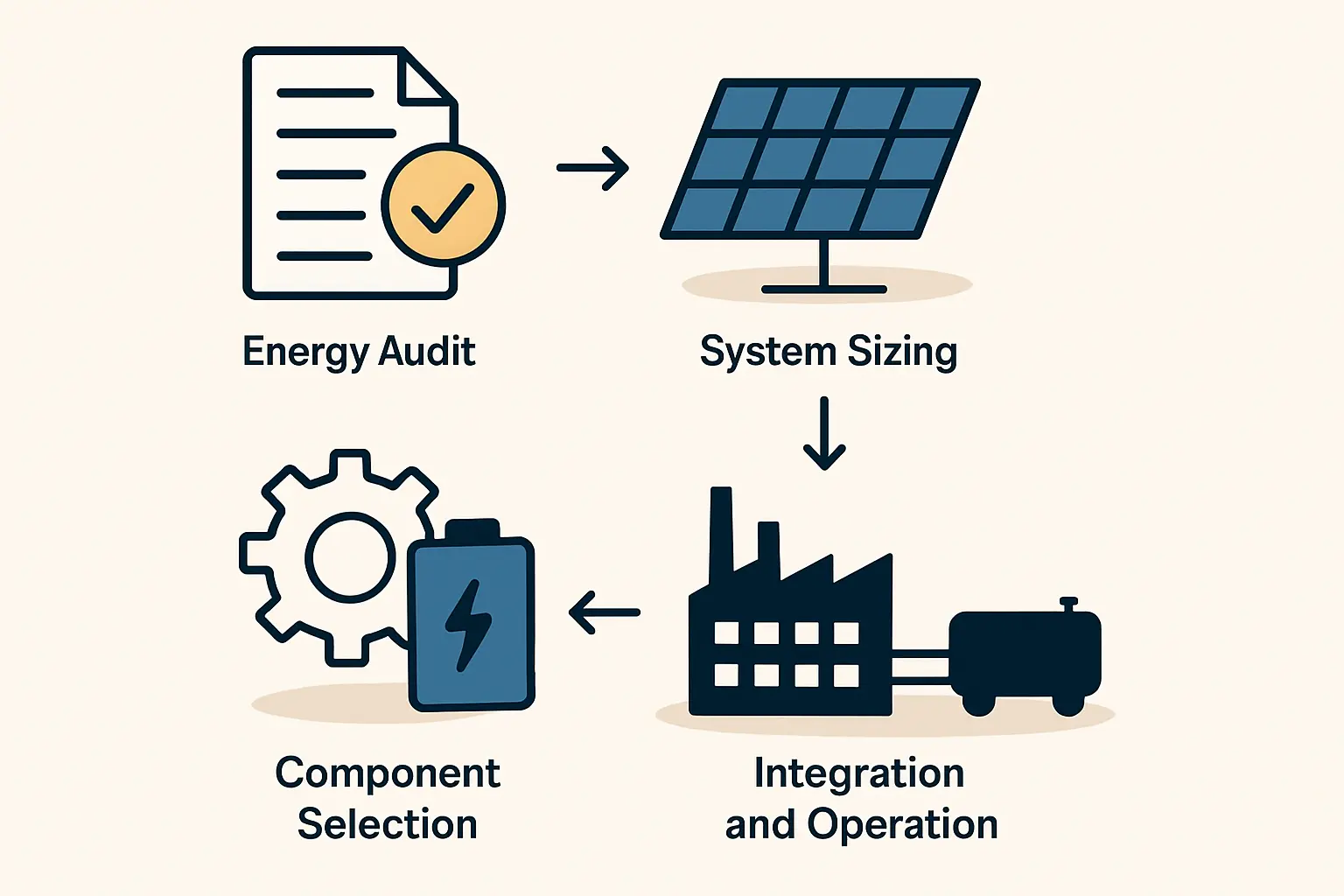
- Conduct a Detailed Load Analysis: Work with an engineering partner to precisely map the power consumption profile of your chosen machinery. This analysis is fundamental to sizing your system correctly.
- Assess Local Grid Conditions: Obtain reliable data on the frequency, duration, and time of day of power outages in your specific location.
- Model Different System Configurations: Analyze the economic trade-offs. A larger solar and battery system provides more autonomy but requires a higher initial investment. The optimal size will balance cost with the desired level of risk mitigation.
- Integrate into Your Business Plan: The costs and benefits of the hybrid power system must be fully integrated into your factory’s financial projections from the outset. The e-learning courses available on pvknowhow.com provide structured guidance on developing a comprehensive business plan that accounts for such critical infrastructure needs.
Frequently Asked Questions (FAQ)
How much land is required for the factory’s solar array?
As a general rule, a 100-kilowatt peak (kWp) solar array requires approximately 1,000 square meters (about 0.25 acres) of space. A system for a 20-50 MW factory would likely be several times this size, depending on the desired level of autonomy.
What is the typical lifespan of a Battery Energy Storage System (BESS)?
Modern lithium-ion battery systems designed for industrial use typically have a lifespan of 10 to 15 years or a specific number of charge-discharge cycles. This longevity is a key factor for a positive long-term ROI.
Can the factory operate entirely off-grid on solar and batteries?
While technically possible, it’s usually not the most economical solution. An off-grid system would need to be oversized to handle consecutive cloudy days, significantly increasing the initial investment. A hybrid approach—using the grid when available and the on-site system for backup and cost reduction—typically offers the best balance of reliability and cost. For more information, the guide on solar panel factory building requirements covers land and infrastructure considerations.
For any entrepreneur considering a solar factory in the DRC or a similar market, planning for grid instability is not optional—it is fundamental to success. A hybrid power system is not a liability but a critical asset. It provides the operational certainty required to protect a significant capital investment, ensuring your factory can run continuously and profitably, powered by the very energy technology it produces.
With a structured approach and the right expertise, this complex challenge can be effectively managed.