For an entrepreneur entering the solar manufacturing sector in Equatorial Guinea, one of the first and most critical decisions is not about technology, but geography. The choice between establishing a factory in the administrative capital, Malabo, or the economic hub, Bata, will fundamentally shape the project’s logistics, costs, and operational timeline. This is more than a simple location preference; it is a strategic choice between governmental proximity and industrial scale.
Understanding the nuances of land acquisition and permitting in these two distinct environments is a foundational step. Equatorial Guinea’s national development plan, Horizon 2035, actively encourages foreign investment to diversify its economy beyond hydrocarbons, with a significant focus on renewable energy, presenting a clear opportunity for the prepared investor.
Understanding the Investment Landscape in Equatorial Guinea
Before comparing locations, it’s important to grasp the national framework governing investment and land use. The government has established specific laws and agencies to facilitate foreign direct investment (FDI).
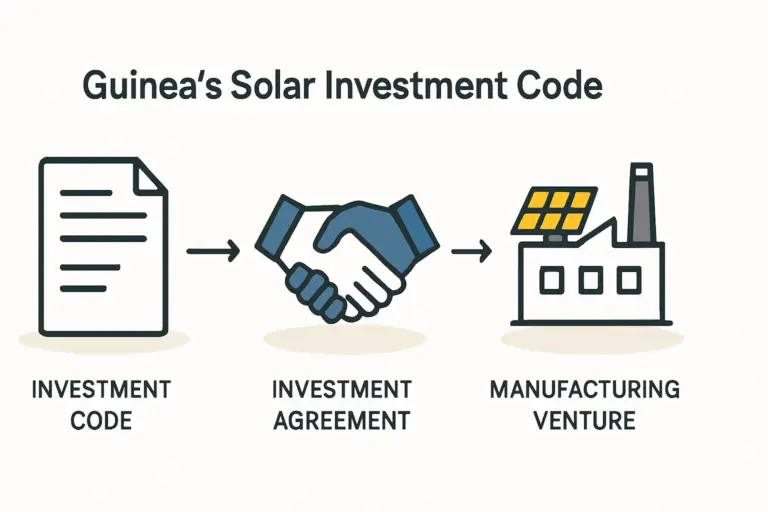
The primary legal instruments are the Investment Law (Law No. 7/1992), which provides guarantees to foreign investors, and the Public-Private Partnership Law (Law No. 1/2020), which opens avenues for collaboration on larger infrastructure projects.
Crucially, all land in Equatorial Guinea is state-owned, as private ownership is not an option for foreign investors. Instead, businesses secure long-term surface rights through a concession or lease agreement with the state. This model, common in many regions, provides the security needed for a significant capital investment in a factory.
To streamline the process, the government established the A.N.G.E. 2035 (Agencia Nacional de Guinea Ecuatorial 2035) agency. This body acts as a “one-stop shop” for investors, guiding them through administrative requirements and coordinating with various ministries.
Malabo vs. Bata: A Strategic Site Selection Analysis
The choice between Malabo and Bata hinges on balancing the unique advantages and challenges each location presents.
Malabo (Bioko Island): The Administrative and Logistical Hub
Located on Bioko Island, Malabo is the nation’s capital and the center of government administration and international commerce.
Advantages:
-
Proximity to Government: Being in the capital offers direct access to central government ministries, simplifying high-level approvals and engagement with regulators.
-
Developed Infrastructure: Malabo boasts a well-established international airport and a modern deep-sea port, simplifying the import of machinery and the export of finished solar modules.
-
Established Business Services: The city has a higher concentration of legal, financial, and logistical support services accustomed to working with international companies.
Considerations:
-
Higher Costs: Land is scarcer and therefore more expensive. Operating costs, from labor to logistics, are also typically higher than on the mainland.
-
Bureaucratic Density: While access to ministries is a benefit, it can also mean navigating a denser, more complex administrative environment.
-
Limited Space: Finding large plots of land suitable for a large-scale, expandable factory can be challenging.
A facility in Malabo is often best suited for assembly-focused operations heavily dependent on import/export, or for investors who prioritize close ties with government bodies.
Bata (Río Muni): The Industrial Powerhouse
Situated on the mainland (Río Muni), Bata is the country’s largest city and its designated economic and industrial capital.
Advantages:
-
Industrial Focus: The government is actively promoting Bata as the center for industrial development, often resulting in more aligned support from local authorities.
-
Land Availability and Cost: Significantly more land is available for industrial use at a lower cost, allowing for a larger solar-factory-layout-design and future expansion.
-
Growing Infrastructure: While historically less developed than Malabo, Bata’s port and road networks are undergoing significant upgrades to support its industrial growth.

Considerations:
-
Logistical Planning: Although improving, regional logistics require careful management to ensure reliable transport links for both materials and products.
-
Distance from Central Government: Routine engagement with central ministries in Malabo will require travel, adding a layer of logistical complexity.
-
Developing Service Sector: The ecosystem of professional services, while growing, is not as mature as in Malabo.
Bata is the logical choice for investors planning a large-scale manufacturing facility, especially when production capacity, scalability, and lower land costs are the primary drivers.
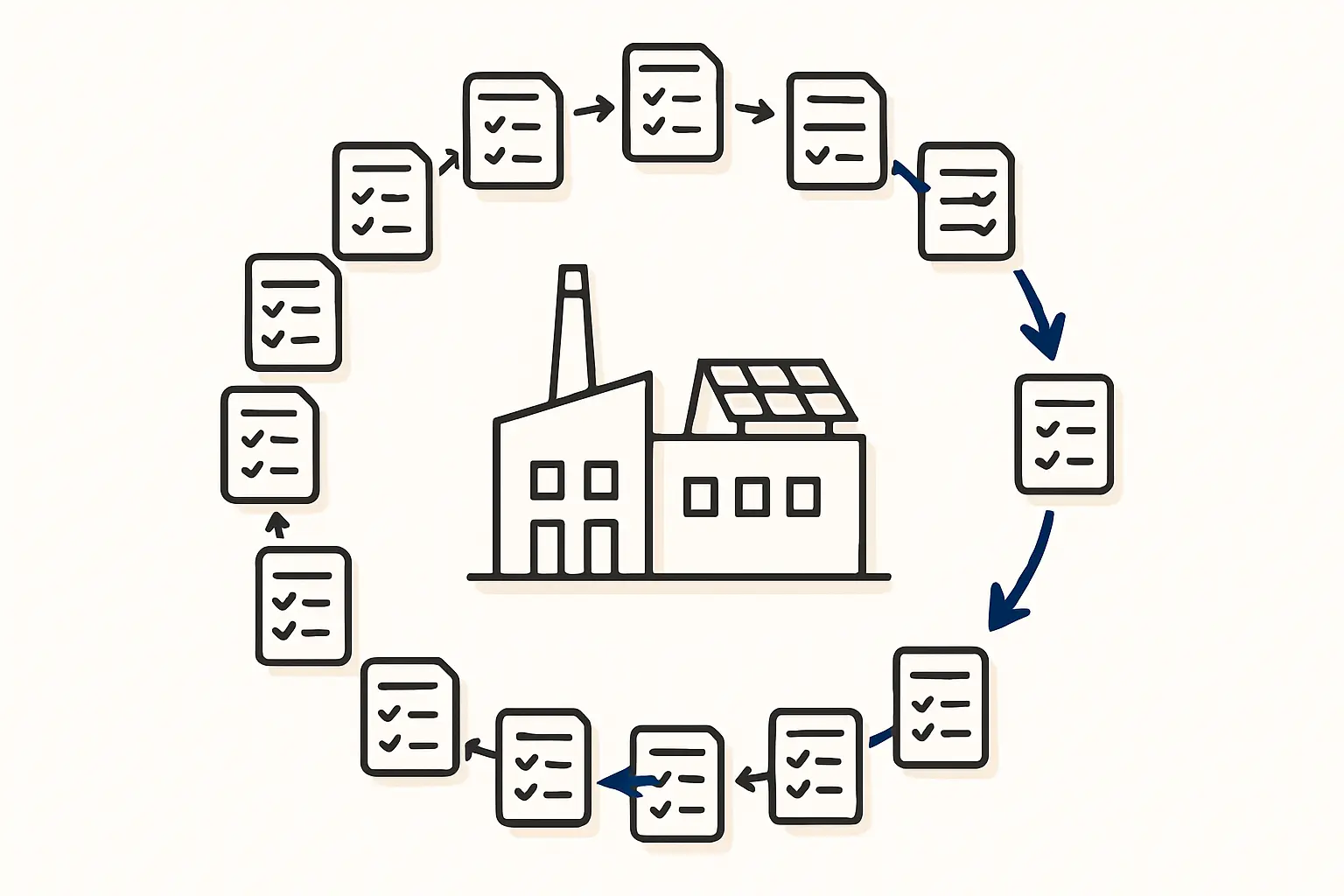
The Process: Acquiring Land and Construction Permits
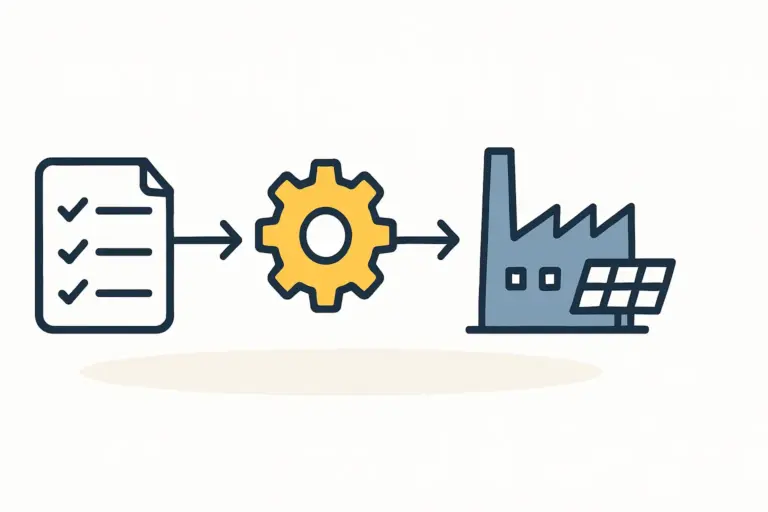
Regardless of the chosen location, the administrative process follows a similar path, requiring a methodical, well-documented approach. Experience from J.v.G. turnkey projects shows that a clear understanding of these steps is vital for managing timelines and expectations.
-
Formal Engagement with A.N.G.E. 2035: The process officially begins when the investor submits a detailed project proposal outlining the business case, technical scope, and the overall solar-factory-investment-cost.
-
Site Identification and Due Diligence: In coordination with A.N.G.E. 2035 and local municipalities (Ayuntamientos), a suitable plot of land is identified. At this stage, it is critical to conduct thorough due diligence to confirm the land’s legal status and verify it is free from any prior claims.
-
Application for Land Concession: The investor submits a formal application for surface rights to the relevant land authority. This includes site plans, project duration, and evidence of financial capacity.
-
Environmental Impact Assessment (EIA): For any industrial project, an EIA is a mandatory step. An accredited local firm must conduct the assessment, which is then submitted to the Ministry of Agriculture and Environment for approval.
-
Submission of Building Plans: Detailed architectural and engineering plans for the factory must be submitted to the Ministry of Public Works, Housing and Urban Planning, as well as the local municipal authority in Malabo or Bata.
-
Issuance of Construction Permit: Once all plans are approved and fees are paid, the final construction permit is issued. Only then can work commence on installing the turnkey-solar-panel-production-line.
Common Challenges and How to Mitigate Them
Investors entering any new market should anticipate hurdles. In Equatorial Guinea, these often relate more to administrative processes than to technical ones.
-
Bureaucratic Delays: The permitting process can be lengthy. To mitigate this, investors should start well in advance, maintain meticulous documentation, and work through A.N.G.E. 2035 to follow up regularly with the various ministries.
-
Navigating Local Nuances: A reliable local partner or legal advisor is invaluable. They can provide insight into local administrative customs and help ensure all submissions meet the specific requirements of each department.
-
Ensuring Transparency: All interactions should be conducted through official channels. Working closely with A.N.G.E. 2035 helps ensure the process remains transparent and compliant with national regulations.
These challenges are manageable with careful planning and expert guidance, and should be factored into the project timeline and budget from the very beginning.
Frequently Asked Questions (FAQ)
Can a foreign company own land directly in Equatorial Guinea?
No. Foreign entities cannot own land outright. However, they can secure long-term (e.g., 30-99 years) surface rights through a land concession from the state, which provides the legal security required for factory construction and operation.
How long does the land and permit process typically take?
The timeline can vary significantly based on project complexity and the efficiency of follow-up. A realistic estimate ranges from 6 to 18 months from initial engagement to receiving the final construction permit.
What is the primary role of A.N.G.E. 2035?
A.N.G.E. 2035 serves as the central coordinating body and facilitator for foreign investors, simplifying the investment process by acting as a single point of contact between the investor and the various government ministries involved.
Are there special economic zones (SEZs) available?
As part of the Horizon 2035 plan, the government is developing SEZs to further attract industrial investment. Investors should inquire with A.N.G.E. 2035 about the current status and potential incentives available in designated zones near Malabo or Bata.
Conclusion and Next Steps
The decision between Malabo and Bata is a critical first step for any investor planning a solar module factory in Equatorial Guinea. Malabo offers unparalleled logistical and administrative convenience, while Bata provides the space and industrial focus for large-scale production.
Neither choice is inherently better; the optimal decision depends entirely on the project’s specific business model, production scale, and logistical strategy. By understanding the legal framework, engaging with the right authorities like A.N.G.E. 2035, and performing meticulous due diligence, an investor can confidently navigate the process of securing land and permits.
This initial phase of site selection and permitting is foundational. A thorough grasp of these preliminary steps is essential for building a successful venture. Further educational resources on pvknowhow.com provide structured guidance on the subsequent phases, from detailed facility planning to equipment procurement and operational readiness.