An investor bids on a large-scale solar project in France. His proposal is competitive, based on high-quality, cost-effective modules from a leading global supplier.
A second investor also submits a bid. His proposed electricity price is slightly higher, but the solar modules he plans to use are made in France. Against conventional wisdom, it’s the second investor who wins the contract.
This scenario isn’t hypothetical—it reflects the strategic reality of France’s renewable energy market. The French government, through its ‘Commission de Régulation de l’Énergie’ (CRE), has designed a tender system that looks beyond price, systematically rewarding projects that use solar modules with a low carbon footprint. This criterion creates a significant, built-in advantage for local and European manufacturers. For any entrepreneur or investor eyeing the solar manufacturing space, understanding this dynamic is crucial.
What is the CRE and Why Does It Matter for Solar Investors?
The ‘Commission de Régulation de l’Énergie’ (CRE) is France’s energy regulatory commission. It is the primary mechanism through which the state procures new renewable energy capacity. To achieve its national energy goals, the CRE organizes highly competitive tenders for large volumes of solar power—typically totaling around 2 GW of ground-mounted and 1.2 GW of rooftop solar each year.
Winning a CRE tender secures a long-term power purchase agreement (PPA) with a guaranteed tariff, making it the primary and most stable route for developing utility-scale solar projects in France. Success, however, is determined by a score that is not based on price alone.
Beyond Price: The Key Evaluation Criteria in CRE Tenders
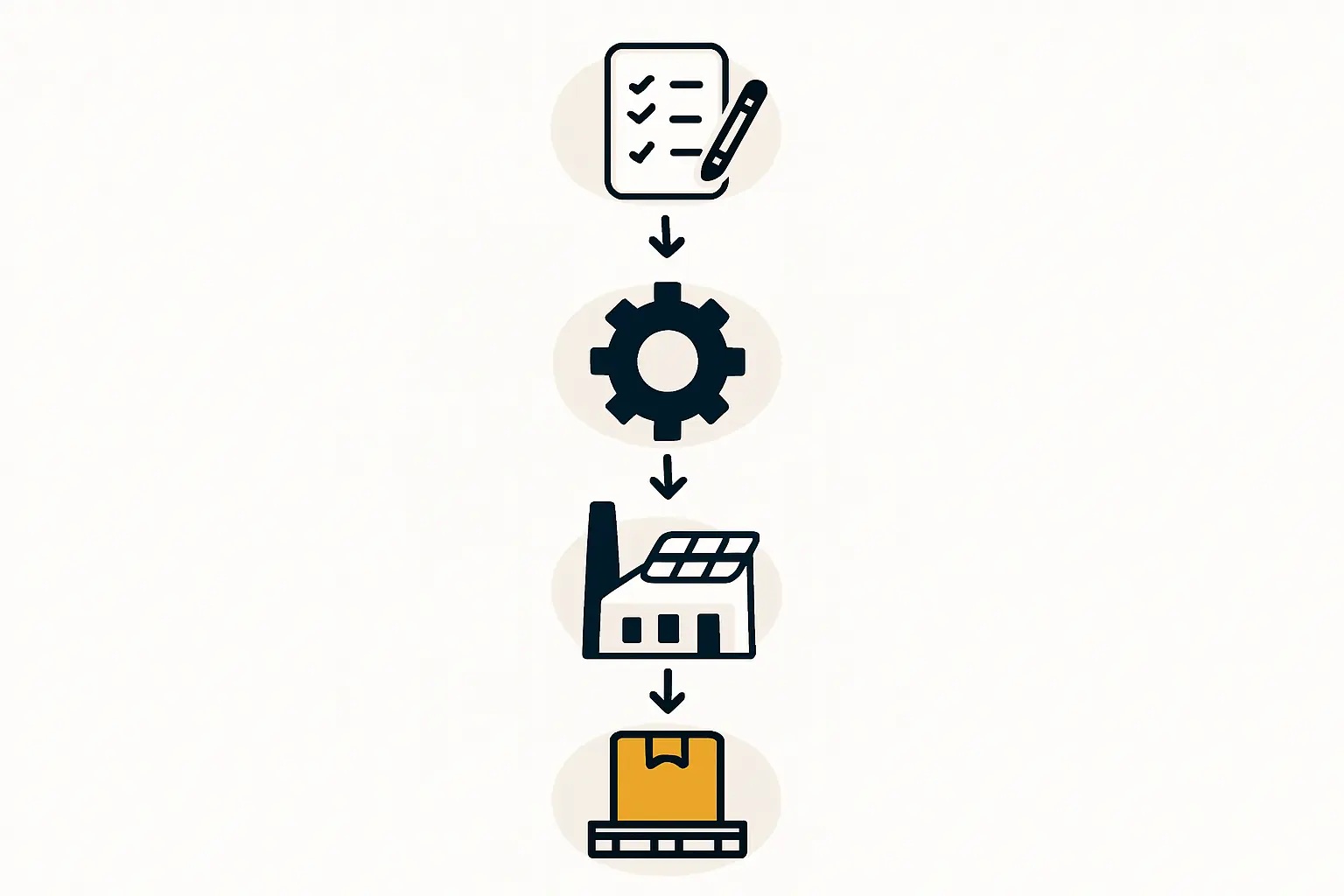
While the proposed price per kilowatt-hour is the most significant factor in a bid (weighted at 70%), a substantial portion of the evaluation (up to 30%) rests on non-price criteria. Chief among these is the environmental performance of the solar modules, specifically their carbon footprint.
This non-price score can be the deciding factor between two closely priced bids, as a project with a superior environmental score can afford to bid a higher electricity price and still win. In fact, based on recent results, a 10% improvement in the non-price score can be equivalent to bidding 2-4% higher on electricity price—a difference that directly affects project profitability and feasibility.
A Closer Look at the Carbon Footprint Score (ECS)
The core of the environmental evaluation is the ECS, or ‘Évaluation Carbone Simplifiée’ (Simplified Carbon Assessment). This metric quantifies the total greenhouse gas emissions from a solar module’s entire manufacturing lifecycle, measured in kilograms of CO2 equivalent per kilowatt-peak (kg-eqCO2/kWp).
The ECS calculation considers several key stages:
- Polysilicon Production: The energy intensity of creating the raw silicon.
- Ingot and Wafering: The process of forming silicon ingots and slicing them into wafers.
- Solar Cell Manufacturing: Turning wafers into photovoltaic cells.
- Module Assembly: Assembling cells, glass, backsheets, and frames into a finished panel.
- Transportation: Logistics from the factory to the project site.
A lower ECS score is better, and modules with a very high carbon footprint may be disqualified outright, regardless of their price.
The Strategic Advantage of European and French Manufacturing
This focus on a low carbon footprint gives manufacturers in France and the wider European Union a clear competitive advantage, stemming from several interconnected factors.
1. Reduced Transportation Emissions
The logic is straightforward: transporting modules by sea from Asia and then by truck to a project site in France generates far more CO2 than sourcing them from a factory within France or a neighboring country. This geographical proximity results in an immediate and measurable reduction in a module’s carbon footprint.
2. Low-Carbon Electricity Grids
An even more decisive factor is the carbon intensity of the electricity used during manufacturing. France’s energy grid, with its high proportion of nuclear power, is one of the lowest-carbon in the world. Consequently, manufacturing solar components here—from drawing ingots to assembling panels—results in a dramatically lower ECS compared to modules produced in regions heavily reliant on coal-fired power.
3. The ‘Resilience’ Score
More recently, the CRE has added a ‘resilience’ criterion to its non-price scoring. This measure rewards projects that strengthen European industrial sovereignty and reduce dependence on single-source global supply chains. Manufacturers earn bonus points for sourcing key components like polysilicon, wafers, cells, and solar-grade glass from within the European Union. A local French manufacturer who establishes a robust European supply chain can therefore achieve a higher resilience score, further enhancing his competitive position.
Meeting the Requirements: What Investors Need to Know
Capitalizing on the CRE tender advantages requires a deliberate and well-planned approach to manufacturing.
Obtaining a favorable ECS is not a matter of simple claims but of rigorous documentation. Manufacturers must provide a detailed lifecycle analysis, often certified by a third-party organization, to validate their carbon footprint calculations. This validation must be factored into the initial planning of a solar module manufacturing line.
The design of the factory and the selection of suppliers are also critical. An investor must secure supply chains for low-carbon materials and ensure the production process itself is energy-efficient.
The business impact is substantial: by producing modules with a low ECS and high resilience score, an investor is not just making an environmental statement—he is creating a premium product specifically tailored to succeed in one of Europe’s largest solar markets.
Frequently Asked Questions (FAQ)
Is this French system unique in Europe?
While the French CRE tender is one of the most developed systems of its kind, the trend of including non-price, environmental criteria in public procurement is growing across the European Union. Countries like Italy and Spain are introducing similar mechanisms, suggesting that low-carbon manufacturing will become a wider European competitive advantage.
Can a non-French company participate in CRE tenders?
Yes, participation is open. However, to leverage the non-price criteria effectively, the solar modules used in the project must meet the low-carbon and resilience standards. This inherently favors modules produced within the EU, particularly in France.
What is a typical investment for a solar module factory?
The capital required varies significantly based on production capacity, level of automation, and technology. However, when developing a business plan, the potential for higher margins and secured demand from CRE tenders should be considered as a key factor in the return-on-investment calculation.
How complex is the solar module certification process for the ECS?
The certification is a detailed and technical process requiring expert knowledge of lifecycle analysis (LCA) and manufacturing. It is not an afterthought but a core requirement that must be integrated into a factory’s operational and quality assurance plans from the very beginning.
Planning Your Entry into the European Solar Market
Success in the French solar market—and increasingly across Europe—is evolving. It’s no longer enough to produce a generic, low-cost solar panel. The market now rewards manufacturers who can produce the right panel, one engineered to meet the specific regulatory demands of the region.
Local manufacturing in France offers a clear, quantifiable, and durable competitive advantage by leveraging low-carbon energy, shortening supply chains, and aligning with strategic goals for industrial resilience. For an investor, this means a deeper level of planning is required, demanding a thorough understanding of the entire solar panel production process through the lens of carbon accounting.
Based on experience from J.v.G. Technology turnkey projects, entrepreneurs who recognize and build their strategy around these regulatory incentives are best positioned for long-term success. For professionals exploring this opportunity, structured educational resources can provide the foundation needed to navigate the technical and commercial complexities of setting up a competitive manufacturing operation in Europe.