For an entrepreneur considering entry into the solar industry, the choice of factory location typically revolves around logistics, labor, and local incentives. In the Caribbean, however, the decision carries far greater strategic weight.
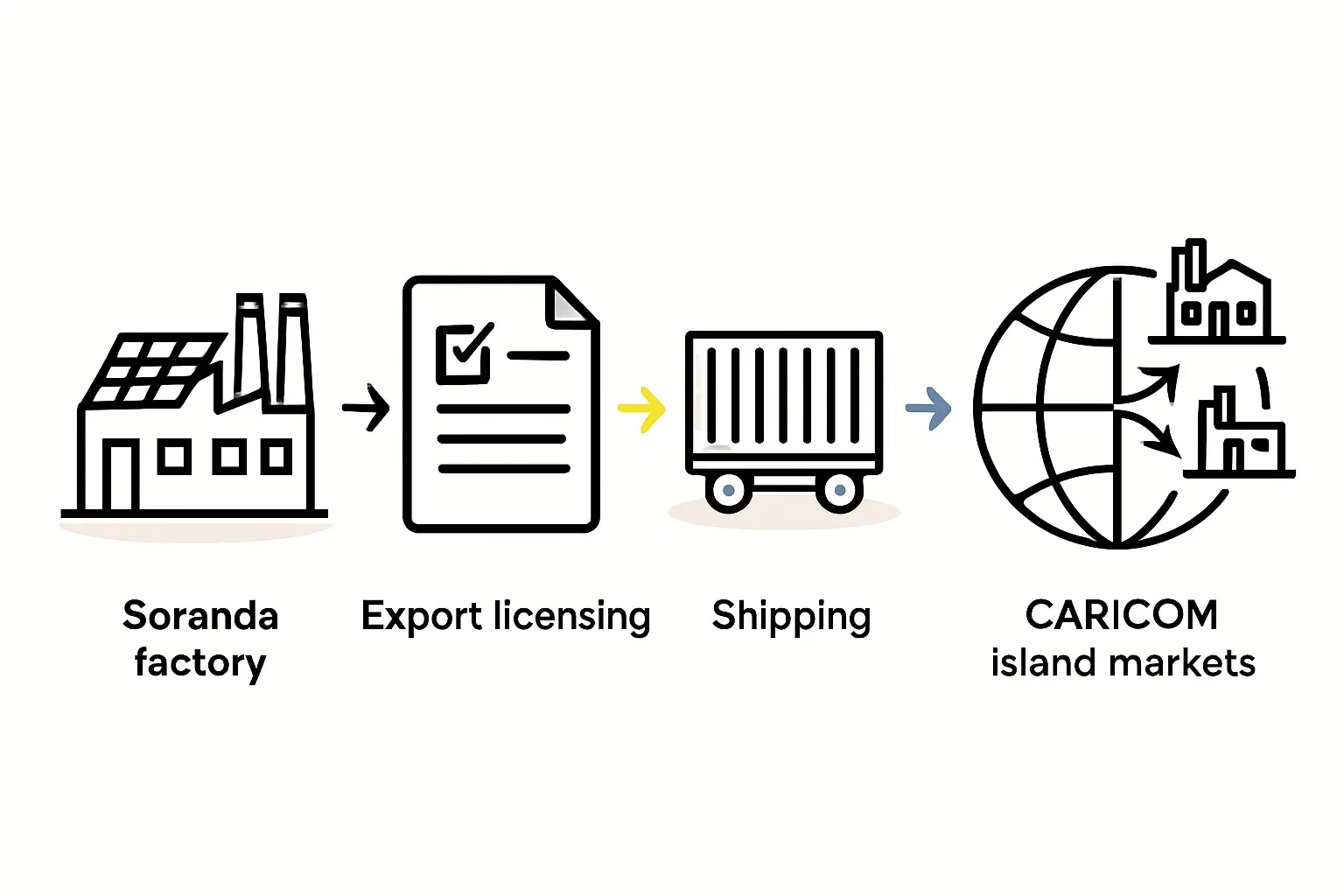
A production facility in Grenada is not merely a base for serving the local market; it is a key that unlocks preferential access to an entire economic bloc of 15 member states. This strategic position transforms a national business plan into a regional export strategy from day one.
Manufacturing solar modules within the Caribbean Community (CARICOM) offers distinct advantages. This guide explores the framework of the CARICOM Single Market and Economy (CSME), the protective function of the Common External Tariff (CET), and how a Grenada-based facility can gain a significant competitive edge when supplying neighboring island nations.
Understanding the CARICOM and CSME Advantage
The Caribbean Community (CARICOM) is an economic and political organization of 15 member states in the Caribbean. Its primary objective is to promote economic integration and cooperation among its members. The cornerstone of this integration is the CARICOM Single Market and Economy (CSME).
In essence, the CSME functions as a unified economic space where goods can move freely. For a manufacturer, this is a powerful feature. Solar modules produced in Grenada can be sold in Jamaica, Barbados, or Trinidad and Tobago without incurring import duties or tariffs. This framework creates a domestic market that extends far beyond Grenada’s shores, reaching millions of potential customers across the region.

This provides a unique opportunity. While international competitors must navigate tariffs and trade barriers to enter each island market individually, a Grenada-based manufacturer operates from within this privileged economic zone.
The Competitive Edge: Tariffs and Rules of Origin
The true power of manufacturing within CARICOM lies in the region’s trade policies, which are designed to encourage intra-regional trade and provide a structural advantage to locally produced goods.
The Common External Tariff (CET) as a Protective Barrier
Goods imported into any CARICOM member state from outside the community—for instance, from China, Europe, or the United States—are subject to the Common External Tariff (CET). This duty, applied at the port of entry, typically ranges from 5% to 20% depending on the product.
Consider this practical scenario:
A developer in Barbados needs to source 1 MW of solar modules.
Option A: Import from Asia. A container of modules valued at $100,000 arrives at the port. If the applicable CET is 15%, an additional $15,000 is immediately added to the cost.
Option B: Source from Grenada. The same container of modules, produced in a Grenada-based factory, arrives at the port. Because the goods are of CARICOM origin, they are not subject to the CET and enter duty-free.
This 15% price advantage is not a temporary promotion or a discount; it is a structural benefit embedded in regional trade law. It allows a Grenada-based producer to be more competitive on price before even factoring in lower shipping costs and faster delivery times. For entrepreneurs exploring how to start a solar factory, understanding this built-in market protection is a crucial first step.
Qualifying Your Modules: The Importance of “Rules of Origin”
To benefit from duty-free treatment, goods must be certified as “Community origin.” This is determined by the CARICOM “Rules of Origin,” which ensure that benefits are reserved for genuine regional producers, not simply for entities trans-shipping foreign goods.
For solar module manufacturing, this typically involves a process of “substantial transformation.” This means the final product is fundamentally different from the imported raw materials used to create it.
A typical solar panel manufacturing process involves importing components like solar cells, glass, EVA film, and aluminum frames. The process of assembling and laminating these components into a finished module is almost always sufficient to meet the “substantial transformation” criteria.
An entrepreneur does not need to source all raw materials from within the Caribbean. The key is that the value-adding production work happens within a CARICOM member state like Grenada. Proper documentation and certification are essential to ensure compliance and unlock the duty-free benefits.
The Caribbean Market: A Region Primed for Solar Energy
The policy advantages of CARICOM are amplified by powerful economic and environmental trends across the region. The demand for renewable energy is not speculative; it is a present-day necessity driven by high costs and national policy.
High Energy Costs and Ambitious Renewable Targets
Many Caribbean nations are highly dependent on imported fossil fuels for electricity generation, leading to some of the highest energy costs in the world, often exceeding $0.30 USD per kWh. This makes the return on investment for solar energy exceptionally attractive for commercial and residential consumers.
Governments across the region have also established ambitious renewable energy goals:
Barbados has a stated goal of achieving 100% renewable energy generation by 2030.
Jamaica aims for 50% of its electricity to come from renewables by 2030.
These policy commitments create a predictable, long-term demand for solar modules that a regional manufacturer is perfectly positioned to meet.
Logistical Advantages of a Grenada-Based Factory
Beyond the tariff advantages, a local manufacturing presence offers significant logistical benefits.
- Reduced Shipping Times: Delivering modules from Grenada to a project in St. Lucia or Guyana can take days, compared to the weeks or months required for shipments from Asia.
- Lower Transport Costs: Proximity dramatically reduces the cost of freight, further enhancing the price competitiveness of Grenada-made modules.
- Supply Chain Resilience: Regional projects are less exposed to global shipping disruptions, port congestion, or geopolitical risks, ensuring more reliable delivery schedules.
Understanding the investment requirements for a solar factory is the next logical step in evaluating this regional opportunity. The initial capital must be weighed against the significant, long-term market access advantages.
A Practical Perspective: Setting Up in Grenada
Establishing a manufacturing operation in Grenada offers a stable and welcoming business environment. For an export-focused business, careful planning of factors like the factory layout and building requirements is essential to ensure an efficient production flow and access to port facilities for streamlined logistics.
Based on experience from J.v.G. Technology GmbH turnkey projects, one of the most common challenges for new investors is underestimating the importance of a well-defined production process. Selecting the right key machinery for module production from the outset is fundamental to meeting regional quality standards and achieving the throughput necessary to serve multiple export markets effectively.
Frequently Asked Questions (FAQ)
What is the primary benefit of manufacturing in a CARICOM country?
The main advantage is duty-free access to the entire 15-member CARICOM market. This allows a manufacturer based in Grenada to sell products to other member states without the import tariffs that apply to competitors from outside the region.
Do I need to source all raw materials from within CARICOM to qualify for duty-free status?
No. The “Rules of Origin” focus on “substantial transformation.” This means that as long as the key manufacturing processes—such as assembling solar cells, glass, and frames into a finished module—take place within a CARICOM state, the final product generally qualifies for duty-free trade, even if the raw components are imported.
Is the CARICOM market large enough to support a solar factory?
While individual island markets may be small, the combined market represents significant and growing demand. High electricity prices, strong solar irradiation, and government policies supporting renewable energy create a robust and expanding regional market for solar modules.
Which CARICOM countries are the most promising export markets?
Larger economies or nations with strong tourism sectors often present the greatest initial opportunities. Countries such as Trinidad and Tobago, Jamaica, Barbados, and the rapidly developing energy sector in Guyana are all prime markets for regionally produced solar modules.
Conclusion and Next Steps
Choosing Grenada as a base for a solar module factory is more than a real estate decision; it is a strategic move to unlock the entire CARICOM region. The combination of the CSME’s duty-free trade, the protective barrier of the Common External Tariff, and escalating regional demand for renewable energy creates a compelling business case.
This unique environment offers entrepreneurs a protected market where they can compete effectively against global suppliers on both price and logistics. For business professionals looking to enter the solar manufacturing space, the CARICOM advantage is a core consideration that should be central to any feasibility study.
To fully grasp the scope of such an enterprise, the next phase involves detailed planning of the operational and financial requirements. A structured approach is essential for navigating the complexities of factory setup and ensuring a successful launch into this promising regional market.