A North American entrepreneur aims to supply solar modules for large-scale projects in the United States. He faces a common dilemma: sourcing from distant Asian markets means long shipping times, exposure to geopolitical disruptions, and complex supply chain management. This challenge highlights a growing need for reliable manufacturing solutions closer to home. For such investors, Honduras presents a strategic, yet often overlooked, opportunity through its advantageous Free Zone (Zona Libre) regime.
This article analyzes the financial, logistical, and regulatory benefits of establishing an export-focused solar module assembly line within a Honduran Zona Libre for business professionals exploring efficient ways to serve the North American and regional solar markets.
The Strategic Advantage of Nearshoring Solar Production
The global shift toward resilient supply chains has made ‘nearshoring’—locating manufacturing operations closer to final markets—an increasingly valuable strategy. For solar module production targeting the United States, nearshoring to a country like Honduras offers several compelling advantages over traditional long-distance supply routes:
-
Reduced Shipping Times: Transit from Honduras to major US ports can be as short as two to three days, compared to several weeks from Asia. This dramatically improves inventory management and responsiveness to market demand.
-
Enhanced Supply Chain Control: Shorter distances and aligned time zones allow for better communication and oversight of manufacturing operations.
-
Geopolitical Stability: Diversifying production away from single regions mitigates risks associated with trade disputes and regional instability.
-
Favorable Trade Agreements: Honduras is a signatory to the Dominican Republic-Central America Free Trade Agreement (CAFTA-DR), which provides duty-free access for qualifying goods into the US market.
Understanding Honduras’ Zonas Libres (Free Zones)
The legal foundation for Honduras’s success as an export hub is the Free Zone Law (Decree No. 356-87). A Zona Libre is a designated geographical area where companies engaged in export-oriented activities operate under a special set of favorable regulations. The regime’s core purpose is to attract foreign direct investment, generate employment, and stimulate the export sector.
Unlike a standard business setup, a company operating within a Zona Libre benefits from a comprehensive suite of exemptions and streamlined procedures designed to minimize barriers to international trade. This framework has been used successfully for decades by industries like textiles and automotive components, providing a proven model for new sectors such as solar module assembly.

Key Financial Incentives for Solar Module Manufacturers
The financial incentives offered within the Zonas Libres are among the most attractive in the region. For an entrepreneur planning a solar panel manufacturing business, these benefits translate directly into lower operational costs and a faster path to profitability.
Exemption from Import and Export Duties
Perhaps the most significant advantage for a solar module assembler is a 100% exemption from all import duties, customs tariffs, and consular fees on:
-
Raw Materials: All components required for production—such as solar cells, glass, EVA encapsulant, backsheets, and aluminum frames—can be imported without tariffs.
-
Machinery and Equipment: All manufacturing machinery and necessary spare parts can be brought into the country tax-free.
-
Finished Goods: The final, assembled solar modules destined for export are not subject to any export taxes or duties.
This exemption effectively removes a major layer of cost from both the setup and operational phases of the factory.
Corporate and Sales Tax Exemptions
Companies within the Free Zones benefit from a complete and permanent exemption from a wide range of taxes. This stable, predictable fiscal environment is critical for long-term financial planning.
Key exemptions include:
-
100% exemption from corporate income tax.
-
100% exemption from sales taxes on domestic purchases of goods and services.
-
100% exemption from all municipal taxes.
These comprehensive exemptions mean revenue from exports can be reinvested into growth or repatriated without being diminished by local taxation, significantly lowering the overall cost of the manufacturing plant.
Unrestricted Capital Repatriation
Investors are guaranteed the unrestricted right to repatriate profits and capital in their currency of choice. This provision provides essential security and flexibility for foreign-owned enterprises, ensuring earnings can be moved without bureaucratic hurdles or financial penalties.
Logistical and Operational Benefits
Beyond the financial incentives, Honduras offers a robust logistical framework well-suited for an export manufacturing operation.
Proximity and Access to the US Market
Honduras’s location provides direct maritime access to both the Atlantic and Pacific oceans, but its proximity to the Gulf of Mexico and the US East Coast is a primary logistical advantage. Puerto Cortés, the country’s main Caribbean port, is one of the most modern and well-equipped deep-water ports in Central America.
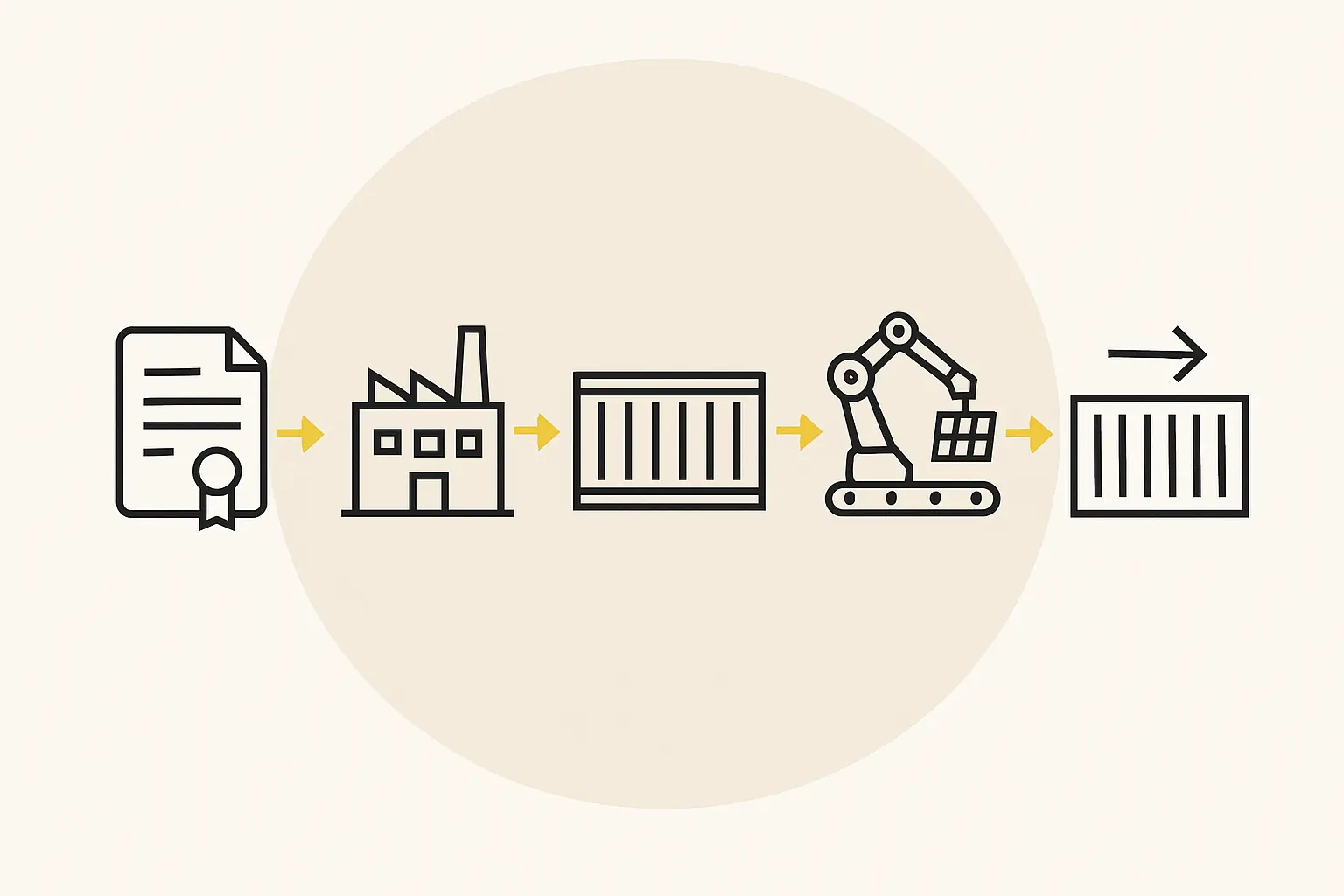
Furthermore, Puerto Cortés is certified under the US Container Security Initiative (CSI), which means cargo is pre-screened before it leaves Honduras. This certification results in faster, more predictable customs clearance upon arrival in the United States—a critical factor for maintaining delivery schedules.
Streamlined Administration and Labor
The Zona Libre system functions as a ‘one-stop shop’ for investors, simplifying administrative processes for permits, customs, and operations. This streamlined bureaucracy reduces the time and complexity of setting up and running a factory.
Additionally, Honduras has a young, trainable workforce. The skills required for solar module assembly are readily transferable, and the region’s competitive labor costs contribute to a favorable operational expenditure model. Based on experience from J.v.G. turnkey projects, matching the right automated equipment with a well-trained local team is a key formula for success.

Frequently Asked Questions (FAQ)
Q1: What exactly is a ‘Zona Libre’ in Honduras?
A Zona Libre, or Free Zone, is a designated industrial area where companies that export at least 95% of their production can operate under a special legal regime. This regime, established by Decree No. 356-87, grants them full exemption from most taxes and import/export duties.
Q2: Are the tax benefits guaranteed for a specific period?
Yes, the exemptions from income tax, customs duties, and other specified taxes are granted for the entire period the company operates within the Free Zone regime. This provides long-term fiscal stability for investors.
Q3: Is navigating the CAFTA-DR agreement complex for solar modules?
The CAFTA-DR agreement has clear ‘rules of origin’ to determine if a product qualifies for duty-free treatment. For solar modules assembled in Honduras, the key is demonstrating that a ‘substantial transformation’ occurred in the country. With the proper documentation and process controls—standard in any quality-certified factory—qualifying the modules for duty-free export to the US is a manageable process.
Q4: How does this model compare to setting up a factory in the United States?
While policies like the Inflation Reduction Act (IRA) offer incentives for US-based manufacturing, a Honduran Free Zone provides a different set of advantages. The primary benefits are a significantly lower cost structure—due to tax exemptions and competitive labor—combined with duty-free access to the US market. This makes it a highly compelling model for export-focused businesses aiming for cost leadership.
Conclusion and Next Steps
For entrepreneurs and business leaders seeking a competitive edge in serving the North American solar market, the Honduran Zonas Libres present a compelling, well-structured opportunity. The combination of comprehensive tax exemptions, strategic logistical positioning, and preferential market access through CAFTA-DR creates a powerful value proposition.
This framework allows a new entrant to build a resilient, cost-effective supply chain at the doorstep of one of the world’s largest solar markets. However, success requires careful planning. For investors ready to capitalize on this opportunity, the next step involves a detailed analysis of the specific requirements for machinery, certifications, and operational best practices.