Domestic Solar Production: Moldova’s Strategic Path to Energy Security
For decades, Moldova’s economic stability has been directly tied to energy sources beyond its borders. With over 70% of its energy imported, the nation faces persistent vulnerability to supply disruptions and price volatility.
Recent geopolitical events have transformed this chronic vulnerability into an acute challenge, making a robust, sovereign energy strategy more urgent than ever. The solution may lie not just in adopting renewable energy, but in manufacturing the core technology domestically.
This analysis examines how establishing local solar module production can become a cornerstone of Moldova’s energy security. It lays out the strategic case for domestic manufacturing, demonstrating how it can insulate the economy from external shocks, stimulate industrial growth, and create a more resilient national power grid.
Understanding Moldova’s Energy Dilemma
Moldova’s energy landscape is defined by a significant structural dependency. The reliance on natural gas and electricity imports, primarily from a limited number of sources including Russia and the Transnistrian region, creates a precarious situation.
This dependency exposes the national economy to supply interruptions and unpredictable price fluctuations driven by external political and market forces. This is not merely a theoretical risk. The conflict in Ukraine has clearly demonstrated how quickly energy supply chains can be disrupted, leading to soaring costs for businesses and consumers.
This reliance also translates into a continuous outflow of capital that could otherwise be invested in domestic economic development. A national strategy focused on domestic energy production is therefore not just an environmental goal but a matter of economic and national security. By leveraging its significant natural advantages, Moldova can fundamentally reshape this dynamic.
Local Solar Manufacturing as a Strategic Solution
Moldova has considerable solar potential, receiving over 3,000 hours of sunshine annually—a level comparable to established solar markets like Italy and Spain. Harnessing this resource through domestically produced photovoltaic (PV) modules offers a direct path to reducing import dependency.
Local manufacturing provides several strategic advantages over simply importing finished solar panels:
-
Supply Chain Control: Domestic production reduces exposure to international shipping disruptions, trade tariffs, and currency fluctuations. It ensures a stable, predictable supply of modules tailored to national energy projects.
-
Grid Resilience: A decentralized network of solar installations, from large-scale farms to rooftop systems, enhances grid stability. Unlike a centralized power plant, this distributed model is less vulnerable to single points of failure, contributing to a more secure energy infrastructure.
-
Technological Sovereignty: Building a local manufacturing base fosters technical expertise and innovation within the country. It enables the production of modules specifically designed for local conditions, such as agri-photovoltaic applications that support the agricultural sector.
The Economic and Industrial Benefits of Domestic Production
The rationale for local manufacturing extends far beyond energy security. It represents a significant opportunity for industrial diversification and economic growth. Establishing a solar module factory triggers a powerful multiplier effect, creating value across multiple sectors.
Key economic benefits include:
-
Job Creation: A typical semi-automated factory creates direct employment for engineers, technicians, and assembly line operators, and stimulates indirect job growth in logistics, raw material supply, and installation services.
-
GDP Contribution: Manufacturing adds tangible value to the national economy, converting raw or semi-finished materials into high-value technology products.
-
Capital Retention: Investing in domestic production capacity ensures that a significant portion of the capital allocated to the energy transition remains within Moldova’s economy, funding local wages and profits rather than foreign suppliers.
-
Ecosystem Development: A local factory becomes an anchor for a broader industrial ecosystem, encouraging the emergence of companies specializing in components like aluminum frames, junction boxes, and specialized glass.
Based on experience from J.v.G. Technology GmbH turnkey projects in other emerging markets, even a modest initial facility can become a catalyst for significant, long-term industrial development.
The Practical Path to Establishing a Solar Factory in Moldova
The prospect of building a high-tech manufacturing facility may seem daunting, particularly for entrepreneurs or institutions without prior experience in the solar industry. However, modern production technology and standardized processes have made it more accessible than ever. With expert guidance, establishing a local manufacturing plant can be structured and managed effectively.
A typical starter facility, with an annual capacity of 20 to 50 megawatts (MW), can be established in a repurposed or new industrial building of around 2,500 square meters. Such a facility can operate with fewer than 30 employees per shift, thanks to a high degree of automation in key process steps.
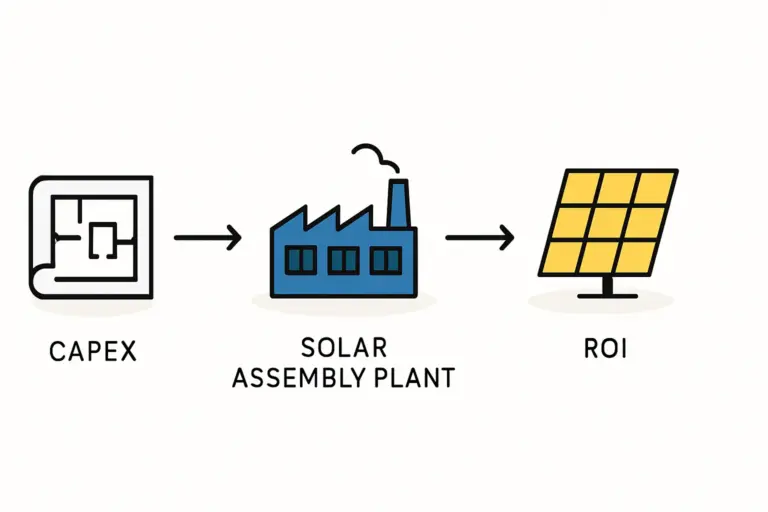
Success depends on meticulous planning. The foundation for any such venture is a comprehensive business plan that includes detailed financial modeling, market analysis, and a clear operational strategy. This plan should also specify the required solar panel manufacturing equipment and outline the entire production workflow, from material sourcing to final quality control.

Frequently Asked Questions (FAQ)
How much capital is required to start a small solar factory?
The investment for a turnkey 20–50 MW semi-automated production line typically ranges from €1.5 million to €3 million. This includes machinery, installation, training, and initial raw material packages. The final figure depends on the level of automation and technology choices.
Can Moldova’s workforce be trained for solar manufacturing?
Absolutely. While key engineering and management roles require specialized experience, the majority of positions on a semi-automated assembly line involve process-oriented tasks. A structured training program, often provided by the equipment supplier, can prepare a local workforce for these roles.
What kind of government support is most effective for this industry?
A stable policy framework is crucial. Effective measures include feed-in tariffs or net metering policies to guarantee a market for the produced energy, tax incentives for local manufacturers, streamlined permitting processes for new factories, and public procurement policies that prioritize domestically produced modules for state-funded projects.
How long does it take to set up a production line?
With a clear plan and experienced partners, a new solar module production line can become operational in under a year. This timeline typically includes factory planning, machinery procurement and shipping, installation, and staff training, with the first certified modules coming off the line within 9 to 12 months from the project start.
A Strategic Imperative for a Resilient Future
For Moldova, developing a domestic solar module manufacturing capability is more than an industrial project; it is a strategic imperative. It directly addresses the nation’s most pressing energy vulnerabilities while building a foundation for sustainable economic growth and technological independence.
By transforming a natural resource—abundant sunshine—into a high-value industrial product, Moldova can secure its energy future, retain economic value, and position itself as a forward-thinking player in the global energy transition. The path forward requires a concerted effort from entrepreneurs, investors, and policymakers, grounded in the understanding that the future of Moldova’s security is inextricably linked to the energy it can produce for itself.