An entrepreneur eyeing the solar market in a country like Sweden or Norway might focus on the high solar irradiation of the long summer days. But a critical factor is often overlooked: the immense physical stress placed on solar installations by the region’s heavy winter snow. A standard solar module, perfectly suitable for a temperate climate, could face premature failure under the crushing weight of a metre of wet snow, leading to warranty claims and reputational damage.
This situation presents both a challenge and a significant market opportunity. Manufacturing solar modules designed specifically for high snow loads is not merely a matter of reinforcement; it requires a fundamental understanding of mechanical stress, material science, and rigorous certification. This guide explores the key technical considerations and testing protocols necessary to produce solar modules that can reliably perform in demanding northern climates.

Understanding Mechanical Load: More Than Just a Number
In solar module engineering, mechanical load refers to the physical force exerted on the panel’s surface. The force is typically measured in Pascals (Pa). To put this into a more tangible context, the standard certification test pressure of 2400 Pa is roughly equivalent to 245 kilograms distributed over a one-square-metre area.
There are two primary types of mechanical load:
-
Downward Pressure (Static Load): This is the force pressing down on the front of the module. The most common source is the accumulated weight of snow and ice.
-
Upward Pressure (Uplift/Dynamic Load): This is the force pulling away from the back of the module, primarily caused by wind creating a lift effect, similar to an airplane wing.
The baseline international standard for module durability, IEC 61215, requires modules to withstand a test load of 2400 Pa. While sufficient for many regions, this specification is wholly inadequate for areas prone to heavy snowfall. In these climates, loads can easily exceed 5400 Pa (approx. 550 kg/m²) and, in some alpine or Nordic regions, reach as high as 8000 Pa.
Why Standard Solar Modules May Fail in Heavy Snow
Modules not engineered for high loads are vulnerable to several types of failure under the weight of heavy snow. These issues often go beyond visible damage and can compromise the long-term energy production and safety of the entire system.
Common points of failure include:
-
Microcracks in Solar Cells: Silicon cells are crystalline and brittle. Excessive flexing of the module under load can create invisible microcracks. While the module may appear intact, these cracks disrupt the flow of electricity, leading to power loss and the formation of ‘hot spots’ that can degrade the module further over time.
-
Frame Deformation: Standard aluminum frames can bend or warp under extreme weight, compromising the module’s structural integrity and potentially breaking the glass seal that protects internal components from moisture.
-
Glass Breakage: While rare, a sufficiently high or uneven load—such as from a drifting snowbank or sliding ice—can cause the front tempered glass to shatter.
-
Junction Box Adhesion Failure: Constant flexing can weaken the adhesive bond holding the junction box to the backsheet, allowing moisture ingress and creating a serious electrical safety hazard.
For a business, these failures translate directly into costly warranty replacements, dissatisfied customers, and a damaged brand reputation in a new market.
Engineering for Resilience: Key Design Considerations
Creating a module capable of withstanding heavy snow loads requires specific adjustments during the design and manufacturing stages. Simply using more robust materials is not enough; the entire structure must be engineered as a cohesive system.
Frame and Glass Reinforcement
The first line of defense is the module’s primary structure.
-
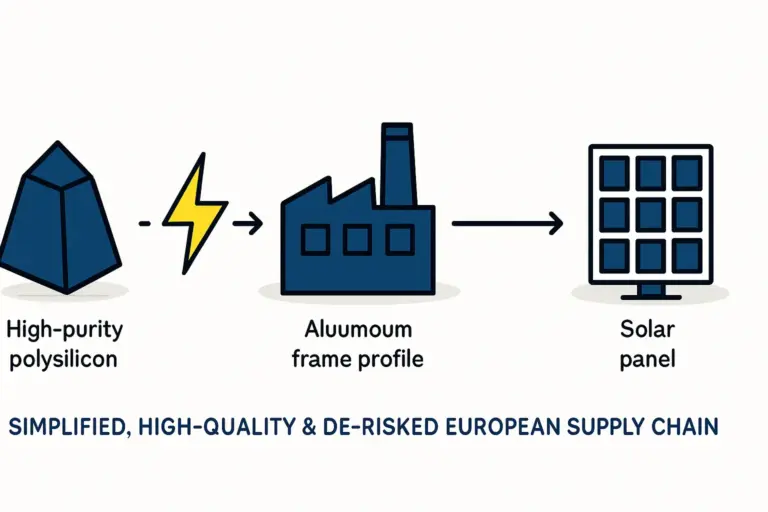
Frame Profile: High-load modules typically use a thicker and more robust aluminum frame profile (e.g., 40mm instead of a standard 30-35mm) with reinforced corner joints to resist bending and torsion.
-
Glass Thickness: The front tempered glass is often increased from a standard 3.2mm to 4.0mm. This seemingly small change significantly increases the module’s rigidity and resistance to flexing.
The Importance of the Mounting System
A module’s certified load rating is only valid when it is installed according to the manufacturer’s specifications. The method of mounting, including the type of clamps and their exact position on the frame, is critical to the system’s overall strength.
A module that can withstand 6000 Pa when clamped along its longer sides may only handle 2400 Pa if clamped on its shorter sides. This makes clear installation instructions as vital as the module’s physical construction. These design choices must be integrated early in the manufacturing process to ensure a reliable final product.
The Path to Certification: Proving High-Load Capacity
To command a premium and build trust in a specialized market, a manufacturer must prove its claims through independent, third-party certification. Bodies like TÜV Rheinland conduct rigorous mechanical load tests that verify a module’s durability beyond the basic IEC 61215 standard.
The testing process involves:
-
Mounting the Module: The module is fixed to a test rig precisely as specified in the manufacturer’s installation manual.
-
Applying Pressure: A uniform pressure is applied to the module’s surface, typically using an array of vacuum cups or an inflatable bladder, and gradually increased to the target level (e.g., 5400 Pa, 6000 Pa, or higher).
-
Cycling the Load: The pressure is held for one hour and then released. This cycle is repeated three times to simulate the effect of repeated stress over the module’s lifetime.
To pass, the module must meet two key criteria:
-
No Major Defects: There can be no visible cracks in the cells or glass, no broken or torn external surfaces, and no loss of mechanical integrity (e.g., the frame separating or the junction box detaching).
-
Minimal Power Degradation: After the stress test, the module’s maximum power output must not have decreased by more than 5% compared to its initial measurement.
Successful completion of these tests allows a manufacturer to market their product with a certified snow-load rating, a critical differentiator in competitive markets. This stringent testing is a cornerstone of the quality assurance protocols required for building a reputable solar brand.
Business Implications for New Market Entrants
For entrepreneurs looking to enter the solar manufacturing space, specializing in high-performance modules for specific climates can be a powerful strategy.
-
Market Differentiation: It allows a new company to avoid competing directly on price with mass-market producers and instead focus on providing a high-value, engineered solution.
-
Enhanced Bankability: Projects using certified high-load modules are often viewed more favorably by investors and insurers, as the risk of climate-related failure is significantly lower.
-
Brand Reputation: Delivering a product that reliably performs in harsh local conditions builds a strong reputation for quality and engineering competence.
Experience from J.v.G. turnkey projects shows that planning for regional climatic extremes from the outset is a critical success factor. A turnkey factory setup must be configured with machinery and materials capable of meeting these higher specifications, such as thicker glass handling and robust framing stations.
Frequently Asked Questions (FAQ)
Does a higher snow-load rating affect the module’s energy output?
Not directly. The design changes, such as a thicker frame or glass, do not impact the efficiency of the solar cells themselves. However, by preventing performance-degrading microcracks, a more robust module ensures a higher and more stable energy yield over its entire operational lifespan.
What is the typical cost increase for a high snow-load module?
The manufacturing cost for a high-load module can be 5% to 15% higher than a standard module. This is due to the increased material costs for thicker glass and a more substantial aluminum frame, as well as the costs associated with certification testing.
Can any module be made ‘high-load’ by using a better mounting system?
While the mounting system is critical, it cannot compensate for a module that is not structurally designed for high loads. A strong mounting system paired with a weak module will still result in the module failing (e.g., glass breaking or cells cracking), even if the system itself remains anchored. Both components must be engineered to work together.
How do I know the actual snow load requirements for my target region?
Consulting local and national building codes is essential. They specify the structural load requirements for different geographical zones based on historical meteorological data. These codes provide the definitive engineering targets for any product intended for that market.
Conclusion: Building for the Future, Not Just the Standard
For markets characterized by significant snowfall, relying on the minimum IEC standard is an approach laden with business risk. True market leadership is achieved by understanding a region’s unique environmental challenges and engineering a product that is not just compliant, but resilient.
By focusing on superior design, robust materials, and verified certification, a new solar module manufacturer can build a trusted brand and capture a valuable segment of the growing global solar industry.
For those planning to enter this specialized market, the crucial next step involves a detailed analysis of the required bill of materials, supply chain, and machinery configurations needed to produce these high-performance solar modules.