For entrepreneurs planning to enter the solar module manufacturing industry, the initial focus often falls on machinery, factory layout, and financing. Yet a factory’s long-term success hinges on a frequently underestimated factor: the stability and quality of its raw material supply chain.
The delay of a single container of high-purity polysilicon or a shipment of defective aluminum frames can bring a multi-million-dollar production line to a standstill. This article explores a strategic way to de-risk a new solar manufacturing venture: sourcing core materials like polysilicon and aluminum from a single, reliable, and high-quality location—Norway. This method offers significant advantages in logistics, quality control, and market positioning, particularly for new businesses.
The Challenge of Global Supply Chains in Solar Manufacturing
The majority of the world’s solar raw materials, particularly polysilicon, originate from Asia. While this concentration has driven down costs, it has also created a complex and often fragile global supply chain. New manufacturers relying on these traditional channels can face several business-critical challenges.
-
Logistical Complexity: Managing long-distance shipping, multiple customs jurisdictions, and potential port delays introduces significant uncertainty into the production schedule.
-
Quality Variance: Ensuring consistent material purity and quality from distant suppliers requires rigorous, and often costly, inspection processes.
-
Geopolitical Risk: Supply can be disrupted by trade policy shifts, regional instability, or unforeseen events, creating vulnerabilities for a new business.
-
High Carbon Footprint: Materials produced using coal-based energy carry a high embodied carbon content, which can be a disadvantage in environmentally conscious markets.
For an entrepreneur, these challenges translate directly into financial risk and operational unpredictability. A more localized and stable supply chain offers a powerful alternative.
Norway’s Unique Position in the Solar Value Chain
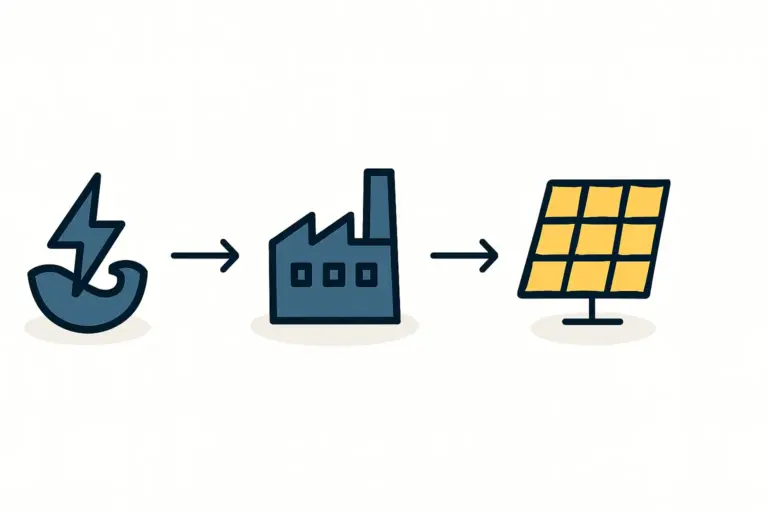
Norway has developed a specialized industrial ecosystem that provides two of the most critical raw materials for solar module production: high-purity polysilicon and low-carbon aluminum. This is not a recent development; the country’s polysilicon industry, for instance, has roots stretching back to the 1990s, built on a long history of industrial processing expertise.
High-Purity Polysilicon: The Heart of the Solar Cell
Polysilicon is the ultra-pure silicon base from which solar wafers, and subsequently solar cells, are made. The purity of this foundational material directly dictates the quality of the final solar module.
Norwegian producers, such as REC Silicon and Wacker, are renowned for manufacturing polysilicon to an exceptional purity level of ‘9N,’ which means it is 99.9999999% pure. This level of purity is crucial for achieving high solar cell efficiency and long-term module performance.
Crucially, this production is powered almost exclusively by the country’s abundant hydropower, giving Norwegian polysilicon one of the lowest carbon footprints in the world—a factor of growing importance for market access, particularly in Europe and North America.
Sourcing from Norway gives new manufacturers two distinct advantages.
-
Technical Excellence: Access to consistently high-purity material reduces the risk of production issues and ensures a premium final product.
-
Market Differentiation: The ability to market modules as ‘Made with low-carbon European materials’ can be a powerful selling point, opening doors to green-conscious customers and public tenders.
High-Quality, Low-Carbon Aluminum for Module Frames
The aluminum frame provides structural integrity and durability for a solar module. As a significant component in the Bill of Materials (BOM), the quality and origin of the aluminum matter significantly.
Norway is home to Norsk Hydro, one of the world’s leading producers of low-carbon aluminum, produced with the country’s hydropower. Sourcing frames or extrusions from a Norwegian supplier ensures material consistency and supply security.
High-grade aluminum provides better corrosion resistance and mechanical strength, leading to a more reliable and durable end product. With production based in Europe, lead times are also shorter and more predictable compared to sourcing from Asia.
The Strategic Business Advantage: A Simplified and De-risked Supply Chain
Consolidating the sourcing of these two key materials from a single, stable region like Norway transforms the logistical and risk profile of a new manufacturing operation.
The benefits are clear and directly impact the business’s bottom line and operational stability.
-
Reduced Lead Times: Shipping from Norway to Europe, the Middle East, or North Africa takes a fraction of the time required for shipments from East Asia. This reduces the amount of capital tied up in inventory in transit.
-
Simplified Logistics: Dealing with a single customs area (the European Economic Area) simplifies paperwork and reduces the risk of bureaucratic delays.
-
Lower Transportation Risk: Shorter, more direct shipping routes minimize the chances of damage, loss, or unforeseen port congestion.
-
Cost Predictability: While the per-unit cost of Norwegian materials may be higher, the total landed cost can be more predictable, with fewer variables like fluctuating trans-oceanic freight rates and tariffs.
Based on experience from J.v.G. turnkey projects, entrepreneurs who establish resilient supply chains early on are better positioned for sustainable growth. By minimizing operational surprises, they can focus resources on production optimization and market entry—critical steps in starting a solar panel business.
Frequently Asked Questions (FAQ)
What is polysilicon and why is its purity so important?
Polysilicon is a highly purified form of silicon that serves as the raw material for most solar cells. Its purity is critical because even minuscule impurities can disrupt the flow of electrons within the solar cell, directly reducing its efficiency in converting sunlight into electricity. The ‘9N’ purity standard ensures optimal performance and reliability.
Is sourcing from Norway more expensive?
The initial material cost might be higher than some global alternatives. However, a business plan should consider the Total Cost of Ownership (TCO). This includes factors like lower shipping costs, reduced risk of delays (which can cost thousands per day in lost production), simplified logistics management, and the marketing value of a low-carbon, high-quality product. Often, the predictability and risk reduction justify the investment.
Does this mean a new factory must source all its materials from Europe?
Not necessarily. A prudent strategy is to diversify the supply chain. However, for core, high-impact materials like polysilicon and aluminum frames, securing a stable, high-quality source like Norway provides a strong foundation. Other components, detailed in the solar panel manufacturing process, can be sourced from various qualified suppliers globally.
How does this supply chain strategy affect my factory’s bankability?
Investors and lenders look for well-managed risk. A business plan that demonstrates a secure, high-quality, and logistically simple supply chain is inherently more attractive. It shows foresight and a commitment to operational stability, making it easier to secure financing for your project.
Conclusion: Building a Resilient Foundation
For entrepreneurs entering the competitive solar manufacturing market, the strategic decisions made before the first machine is installed can define the business’s trajectory. Opting to source critical raw materials from a stable, high-quality hub like Norway is more than a logistical choice—it is a foundational business strategy.
This approach directly addresses key risks related to quality, timeliness, and global disruption, building a stronger, more resilient operation from day one. It also provides a compelling story of quality and sustainability to take to the market. By simplifying the supply chain, a new manufacturer can focus on what truly matters: producing high-performance solar modules efficiently and profitably.