For many entrepreneurs, government funding seems like an opaque and unattainable goal—a bureaucratic maze reserved for insiders. Yet for those aiming to establish advanced manufacturing facilities in the green technology sector, these incentives can be the critical factor that turns a promising business plan into an operational reality.
While programs vary by region, understanding how a world-class system operates provides a valuable blueprint for success. This guide uses Norway’s Enova SF as a case study to demystify the process of securing state support for industrial projects. By examining its criteria, application stages, and funding philosophy, entrepreneurs globally can learn what to look for and how to strategically position their own ventures to attract similar support, wherever they plan to build.
Understanding Enova SF and Its Role in Green Industrialization
Enova SF is a Norwegian state enterprise owned by the Ministry of Climate and Environment. Its primary mission is to finance and promote technologies that accelerate Norway’s transition to a low-emission society. While its focus is national, its operational model serves as a benchmark for industrial policy worldwide.
For a prospective solar module manufacturer, Enova is particularly relevant because it supports projects that go beyond simple assembly. It specifically targets ventures that introduce innovative production technologies, new materials, or processes that significantly reduce the carbon footprint of the final product or the manufacturing operation itself. This aligns perfectly with the next generation of solar manufacturing, which emphasizes efficiency, sustainability, and technological advancement.
While this article focuses on Enova, entrepreneurs in other regions should investigate their own national or regional equivalents, such as the EU Innovation Fund or specific programs within the US Department of Energy. The principles of application remain remarkably consistent.
Key Eligibility Criteria: Is Your Project a Good Fit?
Securing funding from an entity like Enova is not simply a matter of having a good idea; the project must align with specific strategic objectives. Successful applications show that the evaluation typically rests on three core pillars.
Technology and Innovation Level
The project must demonstrate a clear technological advancement beyond the current industry standard. Simply setting up a production line with commercially available equipment is usually not enough.
An applicant must prove that their project introduces a new technology to the market or applies an existing technology in a novel way that leads to significant climate or energy benefits. For a solar manufacturer, this could involve:
- Implementing a new cell interconnection technology that boosts module efficiency by a notable margin.
- Integrating circular economy principles, such as a process for end-of-life module recycling.
- Utilizing novel materials that reduce reliance on silver or other critical raw materials.
Business Viability and Financial Soundness
As stewards of public funds, state enterprises require projects to be commercially sound, with a clear path to profitability and long-term operation. Applicants must submit a robust business plan that includes detailed financial projections, a market analysis, and a competent management team.
Based on experience from J.v.G. turnkey projects, a well-defined business plan is often the most critical non-technical document in the application. It must convince evaluators that the venture is not just an interesting experiment but a sustainable commercial enterprise.
Environmental Impact
Since the ultimate goal of this funding is emission reduction, every application must rigorously quantify its positive environmental impact. This is typically measured in tons of CO2 equivalent reduced per year. Successful projects often demonstrate a highly favorable cost-to-benefit ratio, meaning they achieve significant emission reductions for every euro of funding they receive.
The Application Process: A Step-by-Step Walkthrough
The journey from initial concept to funding disbursement is a structured, multi-stage process that demands patience and meticulous preparation.
Step 1: Initial Dialogue and Pre-Qualification
Before investing significant resources in a full application, it is wise to engage in an initial dialogue with Enova’s advisors. This step helps confirm that the project aligns with their current funding priorities and provides an opportunity to receive preliminary feedback. A project that is clearly outside the scope can be identified early, saving valuable time and effort.
Step 2: The Formal Application
This is the most intensive phase, requiring comprehensive documentation. A typical submission package includes:
- A detailed project description outlining the technology, goals, and implementation plan.
- Validated financial models and budget breakdowns.
- A thorough market and competitor analysis.
- Third-party reports or studies validating the technology’s claims.
- CVs of the key management and technical team members.
Step 3: Evaluation and Due Diligence
Once submitted, the application undergoes a rigorous review by Enova’s technical and financial experts. They assess the project against the eligibility criteria, stress-test the financial assumptions, and may request additional information or clarification. This due diligence phase can take three to six months, depending on the project’s complexity.
Step 4: Grant Agreement and Disbursement
If the application is successful, a formal grant agreement is drafted. This legal document outlines the project milestones, reporting requirements, and payment schedule. Funding is almost always disbursed in tranches tied to achieving specific, pre-agreed milestones, such as securing a building permit, ordering key machinery, or reaching initial production.
Typical Funding Levels and What They Cover
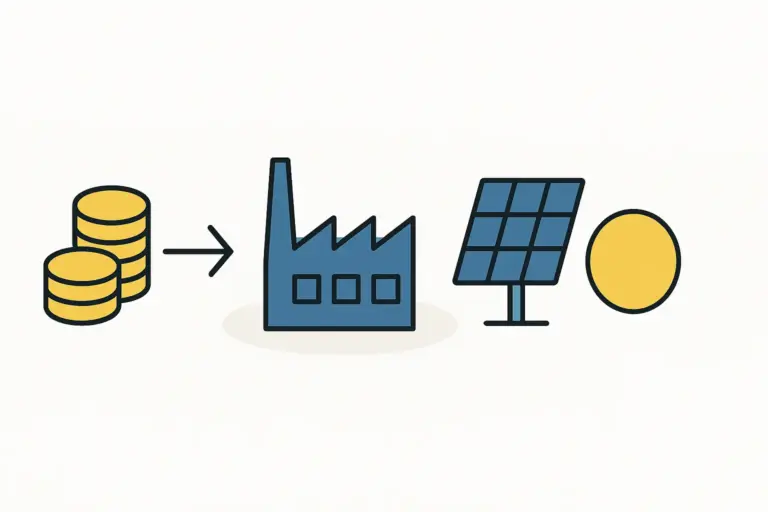
A common misunderstanding is that state funding covers the entire project cost. Instead, it is designed to cover the additional risk and investment associated with the innovative aspects of the project.
Funding typically covers a percentage of the eligible investment costs directly related to the new technology. This can range from 25% to 45% of these specific costs and often comes with a monetary cap (e.g., €15 million).
Eligible Costs May Include:
- Specialized, innovative manufacturing equipment.
- Personnel costs for R&D and engineering during the development phase.
- Costs associated with building and running a pilot production line.
- Third-party consulting for technology validation.
Costs Not Typically Covered:
- Purchase of land.
- Standard building construction.
- Working capital for raw materials.
- Marketing and sales expenses.
Common Pitfalls and How to Avoid Them
Experience with numerous industrial projects shows that several common mistakes can derail an otherwise strong application.
Underestimating the Documentation
The level of detail required for a state funding application is significantly higher than for a conventional bank loan. Applicants must provide deep technical specifications, verifiable data, and conservative financial forecasts. Dedicating a specific team or hiring an external consultant to manage this process is a wise investment.
Weak Innovation Argument
Many applications fail because they do not clearly articulate why their technology is a significant step forward. It is not enough to be ‘new’; the project must solve a specific problem or overcome a known limitation more effectively than existing solutions. This argument must be backed by data, not just claims.
Unrealistic Timelines and Budgets
Credibility is paramount. Submitting a plan with overly optimistic timelines or underestimated costs is a common red flag for evaluators. Based on J.v.G.’s experience setting up turnkey lines, building in a contingency buffer of 15-20% in both the budget and the schedule is crucial to account for unforeseen challenges.

Frequently Asked Questions (FAQ)
Q1: Is Enova SF funding only for Norwegian companies?
A1: Generally, the project must be located and executed in Norway, creating local economic value and contributing to national climate targets. However, international companies can apply if they establish a Norwegian legal entity to run the project.
Q2: Does the funding need to be repaid?
A2: Enova’s support is typically a non-repayable grant, not a loan. However, if the project fails to meet the milestones outlined in the grant agreement, parts of the funding may have to be returned.
Q3: How long does the entire process take from application to first payment?
A3: For a significant industrial project, a realistic timeline is 6 to 12 months. Simpler projects may be faster, while highly complex ones can take longer.
Q4: Can a company apply for other grants simultaneously?
A4: This is possible, but rules on cumulative state aid often apply to prevent over-subsidization. All sources of public funding must be fully disclosed in the application.
Q5: What level of technical detail is required in the application?
A5: A very high level of technical detail is required. Claims about technological performance and environmental benefits must be substantiated with calculations, simulations, or data from pilot tests. Often, a report from a recognized independent technical advisor is necessary.
Conclusion: Using Incentives as a Strategic Lever
Securing state funding like that from Enova SF is a challenging but immensely valuable undertaking. It not only provides non-dilutive capital but also lends significant credibility to a project, making it easier to attract private investment and commercial partners.
The key lesson for entrepreneurs worldwide is that governments are increasingly willing to de-risk strategic investments in green manufacturing. By understanding the logic behind these programs—the focus on innovation, viability, and measurable impact—a business leader can strategically design their project to align with these goals from day one. Investigating and integrating these opportunities should be a core part of the initial planning phase for any new solar manufacturing venture.