For any entrepreneur entering the solar manufacturing sector, choosing a location is one of the most consequential decisions. In Paraguay, a country rapidly emerging as an attractive destination for industrial investment, the choice often narrows to two leading options: the capital, Asunción, and the commercial hub of Ciudad del Este. While both offer significant advantages under Paraguay’s favorable Maquila Law, their unique characteristics present different opportunities and challenges.
Choosing the right city is about more than finding the lowest-cost land; it is a strategic decision that will influence logistics, labor, operational efficiency, and market access for years to come. This analysis breaks down the key differences to help investors make an informed choice that aligns with their specific business model.
The Strategic Importance of Location in Manufacturing
The physical location of a manufacturing facility directly shapes its operational viability and profitability. A well-sited factory benefits from streamlined supply chains, access to a suitable workforce, and reliable infrastructure. Conversely, a poor location choice can lead to persistent logistical bottlenecks, high operational costs, and difficulty scaling production.
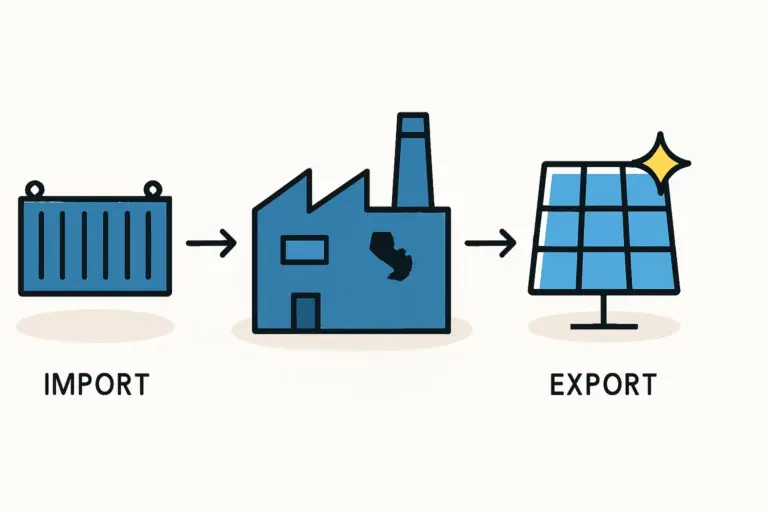
For a solar module factory, where raw materials are imported and finished goods are exported, logistical efficiency is paramount. Understanding the fundamental differences between Asunción and Ciudad del Este is the first step toward mitigating risk and building a resilient manufacturing operation.
Factor 1: Logistical and Market Access
The flow of goods into and out of a factory is its lifeblood. Each city offers its own logistical advantage, depending on the target export market.
Asunción: The Mercosur River Hub
As the nation’s capital, Asunción is situated on the Paraguay River, a major artery connecting the country to the Atlantic Ocean via the Port of Buenos Aires.
- Primary Advantage: Its central port serves as a logistical hub for the Mercosur region. Businesses planning to ship containers to Argentina, Uruguay, or other global markets via Atlantic sea routes will find Asunción’s infrastructure well-suited to their needs.
- Infrastructure: The city boasts the country’s most developed road network and its primary international airport, simplifying the movement of personnel and high-value cargo.
- Consideration: River transport, while cost-effective, can have longer transit times compared to overland routes to neighboring Brazil.

Ciudad del Este: The Gateway to Brazil
Located at the ‘Triple Frontier’ with Brazil and Argentina, Ciudad del Este’s primary logistical advantage is its direct land access to Latin America’s largest economy.
- Primary Advantage: The Friendship Bridge connects the city directly to Foz do Iguaçu, Brazil, providing a direct corridor to the Port of Paranaguá, Brazil’s largest container port. For manufacturers targeting the vast Brazilian market, this is a critical advantage.
- Infrastructure: Built on cross-border trade, the city’s logistics infrastructure is heavily optimized for road freight.
- Consideration: Operations are highly dependent on the efficiency of the border crossing, which can experience congestion.
Factor 2: Labor Pool and Skill Availability
The success of a semi-automated production line, such as a solar module assembly plant, depends heavily on the quality and cost of its workforce. The initial hiring and training of the factory team is a critical phase, one deeply influenced by the local labor market.
Asunción: Access to Specialized Professionals
As the country’s political and economic center, Asunción boasts the largest and most skilled labor pool in Paraguay.
- Strengths: There is a higher concentration of university-educated professionals, including engineers, technicians, and experienced administrative managers. For businesses requiring specialized technical oversight from day one, Asunción offers a clear advantage.
- Cost: This access to skilled labor comes at a premium. Wages for both skilled and unskilled labor are generally higher than in other parts of the country.
Ciudad del Este: A Motivated, Cost-Effective Workforce
Ciudad del Este is known for its dynamic and entrepreneurial spirit, attracting a large, motivated workforce.
- Strengths: Labor costs are significantly lower than in Asunción. The population is often bilingual in Spanish and Portuguese, a key advantage for businesses focused on Brazil.
- Consideration: The local workforce has more experience in commerce and logistics than in technical manufacturing. New investors should anticipate a structured training program for line operators and quality control personnel. Experience from J.v.G. turnkey projects shows that investing in initial and ongoing training is a key success factor in such environments.
Factor 3: Infrastructure, Utilities, and Real Estate
The foundational elements of a factory—the building, power, and water—also differ significantly between the two cities. These local factors can heavily influence the overall investment requirements for a solar factory.
Asunción: Reliability at a Higher Cost
- Utilities: The capital boasts the most developed and reliable utility grid in Paraguay. This is a significant benefit for sensitive manufacturing processes that cannot tolerate power fluctuations, but electricity and water rates are typically higher.
- Real Estate: Industrial land is more expensive and less available, especially for large greenfield projects requiring several hectares. Proximity to the city center comes with a high price tag.
Ciudad del Este: Availability and Opportunity
- Utilities: While the electrical grid is still developing, the city benefits from its proximity to the massive Itaipu Dam, one of the world’s largest hydroelectric plants. Power supply is generally sufficient, though investors should conduct thorough due diligence on grid stability at their specific site.
- Real Estate: Industrial land is considerably more affordable and available. It is easier to acquire large plots for a purpose-built factory, allowing for efficient planning of the factory building and layout.

Factor 4: Business Ecosystem and Government Proximity
The surrounding business environment and ease of administration can play a major role in the speed of setup and ongoing operations.
Asunción: Administrative and Financial Center
- Ecosystem: As the capital, all government ministries, regulatory agencies, and financial headquarters are located here. This proximity can be invaluable for navigating bureaucracy, securing permits, and managing financial affairs. The city also offers a more established local supply chain for industrial consumables and support services.
Ciudad del Este: A Hub of Commerce
- Ecosystem: The city’s special economic status, including its Free Trade Zone, offers powerful tax incentives designed to encourage trade and export-oriented manufacturing. The business culture is fast-paced and commercially focused, though dealing with national government agencies will require travel to Asunción.
Summary Comparison: Asunción vs. Ciudad del Este
| Factor | Asunción | Ciudad del Este |
|---|---|---|
| Logistics | Strong river port access to Mercosur and Atlantic. | Excellent road access to Brazil and Port of Paranaguá. |
| Target Market | Ideal for global or pan-Mercosur export strategies. | Ideal for manufacturers focused on the Brazilian market. |
| Labor Pool | More skilled (engineers, managers); higher cost. | Motivated, bilingual (Spanish/Portuguese); lower cost. |
| Infrastructure | More reliable and developed utility grid; higher cost. | Developing grid, proximity to Itaipu Dam; lower cost. |
| Real Estate | Expensive, limited availability of large plots. | Affordable, ample availability for greenfield projects. |
| Ecosystem | Proximity to government, financial services, suppliers. | Free Trade Zone incentives, strong commercial focus. |
Frequently Asked Questions (FAQ)
What is the Maquila Law and how does it affect the location choice?
The Maquila Law is a government incentive program offering significant tax benefits to companies that manufacture or assemble goods in Paraguay for export. It includes a single 1% tax on the value added in the country and duty-free import of raw materials and capital goods. Both Asunción and Ciudad del Este are excellent locations to operate under this regime. The choice between them depends on which city’s logistical and labor profile best complements an investor’s export strategy.
Is one city better for sourcing raw materials?
Most raw materials for solar module manufacturing (such as solar cells, glass, and aluminum frames) are imported. The key consideration, therefore, is not local sourcing but the efficiency of import logistics. Asunción is better for sea freight from global markets arriving via the Atlantic, while Ciudad del Este is better positioned for materials sourced from or transiting through Brazil.
Which location is better for a business owner with no prior technical experience?
For an entrepreneur new to manufacturing, Asunción’s larger pool of experienced engineers and managers might offer a smoother start-up phase. The proximity to professional service firms (legal, accounting) is also an advantage. However, with a strong on-site management team and a partnership with an experienced consultant for the initial turnkey solar manufacturing line setup, a facility in Ciudad del Este can be equally successful. pvknowhow.com provides structured guidance specifically for business professionals entering the solar industry.
Conclusion: Aligning Location with Business Strategy
There is no single ‘best’ location for a solar factory in Paraguay. The optimal choice depends entirely on the business’s specific goals.
-
Choose Asunción if your strategy involves:Exporting to diverse global markets via sea freight.Requiring immediate access to a deep pool of specialized engineering and management talent.Prioritizing government proximity for administrative processes.
-
Choose Ciudad del Este if your strategy involves:Primarily targeting the Brazilian market.Maximizing cost advantages in labor and real estate.Planning a large-scale greenfield project where land availability is key.
Ultimately, a detailed feasibility study is essential. This analysis should model the costs and timelines associated with logistics, labor, and construction for each location based on the company’s unique production targets and market entry plan. By carefully weighing these factors, investors can lay a strong foundation for a profitable and sustainable solar manufacturing venture in the heart of South America.