An investor considering a solar module factory often focuses first on production technology and financing. The long-term success of such an enterprise, however, particularly in an island nation like Saint Kitts and Nevis, relies fundamentally on logistics.
The ability to efficiently import raw materials and export finished products ultimately defines profitability and market reach. Understanding the nuances of the local supply chain is not just a secondary task; it’s a primary strategic pillar.
This guide details the logistical landscape in Saint Kitts and Nevis for prospective solar module manufacturers, covering port capabilities, the critical role of import duties under CARICOM regulations, and strategic shipping routes to key export markets.
Understanding the Strategic Location: Ports and Infrastructure
The Federation of Saint Kitts and Nevis offers two main commercial seaports. Choosing a factory location depends on a clear understanding of their respective capabilities and limitations.
Key Commercial Ports: Basseterre and Long Point
The primary cargo gateway to the Federation is the Port of Basseterre on St. Kitts, which is equipped to handle containerized cargo, break-bulk, and liquid-bulk shipments. This port will be the main entry point for essential solar panel raw materials such as solar cells, glass, and aluminum frames, which typically arrive in 20-foot or 40-foot containers.
Port of Basseterre (St. Kitts):
- Function: Main deep-water port for commercial cargo.
- Capabilities: Container handling, Ro-Ro (Roll-on/Roll-off) services, and warehousing facilities.
- Consideration: While functional, its capacity is geared toward the general needs of an island economy, not a high-volume industrial hub. Planners must account for potential congestion and schedule shipments accordingly.
On the sister island of Nevis, the Port of Long Point serves a similar commercial function. Although smaller than the Port of Basseterre, it is vital for any manufacturing operation based on Nevis. Any materials arriving in Basseterre but destined for Nevis will require an additional inter-island transfer via barge or ferry.
Note that Port Zante, while a prominent deep-water port on St. Kitts, is almost exclusively dedicated to cruise tourism and is not a viable option for industrial cargo logistics.
On-Island Logistics: From Port to Factory Floor
Once a container arrives at the port, its final journey to the factory begins. The road infrastructure in Saint Kitts and Nevis is generally adequate for standard truck transport. However, project planners must still verify that specific routes from the port to a potential factory site can accommodate heavy truck traffic and provide clearance for large equipment. Engaging a reputable local logistics partner early in the planning process is critical for navigating customs clearance and ensuring reliable ground transportation.
Ready to make big Profits?
The solar Industry is Booming
WE HELP NEWCOMERS to the solar industry start their own solar module production line. Customers can make BIG PROFITS by selling modules and finding investors, without wasting money and time on things they don't need!
The Financial Incentive: Import Duties and CARICOM’s CET
One of the most compelling business arguments for a solar factory in Saint Kitts and Nevis stems from the financial structure of the Caribbean Community (CARICOM) Common External Tariff (CET).
Raw Materials vs. Finished Goods: A Key Advantage
The CET governs duties applied to goods imported into CARICOM member states from outside the community. The system is designed to encourage local manufacturing and value-addition.
-
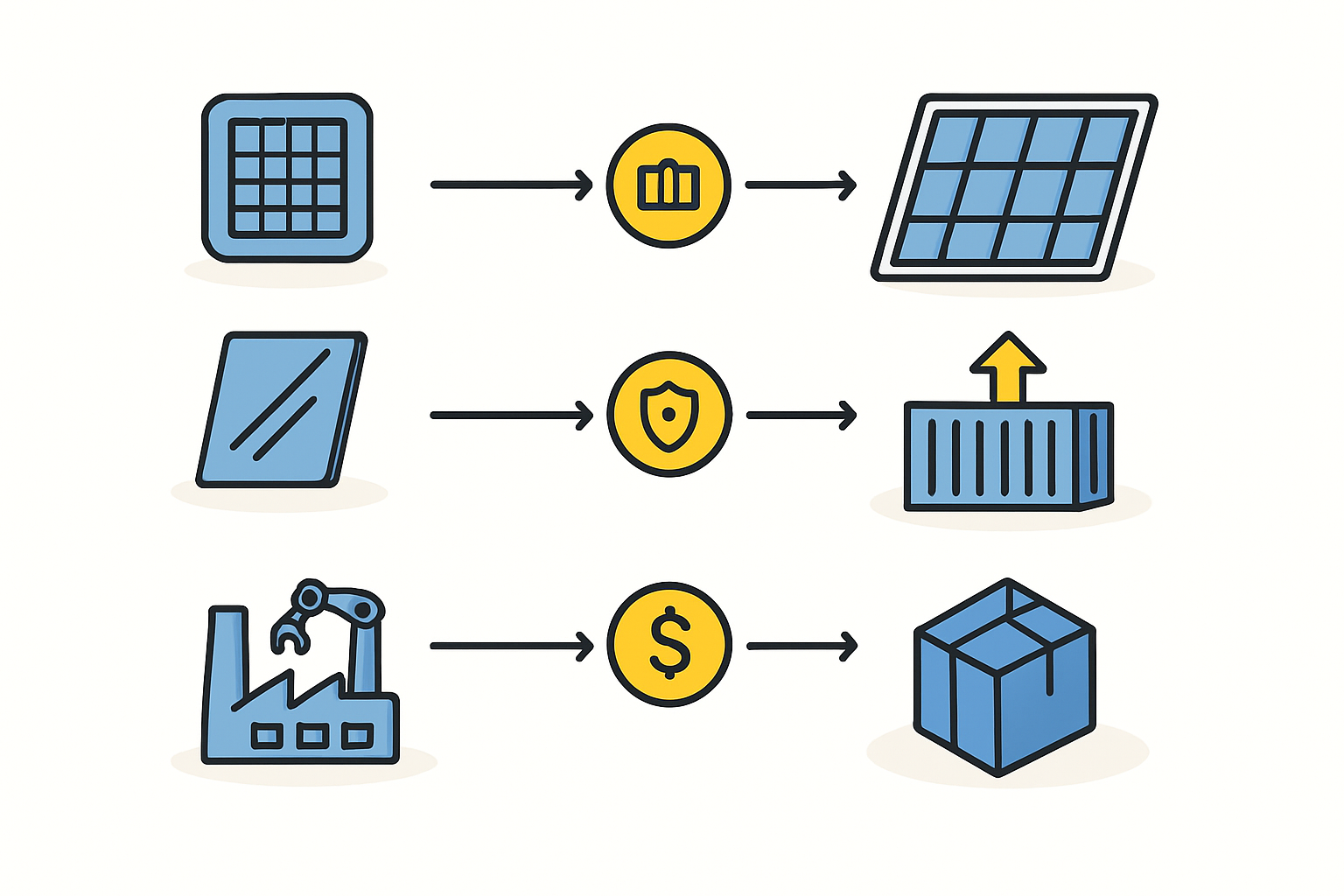
Importing Finished Solar Panels: A business importing ready-made solar panels from China or the United States into St. Kitts would typically face a standard CET rate, which can range from 5% to 20% or higher, depending on the specific product classification.
-
Importing Raw Materials: In contrast, the raw materials required to assemble solar panels are often classified as industrial inputs. Under the Revised Treaty of Chaguaramas, which underpins the CARICOM Single Market and Economy (CSME), such inputs frequently receive duty-free treatment or significantly lower tariff rates.
This tariff differential creates a direct, sustainable competitive advantage. The savings on import duties for raw materials can translate into a substantially lower final price for locally manufactured modules compared to imported ones.
Market Access: Mapping Your Export Shipping Routes
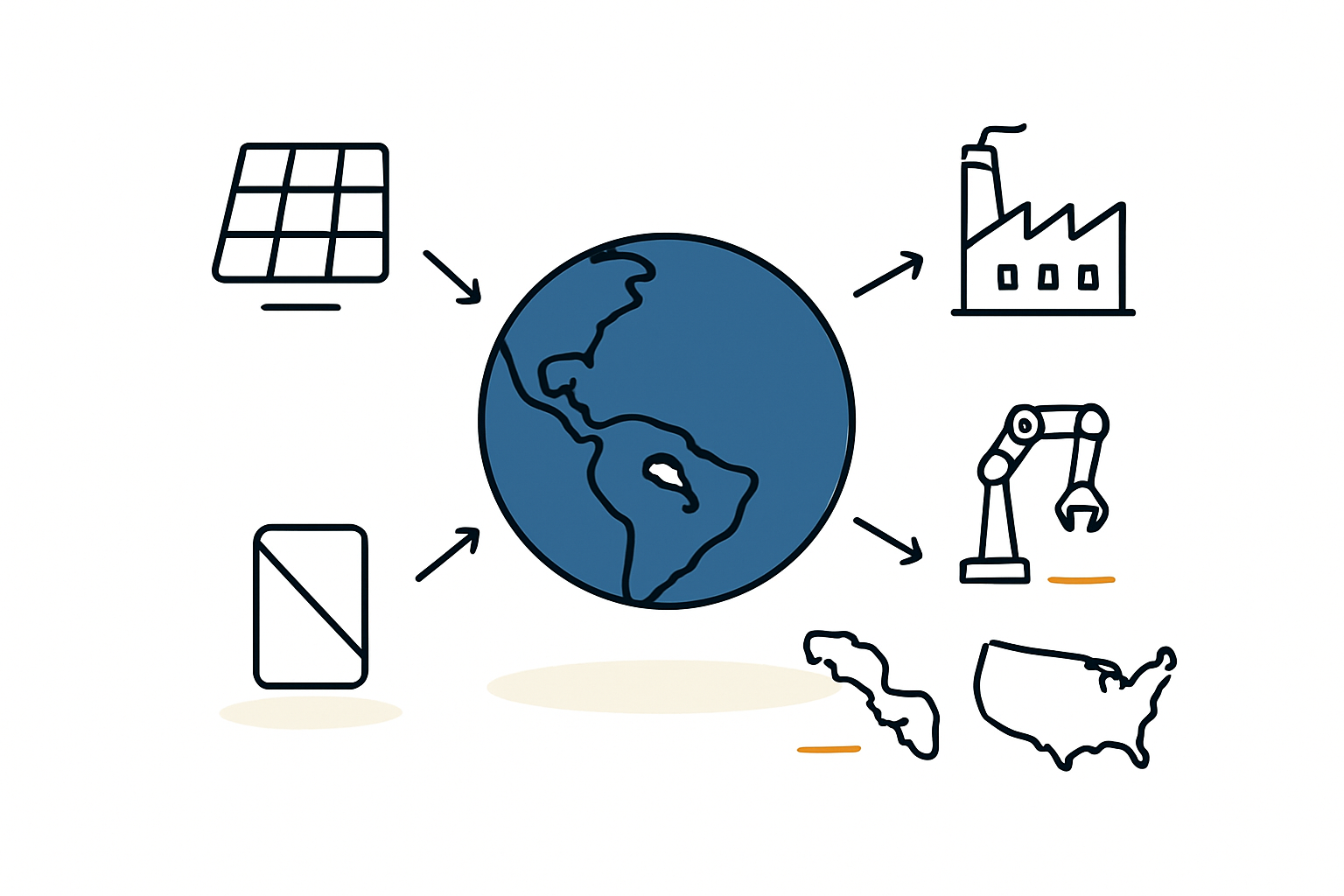
A factory in St. Kitts and Nevis is well-positioned to serve two primary markets: the local CARICOM region and the broader North American market.
The CARICOM Advantage: Duty-Free Regional Trade
Modules manufactured in Saint Kitts and Nevis qualify for duty-free access to other CARICOM member states. This opens a protected market of over a dozen countries, many with high electricity costs and strong solar potential. Shipping routes within the Caribbean are well-established, with carriers like Crowley and Seaboard Marine offering regular services between islands. This allows a Kittitian-based manufacturer to act as a regional supply hub, offering faster delivery times and more competitive pricing than overseas suppliers.
Reaching North America: Opportunities and Challenges
Proximity to the United States also presents a significant export opportunity. Major shipping lines, including CMA CGM, provide regular services from the Caribbean to ports in Florida and along the Gulf Coast. While access is logistically straightforward, a comprehensive solar panel manufacturing business plan accounting for the competitive dynamics of the U.S. market is essential. A successful strategy often involves targeting niche segments or forming partnerships with U.S.-based distributors.
Based on experience from J.v.G. Technology GmbH turnkey projects in similar markets, a phased approach is often effective: first, establish a strong foothold within the protected CARICOM market, then leverage that stability to expand into more competitive North American markets.
Frequently Asked Questions (FAQ)
What are the main logistical challenges in St. Kitts and Nevis?
The primary challenges stem from the scale of the infrastructure. The ports are efficient for their size but are not large-scale industrial ports, which can lead to occasional congestion. Furthermore, any operation on Nevis must factor in the additional cost and time of inter-island transport for all imports and exports.
Is it definitively cheaper to import raw materials than finished solar panels?
Yes. Due to the CARICOM Common External Tariff (CET), raw materials classified as industrial inputs typically have very low or zero-rated duties. Finished solar panels imported from outside CARICOM are subject to higher tariffs, creating a significant cost advantage for local assembly.
How long does it typically take for a container to arrive from Asia?
Shipping from major manufacturing hubs in Asia to the Caribbean generally takes between four and six weeks. However, business plans should prudently budget for up to eight weeks to account for potential transshipment delays, port congestion, or customs inspections.
Can a factory based on Nevis export as easily as one on St. Kitts?
A factory on Nevis can export to the same international markets, but it involves an extra logistical step. All export containers must first be transported by a local sea-bridge or barge service from the Port of Long Point (Nevis) to the Port of Basseterre (St. Kitts) to be loaded onto an international vessel. This adds a minor cost and a day or two to the overall transit time.
Next Steps in Your Planning Journey
A thorough understanding of these logistical factors is critical for developing a viable business model, as it informs everything from factory location and inventory management to pricing strategy and market selection.
With your logistical foundation in place, the next step is to build a complete operational plan. For entrepreneurs ready to move forward, a deeper exploration of factory setup—from machinery selection to cleanroom design—is essential. Our complete guide shows you how to start a solar panel factory, providing a structured path for your venture.