Disclaimer: This case study represents a composite example derived from real-world
consulting work by J.v.G. Technology GmbH in solar module production and factory optimization. All data points are realistic but simplified for clarity and educational purposes.
For many entrepreneurs considering a new industrial venture, the critical question is not just what to manufacture, but where. A location that seems ideal on paper can hide unforeseen logistical or market-access challenges. However, a site that combines world-class logistics with privileged access to a high-growth regional market offers a powerful and sustainable competitive advantage.
This is the strategic case for establishing a large-scale solar module factory near the Port of Dakar. This blueprint outlines a model for a 120 MW manufacturing facility engineered not just for Senegal, but as a production hub for the entire West African Economic and Monetary Union (WAEMU). It is designed for entrepreneurs who see the larger regional opportunity and require a clear path for entering this complex market.
The Strategic Rationale: Why Dakar for a 120 MW Solar Facility?
A manufacturing capacity of 120 MW per year is significant, sized to meet demand that extends far beyond the borders of a single nation. The success of such an enterprise hinges on an export-first strategy from the outset. Senegal, and specifically the area surrounding Dakar, offers a unique combination of logistical, economic, and political factors that directly support this model.
The Logistical Advantage: The Port of Dakar
The Port of Dakar is one of the most significant deep-water seaports in West Africa, handling approximately 95% of Senegal’s international trade. For a solar module factory, its importance is twofold. It is the crucial entry point for raw materials like solar cells, specialized glass, and aluminum frames, where efficiency minimizes delays and reduces working capital requirements.
More importantly for an export model, the port is the gateway for finished products to the rest of the world. A factory located nearby can move certified, ready-to-ship solar modules into containers and onto vessels with maximum efficiency, cutting transport costs and lead times for regional customers.

The Market Advantage: Accessing the WAEMU Region
Senegal is a member of the West African Economic and Monetary Union (WAEMU), an eight-country bloc with a common external tariff and a population of over 120 million people. This is the cornerstone of the export strategy.
Modules produced in Senegal can be exported duty-free to fellow member states like Côte d’Ivoire, Burkina Faso, Mali, and Togo. This provides an immediate price advantage over modules imported from Asia or Europe, which face significant tariffs. A Dakar-based factory is not just in Senegal; it is effectively inside a vast and protected regional market with rapidly growing energy needs.
Download the Export-Oriented Solar Manufacturing Case Study [PDF]
Author: This case study was prepared by the
turnkey solar module production specialists at J.V.G. Technology GmbH
It is based on real data and consulting experience from J.v.G. projects
worldwide, including installations ranging from 20 MW to 500 MW capacity.
The Economic Context: Stability and Growth
Long-term industrial investments thrive in a stable environment. Senegal’s established political stability and consistent economic growth provide a reliable foundation for business planning. The government’s goal of achieving universal electricity access by 2025 further signals strong domestic support for the solar industry, creating a favorable climate for manufacturers.
Core Components of a 120 MW Turnkey Operation
Entering a technically complex field like solar manufacturing can be daunting for investors without a background in the industry. This is why the venture is best structured as a complete turnkey solar manufacturing line, where an experienced engineering partner manages the entire project from design to full operation.
Production Technology and Scale
A 120 MW facility is not a small workshop; it is a highly automated industrial plant. Modern production lines are engineered for efficiency, consistency, and high throughput. Key equipment includes high-speed automatic stringers for soldering cells, automated layup stations, large-capacity laminators, and robotic framing machines. A deep understanding of the complete solar module production process is fundamental. A turnkey partner ensures the machinery selected is state-of-the-art and tailored to the factory’s output goals.
Factory Infrastructure and Logistics Flow
The physical factory layout and building is just as critical. A 120 MW line typically requires a facility of 5,000 to 7,000 square meters to accommodate production, warehousing for raw materials, and storage for finished goods. The internal logistics must be seamless: raw materials are received from the port, stored, fed into the production line, and the finished modules are warehoused before being dispatched for export.
Investment and Human Capital
A project of this scale represents a significant capital outlay. A detailed analysis of the investment requirements covers machinery, building modifications, training, and initial working capital. Equally important is the development of human capital. The factory will employ a mix of skilled engineers, technicians, and line operators. A core component of a turnkey project, such as those delivered by a seasoned turnkey delivery partner, is comprehensive on-site training that ensures the local team can operate and maintain the advanced equipment to international standards.
Securing Market Access: The Critical Role of Certification
For an export business, product quality is paramount. Customers in neighboring countries, as well as the banks financing large solar projects, need absolute confidence in the modules. This confidence is built through internationally recognized certifications.
Non-Negotiable International Standards
The two most critical international certifications for solar modules are IEC 61215 and IEC 61730.
IEC 61215 tests the performance and durability of the module design, ensuring it can withstand harsh environmental conditions like heat, humidity, and mechanical stress over its lifetime.
IEC 61730 is the safety standard, confirming that the module is safe to handle and operate, covering aspects like electrical insulation and fire resistance.
These certifications are not just stamps on a product; they are a prerequisite for accessing commercial markets and securing project financing.
The Certification Pathway with a Turnkey Partner
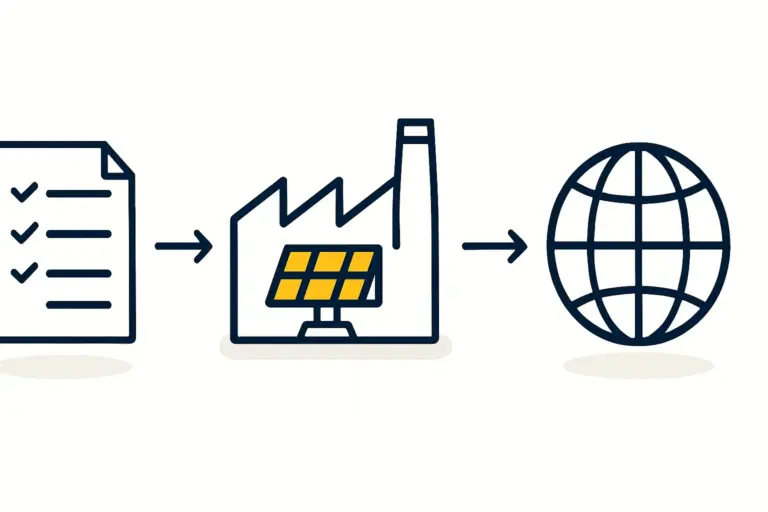
Achieving these standards is a rigorous process that begins long before the first module is produced. Drawing on experience from turnkey projects, the pathway involves:
-
Factory Design: Ensuring the production environment meets the standards required by auditing bodies like TÜV Rheinland.
-
Quality Control Integration: Implementing strict quality checks at every stage of production.
-
Audit and Testing: Guiding the factory through the official audit and submitting sample modules to an accredited laboratory for extensive testing.
An experienced partner de-risks this complex and essential milestone, ensuring the factory’s products are bankable and ready for export from day one.
A Phased Go-to-Market Strategy for the WAEMU Region
Launching into a regional market requires a structured approach.
Phase 1: Establish a Quality Benchmark
The initial focus is on perfecting the production process and achieving all necessary certifications. The first modules produced can be sold to the domestic commercial and industrial (C&I) sector in Senegal. This helps build a local track record and generates early case studies.
Phase 2: Targeted Export to Key WAEMU Markets
With a certified product and a local reputation, the company can begin targeted exports. Initial markets could include Côte d’Ivoire and Burkina Faso, which have significant energy demand and established trade routes with Senegal. Building a network of regional distributors and project developers is key to this phase.
Phase 3: Scaling and Brand Building
As the factory scales up to its full 120 MW capacity, the ‘Made in Senegal’ brand, backed by German engineering and global certifications, becomes a powerful asset. The company can then expand its reach to the wider ECOWAS region, cementing its position as a leading regional manufacturer of high-quality solar modules.
Frequently Asked Questions (FAQ)
How long does it take to set up a 120 MW factory?
From contract signing to the production of the first certified module, a typical timeline for a project of this scale is between 10 and 14 months. This includes factory planning, machine manufacturing, shipping, installation, commissioning, and staff training.
Why is a turnkey solution recommended for new entrants?
A turnkey solar manufacturing line mitigates risk by consolidating responsibility. A single, experienced partner manages the complex integration of machinery, processes, and training. This allows the investor to focus on the business strategy while the technical experts ensure the factory is built to world-class standards and operates efficiently.
Can the factory also serve the local Senegalese market?
Absolutely. Serving the local market is a key part of the initial go-to-market strategy. It provides a valuable opportunity to establish the brand, refine sales processes, and build a reputation for quality before scaling up export operations.
What are the main raw materials that need to be imported?
The primary components that are typically imported via the Port of Dakar include solar cells, high-transmission tempered glass, EVA (ethylene vinyl acetate) encapsulant, polymer backsheets, and extruded aluminum frames.
The blueprint for a 120 MW solar factory in Dakar is more than an industrial project; it is a strategic economic asset. It leverages Senegal’s unique geographical and political advantages to serve a region poised for massive growth in renewable energy. With a clear strategy, a focus on international quality standards, and the guidance of an experienced technical partner, this venture offers a direct path to market leadership in West Africa. Understanding the detailed financial and operational planning is the logical next step in evaluating this opportunity.