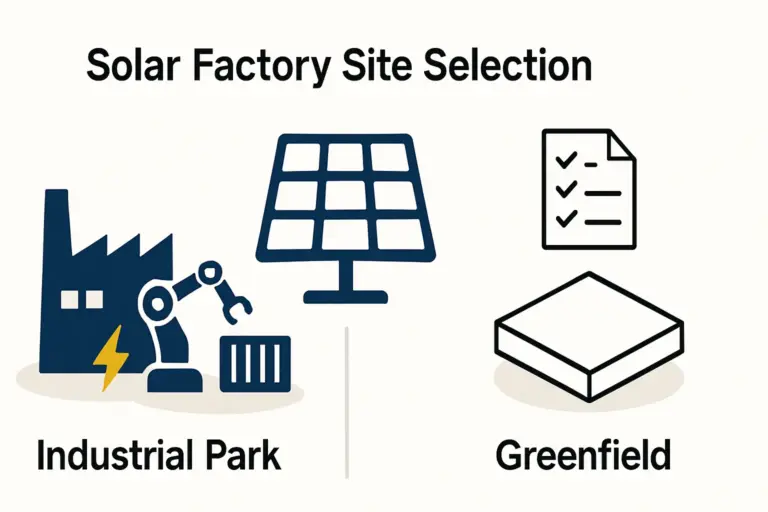
An investor finalizes the funding, selects the machinery for a turnkey solar manufacturing line, and even identifies a prime industrial site just outside Lomé. The business plan is robust, and market demand is clear. Yet, months later, the project is stalled by unforeseen delays and regulatory hurdles.
The reason? A critical step was treated as a mere formality: the Environmental Impact Assessment (EIA).
For any entrepreneur planning a solar module factory in Togo, understanding the EIA process is not just a legal requirement—it is the cornerstone of a successful and sustainable investment. This guide outlines the specific steps, timelines, and documentation required to navigate Togo’s environmental regulations, turning a potential bottleneck into a strategic advantage.
What is an Environmental Impact Assessment (EIA)?
An Environmental Impact Assessment is a systematic process for identifying, predicting, and evaluating the potential environmental effects of a proposed industrial project. In Togo, it is a mandatory prerequisite for obtaining the permits needed to begin construction.
This process is overseen by the National Agency for Environmental Management (Agence Nationale de Gestion de l’Environnement, or ANGE). Its authority is established under Decree N° 2017-020/PR, which mandates that projects with a potential environmental or social impact undergo a thorough review.
International investors should view the EIA not as a bureaucratic obstacle, but as a comprehensive risk assessment. It ensures the project aligns with national development goals, gains local community acceptance, and can operate sustainably for the long term. A well-executed EIA de-risks an investment by addressing potential environmental and social conflicts before they arise.
The EIA Process in Togo: A Step-by-Step Breakdown
Navigating the EIA process requires a structured approach. While a local accredited consultant manages the technical details, the project promoter must understand the key milestones to keep the project on schedule.
Step 1: Project Registration and Screening
The process begins with submitting a ‘Project Notice’ (Formulaire de Renseignement de Projet) to ANGE. This document provides a high-level overview of the proposed solar factory, including its size, production capacity, and location.
Based on this notice, ANGE screens the project and classifies it into one of three categories defined by Order N°003/MERF/ANGE:
- Category A: Projects requiring a full, detailed EIA.
- Category B: Projects requiring a more limited environmental impact study.
- Category C: Projects exempt from a formal EIA but which may require specific environmental management measures.
A solar module manufacturing facility will almost certainly fall into Category A or B, necessitating a formal assessment.
Step 2: Defining the Scope and Terms of Reference (ToR)
Once the project is classified, the next step is to define the scope of the environmental study. The project promoter, working with their chosen environmental consultant, prepares the Terms of Reference (ToR). This critical document outlines:
- The key environmental and social issues to be studied.
- The methodology for data collection and analysis.
- The structure of the final EIA report.
The draft ToR is submitted to ANGE for review and approval, a process that typically takes around 10 business days. A well-defined ToR is essential for preventing delays later on.
Step 3: Conducting the Impact Study
With an approved ToR, the consultant begins the fieldwork. This is the most intensive phase of the EIA process, involving:
- Baseline Data Collection: Gathering information on existing environmental conditions (air quality, water resources, biodiversity, soil) and the socio-economic landscape (local communities, land use, cultural heritage).
- Impact Prediction: Analyzing how the construction and operation of the solar factory will affect baseline conditions.
- Mitigation Measures: Proposing concrete actions to prevent, reduce, or offset negative impacts. This could include waste management systems, water treatment protocols, or worker safety programs.
Step 4: Report Submission and Technical Review
The findings from the study are compiled into a comprehensive EIA report. This report is submitted to ANGE, which conducts an initial review for completeness. If the report meets all requirements, it is passed to a technical committee of independent experts for a detailed evaluation. This review period can range from 30 to 60 days.
Step 5: Public Consultation and Community Engagement
Togo’s EIA regulations strongly emphasize public participation. This phase is crucial for building trust and ensuring the project benefits the local community. It typically involves public hearings and meetings where stakeholders—including local residents, community leaders, and non-governmental organizations—can review the EIA report and provide feedback.
For a foreign investor, successfully navigating this stage requires cultural sensitivity and a genuine commitment to dialogue. This is an opportunity to demonstrate the project’s value and address any concerns transparently. Experience from turnkey projects shows that proactive community engagement is often the determining factor in a project’s smooth execution.
Step 6: The Final Decision and the Certificate of Environmental Conformity (CEC)
After the technical review and public consultations are complete, the technical committee provides its recommendation to the Minister of Environment. If the project is approved, the Minister issues a Certificate of Environmental Conformity (CEC).
The CEC is the official authorization confirming the project complies with national environmental standards. This certificate is a critical legal document required before any construction can begin.

Common Challenges for International Investors
While the process is structured, international investors often encounter several challenges:
-
Underestimating Timelines: The entire EIA process, from initial screening to receiving the CEC, can take 6 to 12 months. Investors must factor this timeline into the overall business plan to avoid costly delays.
-
Selecting the Right Consultant: The choice of a local, accredited environmental consultant is paramount. Their expertise in navigating ANGE’s requirements and understanding local dynamics is invaluable.
-
Incomplete Documentation: Any missing information or poorly prepared documents can lead to significant delays. Attention to detail, particularly in the ToR and final EIA report, is essential.
-
Navigating Public Consultations: Without local knowledge, managing community expectations and addressing concerns during public hearings can be difficult. This is where a good consultant proves their worth.
Key Documentation and Timeline Expectations
To manage the process effectively, investors must be familiar with the core documents and a realistic timeline. A detailed schedule should be part of the initial factory building planning phase.
Key Documents:
- Project Notice (Formulaire de Renseignement de Projet)
- Terms of Reference (ToR)
- Final Environmental Impact Assessment (EIA) Report
- Certificate of Environmental Conformity (CEC)
Typical Timeline:
- Screening & ToR Approval: 1-2 months
- Impact Study & Report Writing: 3-6 months
- Review & Public Consultation: 2-3 months
- Final Decision & CEC Issuance: 1 month
- Total Estimated Time: 7-12 months
Frequently Asked Questions (FAQ)
Is an EIA mandatory for every solar factory in Togo?
Yes. Given its industrial nature, a solar module factory will be classified as a project requiring either a full or a limited EIA. The process cannot be bypassed.
Who is qualified to conduct the EIA study?
Only environmental consultants or firms officially accredited by the Ministry of Environment are authorized to conduct EIA studies in Togo. ANGE maintains a list of accredited experts.
What happens if the EIA report is rejected?
Rejection is uncommon when using a qualified consultant. More typically, ANGE or the technical committee will request additional information or revisions to the proposed mitigation measures. The project promoter and their consultant then resubmit the updated report.
How much does the EIA process typically cost?
The cost varies significantly based on the project’s scale and complexity. Fees paid to ANGE are officially calculated as a percentage of the total investment cost. Additionally, fees for the accredited consultant will form a substantial part of the budget for this phase.
Conclusion: Integrating the EIA into Your Project Plan
For the international investor looking to enter Togo’s promising solar market, the Environmental Impact Assessment is more than a regulatory hurdle—it is a strategic component of the project’s foundation. By treating the EIA process with the seriousness it deserves, investors not only ensure legal compliance but also build a more resilient, sustainable, and locally accepted enterprise.
A robust project plan incorporates these regulatory milestones from the outset, ensuring that environmental due diligence proceeds in parallel with financing, engineering, and site selection. This proactive approach transforms a potential obstacle into a clear path toward launching a successful solar manufacturing operation in Togo.