Disclaimer: This case study represents a composite example derived from real-world
consulting work by J.v.G. Technology GmbH in solar module production and factory optimization. All data points are realistic but simplified for clarity and educational purposes.
Many entrepreneurs watching Europe’s solar market grow exponentially assume manufacturing is a game best left to established Asian giants. But a closer look at evolving trade policies, logistics, and carbon accounting reveals a powerful strategic alternative: establishing a solar module factory in Tunisia to serve the European market.
This model goes beyond traditional cost arbitrage; it’s a ‘nearshoring’ strategy that leverages geographic proximity and preferential trade agreements to build a resilient, transparent, and highly competitive manufacturing operation. This article outlines the complete investment case, explaining how entrepreneurs can turn Tunisia’s unique position into a significant advantage.
The Strategic Advantage: Why Tunisia?
The Tunisia-to-EU model centers on building a manufacturing hub on Europe’s doorstep, combining a cost-effective operational environment with frictionless access to one of the world’s most valuable solar markets.
It directly addresses the primary vulnerabilities of long-distance supply chains—high shipping costs, long lead times, and growing regulatory scrutiny—by creating a more integrated and responsive production system.
The business case is built on a favorable legal and financial framework, a clear logistical and operational edge, and a future-proof position against upcoming EU regulations.
Unpacking the Legal and Financial Framework
Success hinges on understanding and leveraging the robust agreements that connect Tunisia’s economy with the EU.
The EU-Tunisia Trade Agreements: A Duty-Free Gateway
The cornerstone of this model is the EU-Tunisia Association Agreement. First established in 1995 and consistently updated, this agreement eliminates tariffs and quantitative restrictions on industrial goods, including solar modules, traded between the two regions. This gives Tunisian exports an immediate and substantial advantage over imports from regions that face customs duties.
The Pan-Euro-Mediterranean (PEM) Convention on preferential rules of origin adds another layer of supply chain flexibility. This convention allows for ‘cumulation of origin,’ meaning materials sourced from other member countries (such as Turkey, Egypt, or the EU itself) can be processed in Tunisia without losing the product’s preferential origin status.
For a solar module manufacturer, this simplifies sourcing components like solar cells or EVA film while ensuring the final product still qualifies for duty-free entry into the EU.
Tunisian Investment Incentives: Supporting Export-Oriented Growth
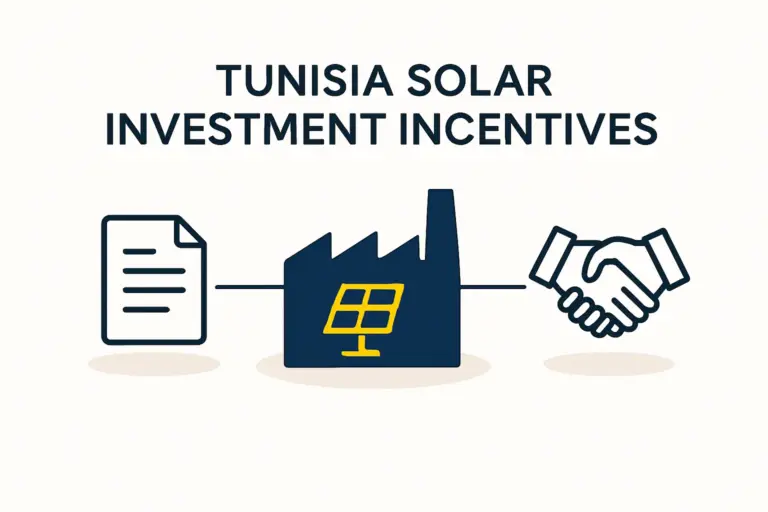
Tunisia’s 2016 Investment Law promotes foreign direct investment, particularly in export-focused sectors. The law provides a range of incentives, including potential tax exemptions for up to 10 years, simplified administrative procedures, and legal guarantees for the transfer of capital and profits.
For solar module manufacturing, establishing an operation within one of Tunisia’s Free Trade Zones, such as those in Bizerte or Zarzis, is particularly advantageous. Companies that export at least 70% of their production can benefit from comprehensive tax and customs exemptions. For a typical 50 MW factory, these benefits can translate into significant operational cost savings over the first decade, directly improving the project’s financial viability.

The Logistics and Operational Edge
Beyond legal frameworks, the physical realities of geography and labor make a compelling case for manufacturing in Tunisia.
Proximity to Market: Reducing Lead Times and Costs
Tunisia’s logistical advantage is significant. Shipping from its ports, like Radès, to major Southern European hubs such as Marseille or Genoa takes just two to three days. This is a dramatic improvement over the four-to-six-week transit times common for shipments from Asia.
This proximity allows for a ‘just-in-time’ inventory model, reducing the need for extensive warehousing in Europe and freeing up working capital. It also enables manufacturers to respond rapidly to shifts in market demand or customer specifications—a level of agility nearly impossible with transcontinental supply chains.
Labor and Operational Efficiency
Tunisia offers a skilled and motivated workforce at competitive labor costs. The country has a strong tradition of technical and engineering education, providing a reliable pool of talent for roles in production management, quality control, and maintenance.
Based on experience from European EPC turnkey projects in the region, training local staff on specialized equipment proves efficient, and teams quickly achieve and maintain high quality control standards. This enables an investor to build a sustainable, local team capable of operating a modern manufacturing facility.
Navigating Future EU Regulations: The CBAM and Forced Labour Advantage
Two major forthcoming EU regulations are set to reshape global supply chains, and the Tunisia export model is uniquely positioned to benefit from both.
The Carbon Border Adjustment Mechanism (CBAM)
Starting in its definitive phase in 2026, the EU’s Carbon Border Adjustment Mechanism (CBAM) will require importers to pay a levy on goods corresponding to the carbon emissions generated during their production. This is designed to level the playing field between EU producers and foreign competitors with lower environmental standards.
This regulation presents a powerful opportunity, as a factory in Tunisia can be powered largely by the country’s abundant solar energy. A solar module produced with low-carbon electricity will have a significantly lower ’embedded carbon’ footprint than one produced using a coal-heavy energy grid, which is common in major Asian manufacturing hubs.
The result: lower CBAM fees and a direct price advantage in the European market. CBAM effectively transforms a regulatory hurdle into a competitive moat for manufacturers located in low-carbon energy regions.
Supply Chain Transparency and the Forced Labour Regulation
The EU is also advancing a regulation that will ban products made with forced labor, which will require companies to conduct thorough due diligence on their supply chains. For many EU importers, tracing the complex and often opaque supply chains for materials originating in some parts of Asia will be a significant challenge.
A manufacturing facility in Tunisia offers a clear solution: a transparent, auditable supply chain. Sourcing raw materials from reputable suppliers in the PEM region and assembling the final product in Tunisia creates a simple, verifiable trail that can easily satisfy EU due diligence requirements. This transparency is becoming a critical purchasing criterion for major European distributors and project developers.
The Technology: Building Modules Certified for the Target Market
A successful export strategy requires a product engineered for performance and certified for the market.
Production lines can be custom-built for challenging environments: Engineered for Performance
The choice of technology is critical. Specialized equipment is designed to work reliably in harsh weather—conditions typical of both North Africa and Southern Europe. Its robust design ensures long-term reliability and high energy yields.
Crucially, the DESERT+ module holds full TÜV certification, a non-negotiable requirement for selling into the European market. This pre-certified technology de-risks the project, ensuring the final product meets the stringent quality and safety standards expected by EU customers.
Structuring the Factory Setup
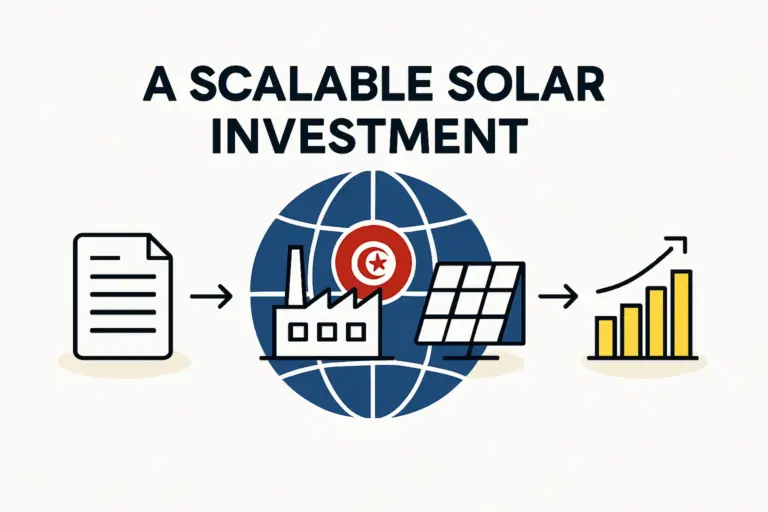
The process of setting up a new solar module production line can be tailored to an investor’s business plan. A phased approach is often recommended, beginning with a semi-automated line of 20–50 MW annual capacity. This allows for a manageable initial investment while establishing a market presence.
As demand grows, the line can be scaled up or duplicated. Platforms like pvknowhow.com provide structured guidance to demystify the technical aspects for business professionals new to the industry.

A Summary of the Investment Case
The Tunisia-to-EU export model presents a compelling and multifaceted investment opportunity.
- Market Access: Duty-free, quota-free access to the entire EU market.
- Cost Structure: Competitive labor costs combined with significant tax incentives in Free Trade Zones.
- Logistics: 2–3 day shipping times to Europe, enabling just-in-time delivery and reducing inventory costs.
- Regulatory Future-Proofing: A natural advantage under CBAM (low-carbon production) and Forced Labour regulations (transparent supply chain).
- Technology: Access to pre-certified, high-performance module technology designed for the target climate zones.
Frequently Asked Questions (FAQ)
What are the typical investment requirements?
The investment requirements for a semi-automated 20–50 MW solar module factory typically range from €2 million to €5 million, depending on the level of automation and the scope of building preparations. This includes machinery, installation, training, and initial working capital.
How complex is the solar module manufacturing process?
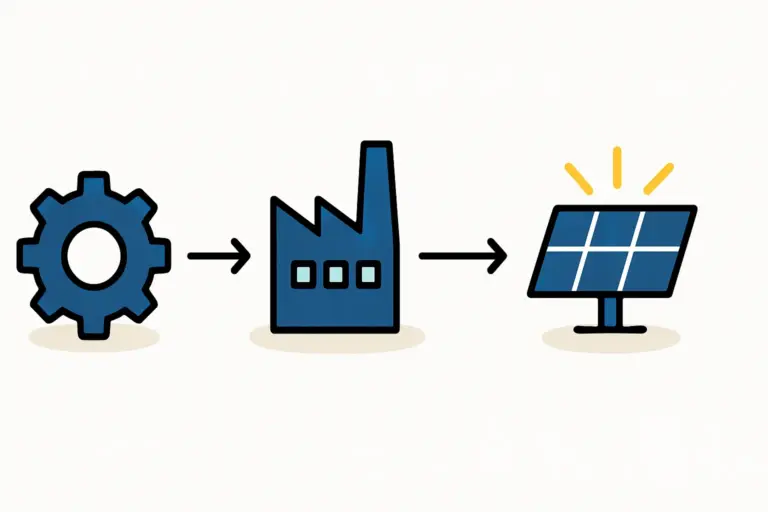
The modern solar module manufacturing process is highly structured and automatable. The key stages involve connecting solar cells with a solar cell stringer, laminating the components together, framing the module, and conducting final quality control tests. A turnkey line provider manages the integration of these steps.
Do I need a technical background to start a solar factory?
No. While technical understanding is helpful, a strong business background is more critical. The key is to follow a structured business plan and partner with experienced technical consultants or turnkey line providers who manage the engineering, installation, and process setup.
What is the timeline from investment decision to first production?
With a well-defined plan, the timeline from the final investment decision to the production of the first certified module is typically between 9 and 12 months. This includes machinery procurement, factory preparation, installation, and staff training.
Next Steps for Exploration
The Tunisia-to-EU export model is a strategic response to the shifting dynamics of global trade and the demands of the European solar market. It offers forward-thinking entrepreneurs an opportunity to build a competitive and sustainable manufacturing business.
For those ready to take the next step, a detailed feasibility study and a comprehensive business plan are the logical starting points. To understand the granular details of such a venture, the structured e-courses at pvknowhow.com offer a complete foundation for planning and execution.
Download the Tunisia-to-EU Export Model Case Study (PDF)
Author: This case study was prepared by the
turnkey solar module production specialists at J.V.G. Technology GmbH
It is based on real data and consulting experience from J.v.G. projects
worldwide, including installations ranging from 20 MW to 500 MW capacity.