A Comparative Analysis of Tunisian Industrial Zones: Bizerte vs. Sfax for a Solar Factory
Choosing a location for a new manufacturing facility is one of the most consequential decisions an entrepreneur will make. It shapes costs, logistics, labor access, and ultimately, the enterprise’s long-term viability.
For investors looking to enter the solar manufacturing sector in North Africa, Tunisia is a compelling choice with its strategic location and pro-investment policies. However, the choice isn’t as simple as selecting the country; it comes down to specific industrial zones, each with a unique profile.
Many investors initially gravitate toward capital cities, but a deeper analysis often reveals more strategic options. This article provides a business-focused comparison between two of Tunisia’s prime industrial locations for a solar panel factory: Bizerte in the north and Sfax, a major economic hub further south. Understanding their distinct advantages is the first step in building a sound business plan.
Key Factors in Site Selection for a Solar Factory
Before comparing Bizerte and Sfax, it’s important to understand the criteria that matter most for a solar module manufacturing operation. This involves more than finding an empty plot of land; it’s about creating an efficient production ecosystem.
Logistical Infrastructure
A solar factory is a nexus of inbound raw materials (glass, cells, aluminum frames) and outbound finished products. Proximity to an efficient commercial seaport is paramount for both importing and exporting. Reliable road and rail networks are just as critical for connecting the factory to the port and to domestic or regional markets. A country’s Logistics Performance Index (LPI), according to World Bank data, is a strong indicator of infrastructure quality and should be assessed at the local level.
Utility Access and Costs
Solar module production is an energy-intensive process. A stable, cost-effective supply of electricity is non-negotiable. Access to water for cooling and cleaning, as well as industrial gas, must also be confirmed. While national grids provide the primary source, many successful projects in the region budget for backup power generation to mitigate any risk of production downtime.
Land and Labor Availability
The physical footprint of a factory and the availability of a workforce are foundational concerns. The investment required for a solar panel factory is significant, and land costs are a major component, though industrial zones often offer preferential lease or purchase rates. Equally important is the availability of skilled labor. While some roles can be trained, access to a pool of technicians, engineers, and managers with industrial experience can accelerate the ramp-up phase.
Government Incentives and Administrative Support
Tunisia, through agencies like FIPA (Foreign Investment Promotion Agency) and APII (Agency for the Promotion of Industry and Innovation), offers various incentives for foreign investors, particularly in designated economic zones. These can include tax breaks, customs duty exemptions on imported equipment, and streamlined administrative processes. Evaluating which zone offers the most relevant benefits is a critical step in financial modeling.
A Head-to-Head Comparison: Bizerte vs. Sfax
With the core criteria established, we can now analyze how Bizerte and Sfax compare. Each city offers a distinct value proposition for a prospective solar manufacturer.
The Bizerte Economic Activities Park: Gateway to Europe
Located on the northernmost tip of Africa, Bizerte’s primary advantage is its strategic geographic position. This historic industrial city has deep roots in manufacturing and trade.
Strengths:
-
Proximity to European Markets: The Port of Bizerte offers some of the shortest shipping routes from Africa to major European ports like Marseille, Genoa, and Barcelona. For a business model focused heavily on exporting finished solar modules to the EU, this can translate into significant savings in time and logistics costs.
-
Established Industrial Heritage: Bizerte has a long history of heavy industry, including steel and cement. This has fostered an existing ecosystem of industrial suppliers and a labor force familiar with a factory environment.
-
Free-Trade Zone Status: The Bizerte Economic Activities Park operates as a free-trade zone, offering significant fiscal advantages. Companies operating within the zone often benefit from a 10-year exemption on corporate income tax and full exemption from customs duties on imported raw materials and equipment. This directly impacts the financial viability of setting up a solar module production line.
Considerations:
-
Port Capacity: While strategically located, the Port of Bizerte is smaller than the Port of Radès (serving Tunis) or Sfax. According to data from Tunisia’s Office de la Marine Marchande et des Ports (OMMP), its container throughput is lower. Investors must verify that its capacity and shipping line connections align with their projected import and export volumes.
-
Competition for Labor: As an established industrial hub, competition for highly skilled engineers and technicians can be more intense compared to less saturated regions.
Sfax: The Economic and Industrial Powerhouse
Sfax is widely regarded as Tunisia’s economic capital and a primary engine of its industrial sector. It’s a bustling commercial center with a diverse and dynamic economy.
Strengths:
-
Major Logistical Hub: The Port of Sfax is one of the country’s largest and most active commercial ports. It has a high container throughput and serves as a critical hub for trade with the Middle East and other parts of Africa. Its well-developed road and rail links provide excellent connectivity to southern Tunisia and neighboring countries like Libya and Algeria.
-
Large and Skilled Workforce: Sfax is home to a major university and numerous technical colleges, producing a steady stream of engineers, technicians, and business graduates. This creates a large and competitive talent pool for a new factory.
-
Diverse Industrial Ecosystem: Unlike Bizerte’s focus on heavy industry, Sfax boasts a highly diversified industrial base, from textiles and agribusiness to chemicals and engineering. This provides a robust network of potential local suppliers for ancillary materials and services.
Considerations:
-
Distance to Europe: While well-connected globally, the shipping routes from Sfax to Europe are longer than from Bizerte. This could result in slightly higher logistics costs and longer lead times for exports to the EU.
-
Land Costs: As a prime economic center, industrial land costs in Sfax may be higher than in other regions. Investors should consult APII data for the latest figures on land prices per square meter.
Side-by-Side Evaluation
Bizerte Economic Activities Park
- Primary Advantage: Proximity to European markets
- Logistics: Shorter sea routes to EU; smaller port capacity.
- Labor Pool: Experienced in heavy industry.
- Industrial Ecosystem: Focused on heavy industry and trade.
- Incentives: Designated Free-Trade Zone with significant tax benefits.
- Best Suited For: Export-oriented model targeting the European Union.
Sfax Industrial Zones
- Primary Advantage: Strong domestic economic hub
- Logistics: Major national port; strong links to Africa/MENA.
- Labor Pool: Large, diverse, and well-educated.
- Industrial Ecosystem: Highly diversified with many potential suppliers.
- Incentives: Multiple industrial zones with standard national incentives.
- Best Suited For: Models targeting Tunisia, North Africa, and MENA markets.
Frequently Asked Questions (FAQ)
Q: Are there other industrial zones in Tunisia to consider?
A: Yes. The Greater Tunis area, particularly around the Port of Radès, is the country’s largest logistical center. Other zones near cities like Sousse also offer good infrastructure. However, Bizerte and Sfax represent two distinct strategic poles—one focused on EU proximity and the other on being a national economic engine—making them an excellent starting point for analysis.
Q: What are the typical land lease costs in these zones?
A: Costs vary based on the specific zone and available infrastructure. As a general reference, prices managed by the APII can range from 15 to 50 Tunisian Dinars (TND) per square meter per year. Obtaining a formal quote is a crucial step in the due diligence process.
Q: How reliable is the electricity supply for a factory?
A: Tunisia’s national grid is generally reliable in major industrial zones. However, for a 24/7 manufacturing operation where uptime is critical, it is standard practice to budget for on-site backup power generation to ensure production continuity. J.v.G. Technology GmbH has observed this as a best practice in numerous turnkey projects across the region.
Q: Do I need a local partner to set up a factory in Tunisia?
A: While not legally mandatory for many investment structures, having a local partner can be highly beneficial for navigating administrative procedures, understanding the business culture, and building local relationships. However, a foreign entity can establish a wholly-owned subsidiary.
Conclusion: Matching the Location to the Business Strategy
The choice between Bizerte and Sfax is not about which zone is definitively ‘better,’ but which is the optimal fit for a specific business model.
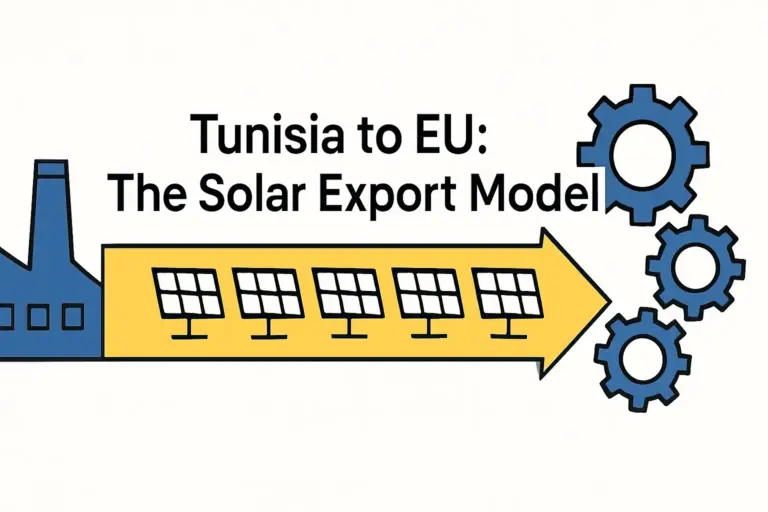
An investor whose primary objective is to export solar modules to the European market will likely find Bizerte’s geographic proximity and free-trade incentives a decisive advantage. The streamlined logistics to key EU ports can create a significant competitive edge.
Conversely, an entrepreneur focused on serving the growing Tunisian domestic market and expanding into other North African and Middle Eastern countries may find Sfax’s powerful economic ecosystem, vast talent pool, and robust logistical connections to the south and east more compelling.
Ultimately, site selection is a foundational pillar of a successful solar factory. Making this decision requires a detailed feasibility study that models costs, revenues, and logistical chains for each potential location. This analysis transforms the project from a general idea into a data-driven business case.