All data points are realistic but simplified for clarity and educational purposes.
The United Arab Emirates has committed to an ambitious goal: generating 50% of its power from clean sources by 2050. As part of the UAE Energy Strategy 2050, this national directive will require an investment of roughly AED 600 billion to install tens of gigawatts of new solar capacity. Yet, the vast majority of solar modules for these landmark projects are currently imported. This reliance creates a significant strategic opportunity for entrepreneurs to establish local manufacturing, securing a key role in the nation’s energy future.
This article outlines the business case for launching a solar module plant in the UAE, detailing the investment framework from land acquisition and offtake agreements to an operational plan optimized for the region’s unique environmental challenges.
The Strategic Imperative: Local Production for National Energy Security
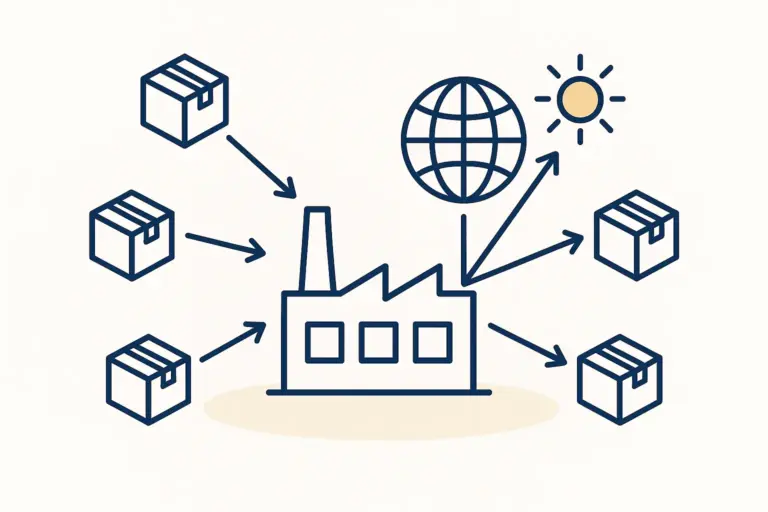
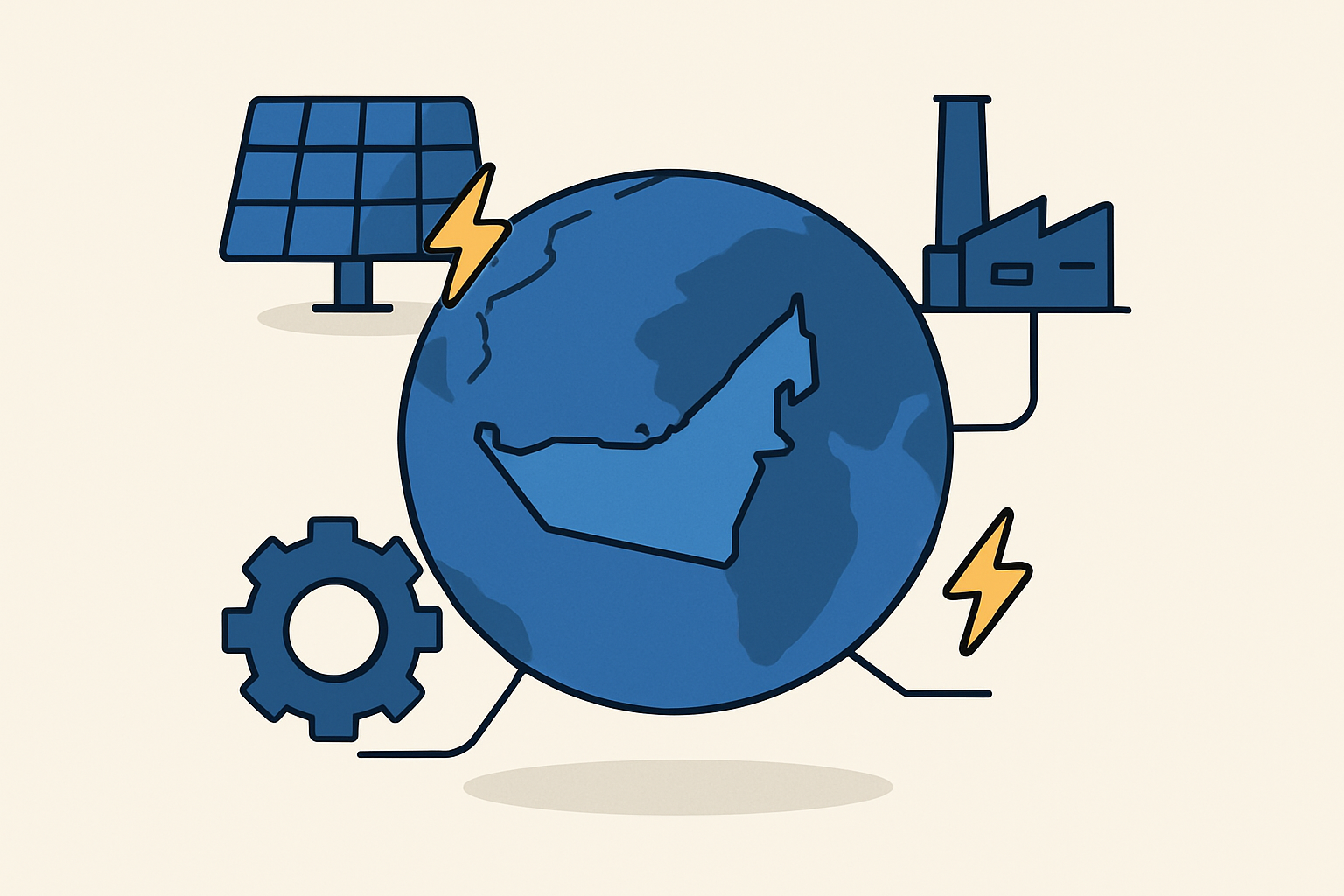
The UAE’s push towards renewable energy is not merely an environmental objective—it is a matter of long-term economic and energy security. Relying on foreign supply chains for critical energy infrastructure like solar panels creates vulnerabilities, including price volatility, shipping delays, and geopolitical instability.
A domestic manufacturing plant would directly address these concerns while offering several key advantages:
-
Supply Chain Resilience: Local production ensures a stable, predictable supply of modules for the UAE’s utility-scale and Commercial & Industrial (C&I) projects.
-
Economic Diversification: Aligns with national initiatives to build a non-oil-based economy by fostering a high-tech manufacturing sector.
-
Job Creation: Creates skilled employment opportunities in engineering, manufacturing, and operations.
-
Technology Customization: Enables the production of solar modules specifically engineered to perform optimally in the harsh desert climate.
Ready to make big Profits?
The solar Industry is Booming
WE HELP NEWCOMERS to the solar industry start their own solar module production line. Customers can make BIG PROFITS by selling modules and finding investors, without wasting money and time on things they don't need!
An Actionable Investment Plan: From Concept to Production
With proper planning, launching a solar manufacturing facility is a structured process that can be completed in under 15 months. The plan breaks down into three distinct phases.
Phase 1: Strategic Planning and Agreements (Months 1-3)
This initial phase is critical to laying a solid commercial foundation. The primary objective is to de-risk the investment by securing land and initial customers.
Land Acquisition in a Strategic Industrial Zone
The UAE offers several world-class industrial zones that provide significant logistical and financial advantages. Locations such as the Khalifa Industrial Zone Abu Dhabi (KIZAD) or Jebel Ali Free Zone (JAFZA) in Dubai are ideal. They offer:
-
Pre-built infrastructure (power, water, logistics).
-
Favorable tax and customs policies.
-
Proximity to major seaports for importing raw materials and potentially exporting finished goods.
A medium-sized plant (e.g., 100-250 MW annual capacity) typically requires a 7,000 to 15,000-square-meter plot to accommodate the factory building, storage, and administrative offices.
Securing Offtake Agreements
Securing commitments from future buyers is vital before committing major capital. An offtake agreement is a contract to purchase a specified volume of future production. Key targets for these agreements in the UAE include:
-
Utility-scale developers: Companies building large solar farms, such as those contracted by the Dubai Electricity and Water Authority (DEWA) or the Emirates Water and Electricity Company (EWEC).
-
C&I EPCs: Engineering, Procurement, and Construction firms that install large rooftop and ground-mounted systems for factories, malls, and other commercial enterprises.
Engaging with these entities early demonstrates market demand and is often a prerequisite for securing financing.
Phase 2: Factory Execution and Setup (Months 4-12)
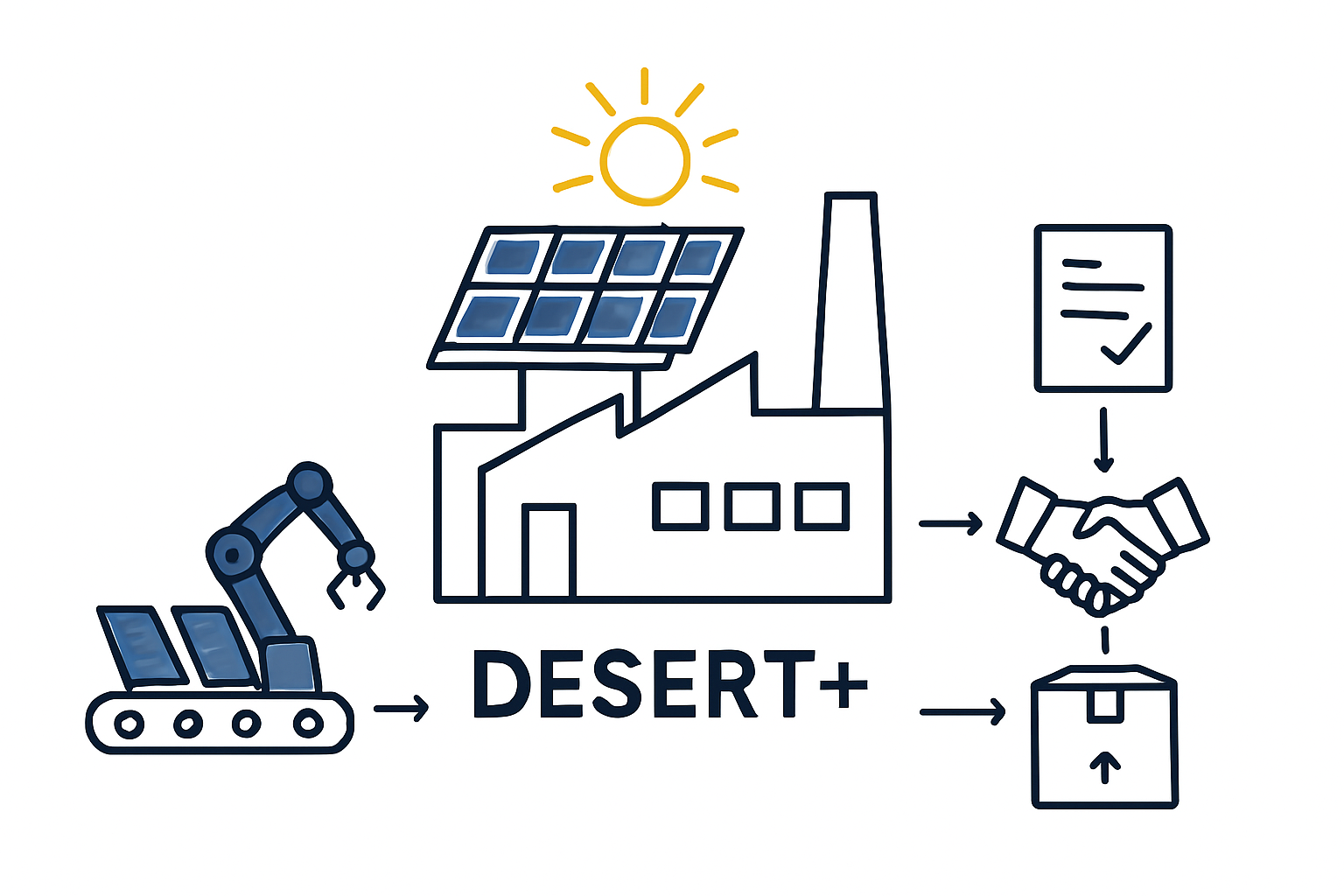
With land and initial orders secured, the focus shifts to building and equipping the factory.
The Turnkey Factory Approach
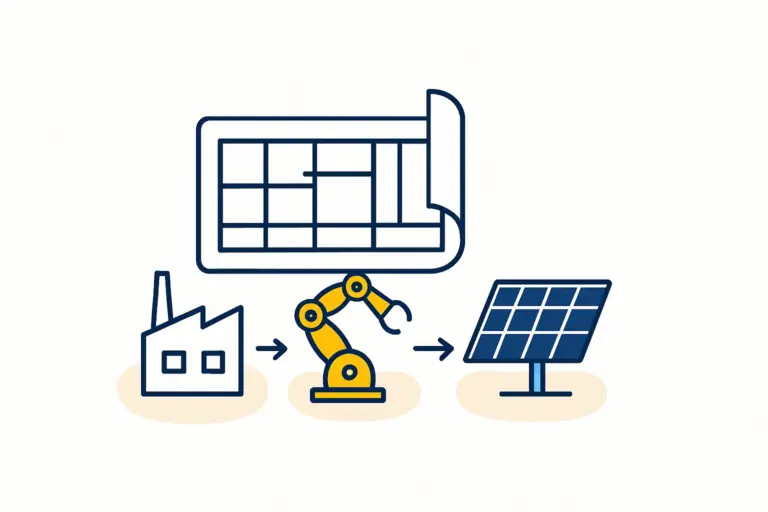
For entrepreneurs without a background in solar engineering, partnering with a turnkey provider is the most efficient path to market. An EU-based photovoltaic manufacturing solutions partner, for example, manages the entire setup process, from factory layout design to machine installation and commissioning. This approach consolidates accountability and ensures the production line is both cohesive and efficient.
A complete turnkey solar module manufacturing line includes all necessary equipment, such as cell stringers, laminators, framing machines, and testing simulators.
Financial Projections and Budget
The total investment required for a 100 MW per year semi-automated facility typically ranges from USD 6 million to USD 9 million. This capital expenditure covers:
-
Machinery & Equipment: The core production line.
-
Building & Civil Works: Factory construction or retrofitting.
-
Working Capital: For raw materials, salaries, and operational expenses during the initial ramp-up.
A detailed solar manufacturing business plan is essential for outlining costs, revenue projections, and profitability timelines. Based on European PV manufacturers’ experience with turnkey projects, a well-managed plant can achieve profitability within 2-3 years.
Phase 3: Operations and Market Penetration (Month 13 Onwards)
Once the factory is commissioned, the focus turns to production, quality control, and scaling operations.
-
Staffing: A 100 MW semi-automated line requires approximately 40-50 employees, including operators, technicians, engineers, and administrative staff. Comprehensive training is typically included as part of a turnkey solution.
-
Quality Control: Adherence to international standards (e.g., IEC 61215, IEC 61730) is non-negotiable for supplying utility-scale and C&I projects. This involves rigorous testing at multiple stages of the solar panel manufacturing process.
-
Supply Chain Management: Establishing reliable sourcing for raw materials (solar cells, glass, aluminum frames, etc.) is crucial for uninterrupted production.
The Technical Edge: Manufacturing for the Desert Environment
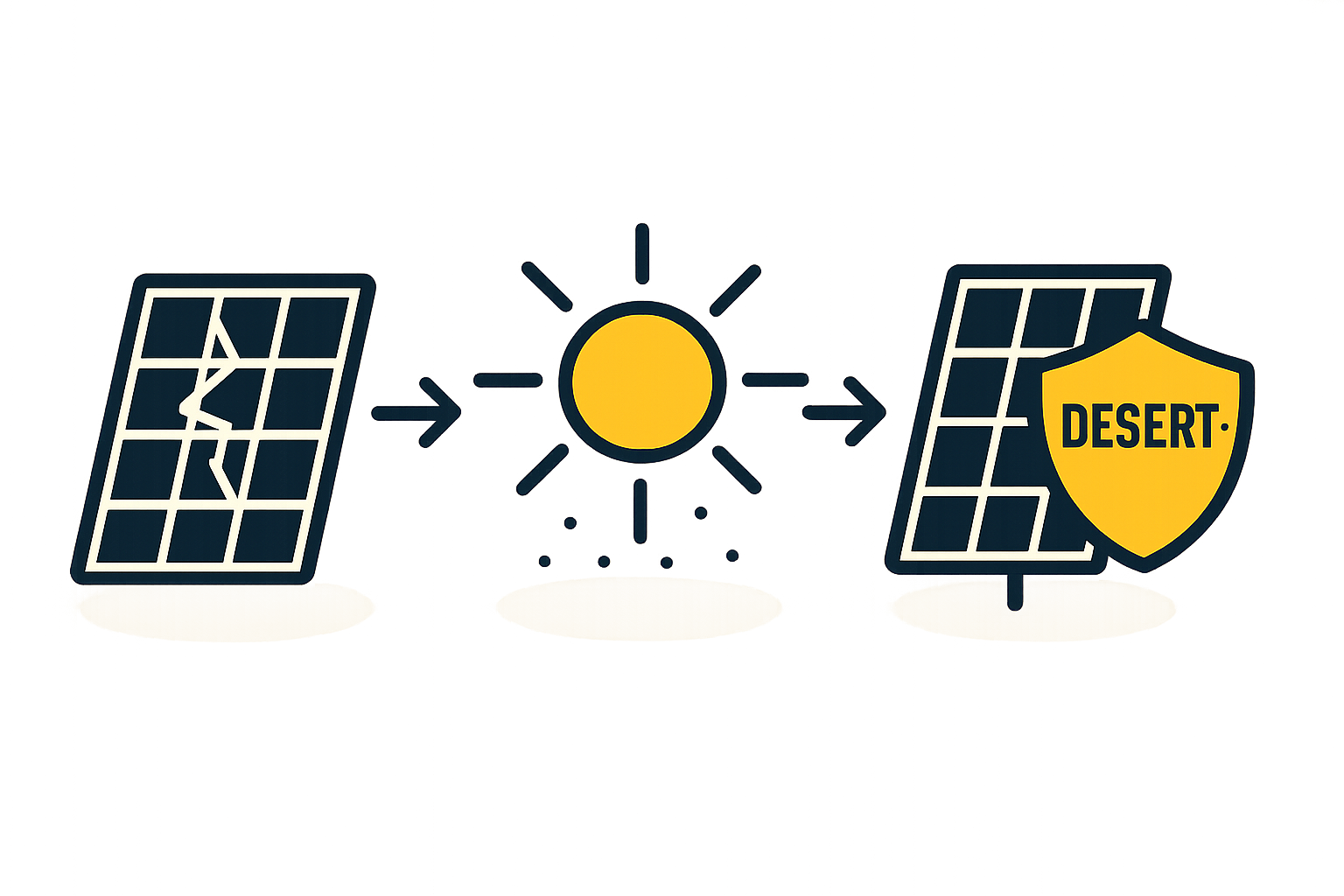
Standard solar modules, often designed for moderate European climates, can suffer from accelerated degradation and underperformance in the UAE’s unique environment:
-
High Ambient Temperatures: Reduces electrical efficiency.
-
High UV Radiation: Can degrade module backsheets and encapsulants.
-
Soiling: Dust and sand accumulation blocks light and can cause abrasive damage.
-
Humidity and Saline Air: Can lead to corrosion in coastal areas.
A local factory can produce modules specifically designed to withstand these conditions. Technology packages, sometimes referred to as ‘DESERT+’, incorporate specialized materials and construction techniques, such as:
-
High-Temperature Resistant Cells: Maintain performance better under extreme heat.
-
Anti-Reflective and Anti-Soiling Coated Glass: Maximizes light absorption and makes cleaning more effective.
-
Durable, UV-Resistant Backsheets and Encapsulants: Prevent premature aging and delamination.
-
Corrosion-Resistant Frames: Ensure structural integrity over a 25-30 year lifespan.
Producing these specialized modules locally provides a distinct competitive advantage over standard imported products.
Frequently Asked Questions (FAQ)
Q1: Do I need a technical background in solar energy to start a factory?
No. While technical curiosity helps, the primary requirements are business acumen and access to capital. Partnering with a seasoned turnkey delivery partner supplies the necessary engineering and process expertise.
Q2: How much land is required for a 100 MW solar factory?
A 100 MW per year facility typically requires a building of around 4,000-5,000 square meters on a total land plot of 7,000-15,000 square meters. This provides adequate space for production, warehousing, and future expansion.
Q3: Is it difficult to source raw materials in the UAE?
While some materials like specialized glass and solar cells must be imported, many others—such as aluminum for frames and packaging materials—can be sourced locally. A key part of the initial business plan is establishing a robust and diversified supply chain for all critical components.
Q4: What is the typical timeline to start production?
From signing contracts with a turnkey provider to producing the first certified module, a realistic timeline is 12 to 15 months. This includes factory construction, machine delivery and installation, commissioning, and staff training.
Q5: Can a local factory compete with large international manufacturers?
Yes, by focusing on key advantages. A local manufacturer can offer shorter lead times, customized products for the local climate (e.g., DESERT+ technology), reduced shipping costs, and better after-sales support. Furthermore, government incentives and a ‘Made in the UAE’ preference can provide a significant edge in public and private tenders.
Conclusion: A Timely and Strategic Venture
The UAE’s ambitious Energy Strategy 2050, its push for economic diversification, and the global need for secure supply chains have converged to create an ideal environment for domestic solar module manufacturing. This convergence offers the discerning investor a unique opportunity not just to build a profitable enterprise, but to become a cornerstone of the nation’s sustainable energy infrastructure. With a structured plan and the right technical partners, launching a solar factory is a feasible and strategically sound investment in the future of the UAE.
Download: UAE Solar Manufacturing Business Case Study (PDF)
Download the PDF business case for domestic solar manufacturing in the UAE.
Author: This case study was prepared by the
turnkey solar module production specialists at J.V.G. Technology GmbH
It is based on real data and consulting experience from J.v.G. projects
worldwide, including installations ranging from 20 MW to 500 MW capacity.