Why Financing Solar Recycling Is Fundamentally Different
Many professionals exploring solar module recycling expect the financing to resemble that of a standard manufacturing plant. This is a common misunderstanding, as the financial logic for a recycling facility is fundamentally different and requires a new perspective.
A manufacturing plant generates revenue by selling new products into a growing market. Its success is measured by production output and sales growth. A recycling plant, in contrast, operates more like a waste management or infrastructure project. Its revenue depends on three factors often outside its direct control:
- The volume of available end-of-life solar modules.
- The stability of government regulations and recycling fees.
- The market price of recovered materials like aluminum, glass, and silver.
This combination of factors introduces long-term uncertainty—and for financiers, uncertainty is risk. Securing investment for a solar recycling project, therefore, is less about demonstrating high growth potential than about proving long-term stability and risk management.
The Three Building Blocks of Solar Recycling Finance
As a capital-intensive project with a long operational life, a solar recycling plant requires a financing structure designed for stability. Funding typically comes not from a single source but from a combination of various types of capital.
The most common financing structure includes three building blocks:
- Equity from Project Sponsors: This is capital invested by the project’s owners or founders. It signals their financial commitment and is a critical indicator for other financiers, as a significant equity contribution demonstrates confidence in the project’s viability.
- Long-Term Debt: This capital is borrowed from financial institutions and must be repaid over a long period, often 10 years or more. Lenders provide this debt only when highly confident the project can generate stable, predictable cash flow to cover loan payments over the entire term.
- Public or Semi-Public Support: Because solar recycling provides a critical public service—managing waste and securing resources—governments often play a role in making projects financially viable. Support can take the form of grants, low-interest loans, or financial guarantees that reduce the risk for private lenders.
In practice, purely private financing is rare, especially for the first recycling plant in a region without an established market. A stable framework combining private investment with public support not only reduces the overall cost of financing but is often essential to getting a project off the ground.
Input Security: The Most Critical Factor for Investors
For any financier evaluating a recycling project, the first and most critical question concerns the input material: Where will the end-of-life modules come from? How can this supply be guaranteed not just for next year, but for the next 10 to 15 years? Without a secure, long-term supply of modules to process, the plant has no revenue.
A business plan must present a clear and credible strategy for securing this input volume. This is typically achieved through several mechanisms:
- Take-Back Schemes: In regions with strong environmental laws, a system of Extended Producer Responsibility (EPR) may exist. This legally requires module manufacturers or importers to finance the collection and recycling of their products at the end of their life. Such schemes create a predictable, regulated flow of modules to certified recyclers.
- Regulatory Allocation: In some markets, a central government or industry-managed body collects all end-of-life modules. This organization then allocates the volume to licensed recycling facilities, providing a secure and centrally managed input stream.
- Long-Term Supply Agreements: These are direct contracts between the recycling plant and large owners of solar assets, such as utility-scale power plant operators. The agreements specify that when a solar farm is decommissioned, its modules will be sent to the recycling plant.
A project that cannot demonstrate a secure, long-term plan for its input material is generally considered un-financeable.
Navigating Regulatory and Policy Risk
The security of the input stream is often directly linked to the stability of government policy, making solar recycling projects highly sensitive to regulatory risk. A change in environmental laws, waste import/export rules, or the structure of recycling fees can dramatically impact a plant’s financial projections.
For example, if a government lowers the recycling fees paid by producers, the recycler’s revenue per module decreases. If rules change to allow the export of untreated electronic waste, the local plant might lose volume to competitors in other countries.
This dependency creates a significant long-term risk, one that financiers scrutinize carefully. Experience shows that projects in regions with unstable or undeveloped environmental policies face significant delays in securing financing. Financial models for a recycling plant must therefore be built on conservative assumptions, anticipating potential negative policy changes rather than assuming conditions will remain favorable.
Avoiding Operational and Scale-Up Risks
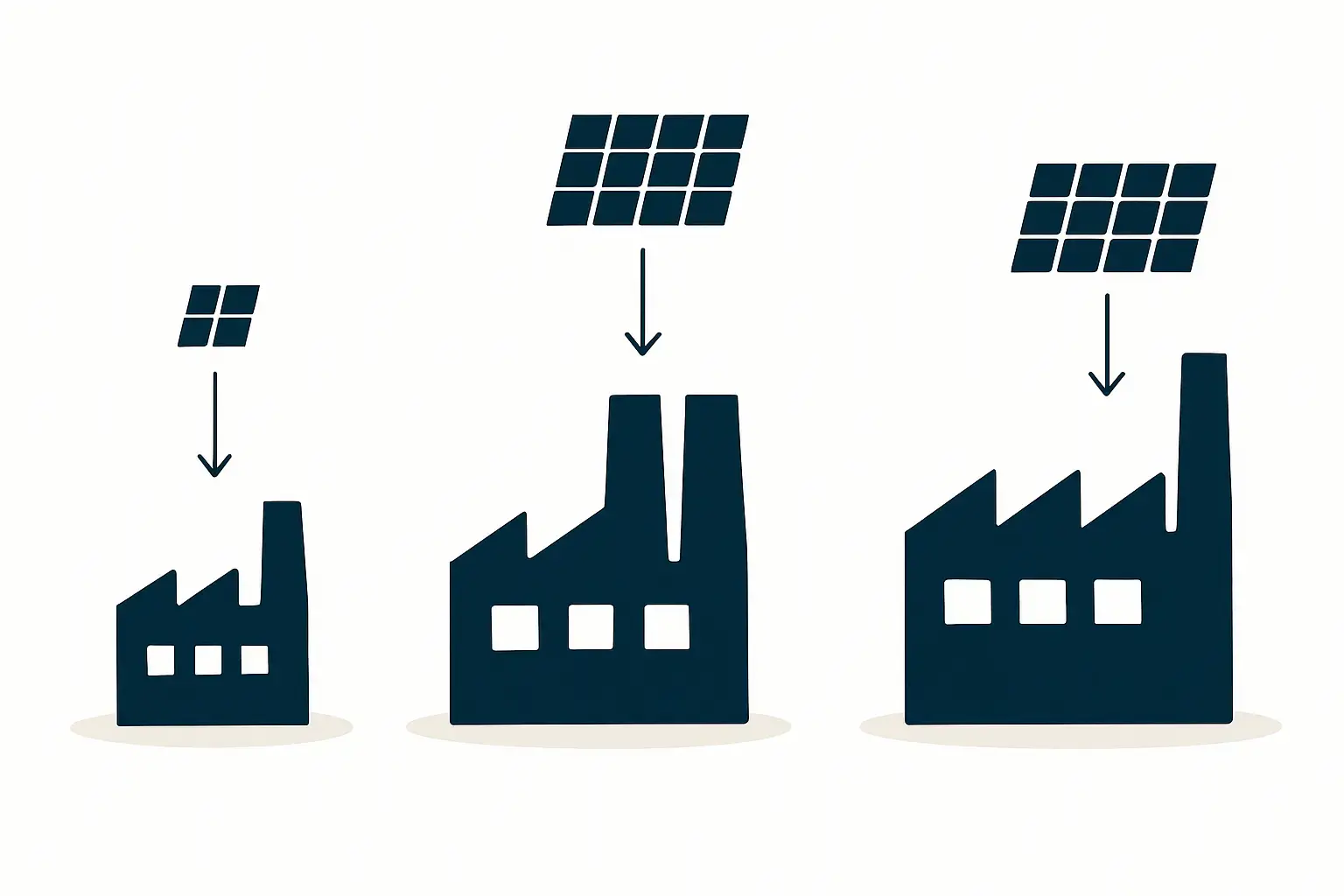
Beyond external factors like input and policy, financiers also focus on internal operational risks—particularly those associated with plant size and utilization. An oversized or underutilized plant creates severe financial stress.
- Oversizing the Plant: Building a recycling facility with a capacity far larger than the realistically available volume of end-of-life modules is a common mistake. This leads to high fixed costs for buildings, machinery, staff, and debt service, while revenue remains low. As a result, the plant consistently loses money because it is not operating efficiently.
- Scaling Too Early: Attempting to expand a plant’s capacity before initial operations are stable and all technical processes are fully optimized adds unnecessary complexity. This can disrupt the core business and strain financial and human resources.
For financiers, a smaller plant that operates consistently at or near full capacity is a much lower risk than an ambitious, large-scale plant that struggles to secure enough input. In the early years, the primary goal must be stable, efficient operation—not rapid expansion. This approach demonstrates managerial competence and builds the foundation for future, bankable growth.
Strategic Principles for a Bankable Project
To successfully finance a solar recycling facility, project sponsors must adopt the mindset of an infrastructure developer. The key is to demonstrate stability, mitigate long-term risk, and build a conservative, realistic business case.
This requires adhering to several core principles:
- Financing follows stability, not ambition. A solid, well-researched plan with conservative projections is more compelling to lenders than one based on optimistic, high-growth assumptions.
- Long-term planning reduces risk. Securing input volumes with long-term contracts and understanding the regulatory landscape are prerequisites for seeking finance.
- Conservative sizing supports bankability. Starting with a plant that matches the proven available input volume demonstrates operational prudence and makes the project a lower risk for investors.
By understanding how these facilities are planned, built, and financed, professionals can better evaluate the opportunities and challenges in this important and growing industry. For projects requiring deeper, specific evaluation, a professional pre-investment analysis is the logical next step.