Investors exploring solar module manufacturing often begin their search with suitable land. In a nation like Vanuatu, they might discover large, affordable parcels on islands like Espiritu Santo or Malekula that seem far more financially attractive than options near the capital, Port Vila.
This initial assessment, however, can be misleading. The true cost and viability of a factory location depend less on the price of land and more on the quality of the infrastructure that supports it.
For a sophisticated industrial operation like a solar module factory, seemingly minor logistical hurdles can become significant operational and financial challenges. This guide offers a framework for evaluating potential factory sites across Vanuatu, focusing on the critical infrastructure criteria that extend beyond the primary business hub of Efate.
The Strategic Importance of Site Selection in an Archipelago
Vanuatu’s geography—an archipelago of over 80 islands—presents a unique set of logistical and operational variables. While decentralization offers benefits like access to a broader labor pool and potentially lower land acquisition costs, it also introduces complexities. The reliability of inter-island transport, the stability of local power grids, and access to a technically competent workforce are paramount.
Investors must shift their perspective from simply acquiring a site to building a resilient operational ecosystem. A decision based solely on the upfront cost of land, without a thorough analysis of supporting infrastructure, is a common pitfall.
Experience from J.v.G. Technology GmbH projects in similar markets indicates that underestimating these factors can inflate operational costs by 15-30% annually, negating any initial savings.
Core Infrastructure Criteria for Evaluation
A systematic approach to evaluation is essential. The following criteria form the foundation for a sound decision, helping ensure the chosen location can sustain a manufacturing facility efficiently and profitably.
Port Access and Inter-Island Logistics
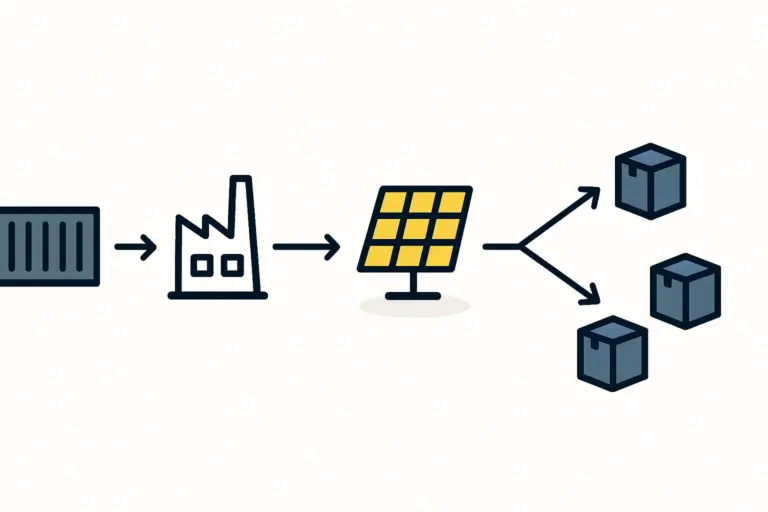
The lifeblood of a solar module factory is its supply chain. Raw materials—including glass, aluminum frames, and solar cells—are typically imported in shipping containers. Finished modules must then be transported to local markets or exported.
-
Proximity to an International Port: Port Vila on Efate and Luganville on Espiritu Santo are the only two international deep-water ports. A factory located far from these hubs will face significant additional costs for inter-island freight.
-
Secondary Port Capabilities: While other islands have smaller ports, they often cannot accommodate large container vessels. This necessitates transshipment (the process of moving cargo from a large vessel to a smaller one), which adds time, cost, and risk of damage.
-
Logistical Reliability: Assessing the frequency and reliability of inter-island shipping schedules is crucial. Delays can halt production, impacting both revenue and client commitments. A comprehensive analysis of the solar module factory infrastructure must account for potential supply chain bottlenecks.
Grid Stability and Energy Costs
A solar module assembly line relies on sensitive, automated machinery that requires a consistent and stable supply of electricity. Power fluctuations or outages can damage equipment and lead to costly repairs and production downtime.
-
Grid Infrastructure: The UNELCO grid serving Port Vila and its immediate surroundings is the most stable in the country. Outside this area, power is often supplied by smaller, localized grids or independent producers, which may experience greater frequency variations and outages.
-
Cost of Electricity: Electricity costs in Vanuatu are among the highest in the region, largely due to a reliance on imported diesel fuel for generation. These costs are often even higher on the outer islands. A factory’s business plan must accurately forecast energy expenditures, which can represent a substantial portion of its operating budget.
-
Backup Power Solutions: For any site outside the primary grid, a robust backup power strategy isn’t optional—it’s a necessity. This typically involves an on-site diesel generator and, increasingly, a battery storage system paired with a solar installation to create a microgrid that ensures operational continuity.
Land Availability and Tenure
While land may appear plentiful, the legal framework governing its use is complex. Vanuatu’s land tenure system is a dual system of both government-leased and customary land.
-
Leasehold vs. Customary Land: Government-leased land generally provides greater security for commercial and industrial development. Navigating customary land ownership requires extensive negotiation with local communities and chiefs—a process that can be lengthy and uncertain.
-
Due Diligence: Thorough due diligence is critical. This includes verifying the title, confirming land use zoning, and understanding any covenants or restrictions. Engaging a reputable local legal expert is an indispensable step.
-
Site Suitability: The physical characteristics of the land are also a key consideration. The site must be flat, stable, and not prone to flooding, particularly given Vanuatu’s exposure to cyclones. Proper geotechnical surveys should be part of any initial feasibility study for a turnkey solar production line.
Labor Pool and Technical Skills
A factory needs both a general workforce and a core team of technically skilled staff, including engineers and maintenance technicians.
-
Skill Concentration: The majority of Vanuatu’s skilled and educated workforce is concentrated in and around Port Vila. Recruiting for technical roles on an outer island will likely require offering significant incentives or investing heavily in relocation and housing.
-
Training and Development: While a general labor force can be trained for assembly line tasks, developing local technical talent is a long-term investment. Investors should factor in the cost and time of establishing a comprehensive training program. Based on past J.v.G. turnkey projects, a structured six-month training program is typically required to bring a new technical team up to operational readiness.
A Comparative Scenario: Efate vs. Espiritu Santo
To illustrate these trade-offs, consider a hypothetical investor evaluating a site for a 50 MW factory.
Location A: Efate (near Port Vila)
-
Pros: Direct access to the international port, a stable power grid, and the nation’s largest pool of skilled labor. Simplified logistics for both imports and exports.
-
Cons: Higher land lease costs and greater competition for prime industrial sites.
Location B: Espiritu Santo (near Luganville)
-
Pros: Availability of larger land parcels at a lower cost. Access to a second international port, although with less frequent global shipping connections.
-
Cons: The power grid may be less reliable, necessitating a larger investment in backup systems. The skilled labor pool is smaller, potentially requiring the relocation of key personnel. Inter-island distribution to markets on other islands would still be a factor.
Ultimately, while Location B may offer a 20% saving on initial land acquisition, the required investment in a microgrid—plus a potential 10% increase in annual logistics and staffing costs—could make Location A the more economically sound choice over a ten-year operational period.
Frequently Asked Questions (FAQ)
What is the primary challenge for manufacturing outside Port Vila?
The primary challenge is logistical friction, which includes the higher cost and lower reliability of inter-island shipping for materials and finished goods, as well as the potential instability of essential utilities like electricity.
How much more expensive can electricity be on the outer islands?
Depending on the island and the local provider, electricity tariffs can be 10-25% higher than in Port Vila due to smaller-scale generation and higher fuel transport costs. This makes an on-site solar and battery system a critical investment for cost control.
Is it feasible to train a local workforce from scratch?
Yes, it’s feasible for most assembly and operational roles, but it requires a structured and well-resourced training program. For specialized maintenance and engineering positions, it’s more realistic to plan for a mix of relocated experienced staff and a long-term local apprenticeship program.
What impact do cyclones have on factory planning?
Cyclone risk is a major consideration. The factory building itself must be engineered to the highest cyclonic building codes. Site selection should avoid low-lying or coastal areas prone to storm surges. The business continuity plan must also account for potential disruptions to shipping and infrastructure following a major weather event.
Conclusion: A Balanced Approach to Site Selection
Choosing a factory location in Vanuatu is a decision that demands a holistic, long-term perspective. The most promising sites are rarely those with the lowest initial land price. Instead, they are locations that offer the best balance of cost, logistical efficiency, and operational stability.
Successful investors conduct a rigorous feasibility study that models the total cost of ownership, accounting for the recurring expenses of logistics, energy, and skilled labor. By prioritizing infrastructure and operational resilience over superficial land savings, they lay the groundwork for a sustainable and profitable manufacturing enterprise.
For those planning such a venture, understanding these foundational business and infrastructure requirements is the first and most crucial step. A detailed business plan and feasibility analysis provide the clarity needed to make an informed investment decision.