An investor looking at Venezuela sees a paradox. The country boasts some of the highest solar irradiation levels in the world, a significant energy deficit, and clear demand for localized power generation.
Yet, headlines of hyperinflation and economic instability present a formidable barrier. For many, the financial risks associated with the volatile Venezuelan Bolívar (VED) eclipse the technical opportunity.
For the discerning entrepreneur, however, this isn’t an impassable wall but a complex problem demanding a sophisticated financial architecture. The key to unlocking Venezuela’s solar potential lies not in ignoring currency risk, but in strategically structuring the investment to insulate it from that volatility. This article explores several core financial strategies for navigating this high-stakes environment.
Understanding the Venezuelan Economic Landscape
Before devising a strategy, one must first grasp the specific nature of the financial environment. Operating in Venezuela isn’t a typical emerging market scenario; it is an economy defined by unique factors.
The country has experienced one of the most severe hyperinflationary periods in modern history. While government measures have attempted to curb this, the Bolívar remains subject to rapid devaluation. This has led to a widespread, unofficial ‘dollarization’ of the economy, where many transactions, from real estate to everyday goods, are priced and settled in U.S. Dollars, even if the official currency remains the Bolívar.
This creates a dual-currency reality for any business, forcing investors to manage costs and revenues across two different currencies—one stable and one highly volatile.
Core Financial Risks for Solar Manufacturing Investments
A solar module factory is a capital-intensive undertaking. Its primary equipment, such as a turnkey solar manufacturing line, is imported and priced in hard currency (USD or EUR), creating several points of currency exposure from the outset.
Revenue and Cost Mismatch
The most significant risk is earning revenue in a devaluing local currency while having major costs denominated in a stable foreign one. If a solar factory sells modules to local distributors for Bolivars, the value of that revenue can decrease dramatically by the time it is converted to pay for imported raw materials or service foreign-currency debt.
Asset Valuation and Depreciation
A factory’s assets, when valued in the local currency, can see their balance-sheet value plummet during hyperinflation. This complicates financial reporting and can send false signals about the health of the business to stakeholders.
Repatriation of Profits
Converting profits earned in Bolivars back into USD or EUR to pay dividends to foreign investors is a critical challenge. The process can be subject to official controls, and the exchange rate at the time of conversion can severely impact returns.
Strategic Approaches to Mitigate Currency Exposure
A robust financial strategy is proactive, not reactive. It involves building a business model that is resilient to currency shocks from day one.
Strategy 1: Structure Revenue Streams in Hard Currency
The most effective way to mitigate currency risk is to create a ‘natural hedge’ by ensuring revenues are denominated in the same hard currency as the majority of costs.
-
USD-Denominated Power Purchase Agreements (PPAs): For projects that include power generation, negotiating PPAs with large industrial or commercial clients who earn revenue in USD (e.g., mining, oil, or export-oriented businesses) is a crucial strategy. These clients can pay for electricity in dollars, directly matching the currency of the project’s financing and equipment.
-
Export-Oriented Manufacturing: A solar module factory can be structured to serve not only the domestic market but also neighboring countries in Latin America or the Caribbean. By pricing exports in USD, the facility generates the hard currency needed to cover its obligations.
Strategy 2: Optimize the Capital Structure
How a project is financed is as important as how it operates. The balance between equity and debt—and the currency of that financing—is critical.
-
Prioritize Equity Financing: Relying heavily on foreign-currency debt can be perilous if revenues are not fully secured in the same currency. A higher proportion of equity financing reduces fixed debt service obligations, providing more flexibility during periods of economic turbulence.
-
Cautious Use of Local Debt: Taking on debt in Bolivars can seem attractive, as hyperinflation erodes the real value of the loan over time. This is often offset, however, by prohibitively high interest rates and the scarcity of long-term financing. This approach should only be considered if a reliable and significant portion of revenue is also generated in Bolivars.
A well-researched solar manufacturing business plan is essential for modeling these capital structure scenarios.
Strategy 3: Implement Disciplined Operational and Treasury Management
Day-to-day operations must be managed with currency risk at the forefront.
-
Minimize Local Currency Holdings: Cash held in Bolivars should be kept to the absolute minimum required for immediate operational expenses like payroll and local taxes. Any excess VED should be converted to a more stable asset as quickly as regulations permit.
-
Dynamic Pricing: For any sales made in the local market, prices must be indexed to the U.S. Dollar and adjusted frequently—daily or weekly—to reflect currency devaluation. This protects profit margins from eroding between the time of sale and receipt of payment.
-
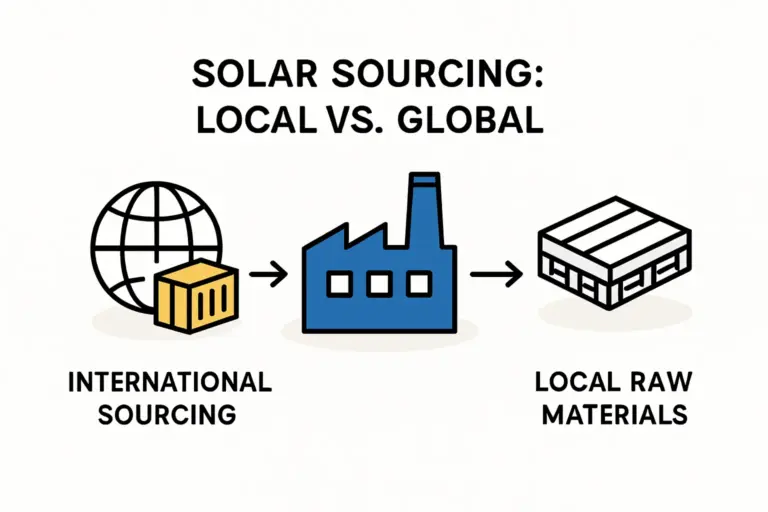
Strategic Sourcing: All inputs require careful analysis. While importing key materials like solar cells and EVA film exposes the project to currency risk, it often ensures higher quality. Sourcing locally can reduce this exposure but requires rigorous quality control. The operational investment requirements for a solar factory must account for this strategic choice.

A Practical Case Scenario: Structuring a 50 MW Project
Consider an investor planning a 50 MW solar module factory in Venezuela. A resilient financial structure might look like this:
-
Capitalization: 80% foreign equity (USD) and 20% reserved for short-term, local-currency operational credit lines.
-
Revenue Model: 70% of production is pre-sold via offtake agreements to regional industrial exporters, with contracts priced and settled in USD. The remaining 30% is sold to the domestic market with USD-indexed pricing, adjusted weekly.
-
Cost Management: All capital equipment is purchased in EUR. A six-month inventory of critical imported raw materials is maintained to buffer against supply chain and payment disruptions. Local employee salaries are paid in Bolivars but are benchmarked against a USD equivalent to retain talent.
This structure does not eliminate risk, but it makes it quantifiable and manageable. It aligns the majority of revenues with the majority of costs, insulating the core business from the volatility of the local currency.

Frequently Asked Questions (FAQ)
What is the primary financial challenge when investing in a hyperinflationary economy?
The primary challenge is the ‘asset-liability currency mismatch.’ This occurs when a company’s costs and debts (liabilities) are in a stable currency like the USD, while its income (from assets) is in a rapidly devaluing local currency. An effective strategy is therefore built on minimizing this mismatch.
Is it legally permissible to conduct business in U.S. Dollars in Venezuela?
While the Venezuelan economy is unofficially dollarized and many private transactions are conducted in USD, the official legal and tax framework can be complex. Securing expert legal counsel familiar with local regulations is imperative to ensure all contracts and transactions are structured in a compliant manner.
How can a foreign investor repatriate profits?
The mechanisms for repatriating profits can change with government policy and have historically been a significant challenge. Structuring the investment through legally sound frameworks and potentially working with international financial institutions can provide pathways. Specialized legal and financial advice is non-negotiable.
What is the first step in assessing a project’s financial viability in Venezuela?
The first step is a detailed feasibility study with a heavy emphasis on financial modeling. This model must be able to simulate various inflation and devaluation scenarios to stress-test the project’s resilience. Platforms like pvknowhow.com provide foundational knowledge to help entrepreneurs prepare for this critical planning phase.

Conclusion: From High Risk to Calculated Opportunity
Investing in Venezuela’s solar sector is undeniably complex, but not impossible. The narrative of prohibitive risk can be reframed as one of calculated opportunity through intelligent and deliberate financial design.
By structuring revenues in hard currency, optimizing the capital stack, and enforcing disciplined treasury management, an investor can build a financial fortress around their operational assets. The journey of how to start a solar module factory in such an environment is a masterclass in financial strategy, where success is defined not just by technical execution but by economic resilience.