Angola Solar Report

Discover comprehensive insights into the statistics, market trends, and growth potential surrounding the solar panel manufacturing industry in Angola

  1. Climate Top. (2024). Sunshine & daylight hours in Luanda, Angola. Retrieved May 21, 2024, from https://www.climate.top/angola/luanda/sunlight/
  2. Solargis, (nd), Solar resource maps of Angola, Retrieved on 16 May 2025 from https://solargis.com/resources/free-maps-and-gis-data?locality=angola
  3. Voronoi, (Dec, 2024), What’s the Average Cost of 1 kWh Electricity around the World, Retrieved on 16 May 2025 from
    https://www.voronoiapp.com/energy/Whats-the-Average-Cost-of-1-kWh-Electricity-around-the-World–3398
  4. Afrobarometer. (2023). Lack of access, connection to the electric grid still plagues most rural residents in Angola. Retrieved May 21, 2024, from https://www.afrobarometer.org/wp-content/uploads/2023/07/AD664-Most-rural-Angolans-still-lack-electricity-Afrobarometer-4july23.pdf
  5. Kemp, Y. (2023). Angola leads the PV way as Africa increases solar energy capacity. ESI Africa. Retrieved May 21, 2024, from https://www.esi-africa.com/renewable-energy/solar/angola-leads-the-pv-way-as-africa-increases-solar-energy-capacity-report/
  6. Trade.gov. (2024). Angola – Country Commercial Guide. Retrieved May 21, 2024, from https://www.trade.gov/angola-country-commercial-guide
  7. Climate Scope. Angola. Retrieved May 21, 2024, from https://www.global-climatescope.org/markets/ao/
  8. Ministry of Energy Republic of South Africa. Memorandum from the Parliamentary Office. Retrieved May 21, 2024, from https://angolaenergia2025.gestoenergy.com/en/conteudo/solar-energy
  9. DLA Piper. (2022). Africa energy futures Angola. Retrieved May 21, 2024, from https://www.dlapiper.com/en-ar/insights/publications/2022/11/africa-energy-futures/africa-energy-futures-angola
  10. Statista. (2024). Share of the population with access to electricity in Angola from 2011 to 2021. Retrieved May 21, 2024, from https://www.statista.com/statistics/1221078/population-with-access-to-electricity-in-angola/
  11. Mwirigi, C. (2023). Angola secures $1.44 billion to power rural areas with solar. PV Magazine. Retrieved May 21, 2024, from https://www.pv-magazine.com/2023/07/13/angola-secures-1-44-billion-to-power-rural-areas-with-solar/
  12. Energy Capital & Power. (2023). 6 solar projects driving electrification in Angola. Retrieved May 21, 2024, from https://energycapitalpower.com/solar-energy-angola-electrification/
  13. DAR Group. Angola’s 370 MWp solar photovoltaic power plants. Retrieved May 21, 2024, from https://www.dar.com/work/project/angola%E2%80%99s-370-mwp-solar-photovoltaic-power-plants
  14. Energycapitalpower (Nov, 2022), Harnessing Angola’s Solar Power Potential, Retrieved on 23 May 2025 from https://energycapitalpower.com/harnessing-angolas-solar-power-potential
  15. International Trade Administration (Feb, 2024), Angola Country Commercial Guide, Retrieved on 23 May 2025 fromhttps://www.trade.gov/country-commercial-guides/angola-energy
  16. The Energy Year. (2024). Angola’s power generation and electrification ambitions. Retrieved May 21, 2024, from https://theenergyyear.com/articles/angolas-power-generation-and-electrification-ambitions/
  17. World Salaries. (2024). Average solar photovoltaic installer salary in Angola. Retrieved May 21, 2024, from https://worldsalaries.com/average-solar-photovoltaic-installer-salary-in-angola/
  18. Worldometer. (2024). Population of Angola. Retrieved May 21, 2024, from https://www.worldometers.info/world-population/angola-population/
  19. OEC World. Angola. Retrieved May 21, 2024, from https://oec.world/en/profile/country/ago&quot
  20. CMS Law. (2024). Renewable energy in Angola. Retrieved May 21, 2024, from https://cms.law/en/int/expert-guides/cms-expert-guide-to-renewable-energy/angola
  21. Energy Capital & Power. (2022). Five solar projects to watch in Angola. Retrieved May 21, 2024, from https://energycapitalpower.com/top-five-solar-energy-projects-in-angola/
Key points

  • All figures have been converted into USD

Yearly sunshine (sun hours per year)

The weather in Angola depends on region and season; However, it receives an average of 2,340 hours of sunlight per year, or 6 hours and 24 minutes per day.1

Read less

kWh per kWp installed

Solar output per kW of installed solar PV differs by season in Angola. It averages between 1241 to 1972 kWh/kWp.22

Read more


Average cost per kWh from utility company

3The average cost of 1 kWh electricity in Angola is 0.013USD.


Read more


Reliability of electrical power supply grid

  • According to Afrobarometer, a significant majority (78%) of Angolans connected to the power grid report that their electricity supply is reliable, working “most of the time” or “all of the time”.
  • However, a notable minority (21%) experience less reliable power, with electricity available only “about half of the time” or less.
  • When considering both connection and reliability rates, fewer than half (47%) of Angolans have access to a reliable electricity supply.
  • Disparities in access to reliable electricity are stark, with only 6% of rural residents and 28% of citizens experiencing high levels of poverty enjoying reliable power.
  • Despite Angola’s abundant energy resources, including oil, natural gas, and hydroelectric power, the country struggles with power shortages due to underdeveloped infrastructure and economic challenges. The growing interest in Angola solar energy projects may offer a potential solution to these energy challenges. 4

Read less


Detailed Information

  • All figures have been converted into USD
  • Total solar panel production capacity (installed)

    As of the end of 2023, Angola had 284 MW of installed photovoltaic (PV) capacity.5

    Total solar panel production capacity (projected)

    Angola’s Ministry of Energy and Water (MINEA) estimates that the country has the potential for 16.3 GW of solar power generation capacity.6

    Average costs of various electricity generation sources (coal, natural gas, solar, etc)

    The average price of electricity in Angola in 2022 was $21.52/MWh.

    Coal

    Not available.

    Natural Gas 7

    The average cost of electricity generation in Angola from natural gas was $21.52/MWh in 2022.

    Solar 8

    • Medium and large-scale solar projects, particularly those in the Eastern System and isolated systems without batteries, have achieved a levelized cost of electricity below $0.2 per kilowatt-hour (kWh).

    Percentages of various electricity generation sources (coal, natural gas, solar, etc)

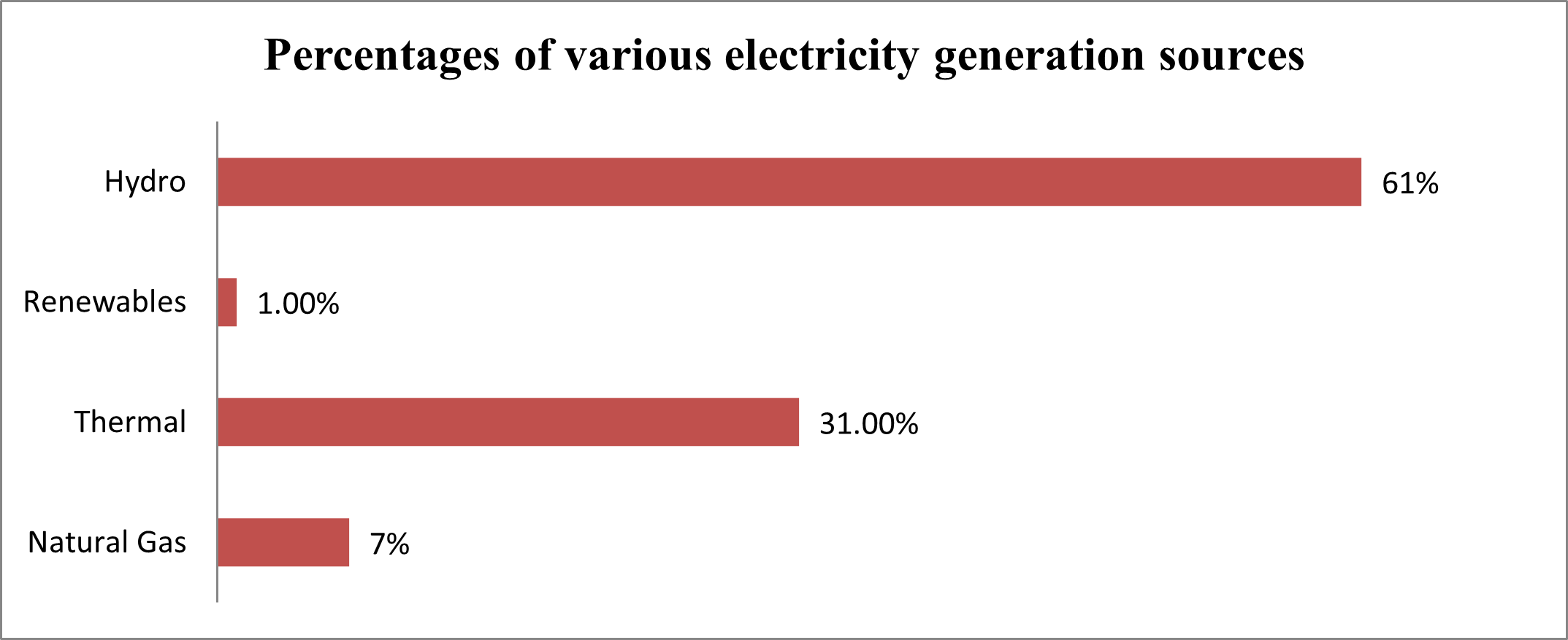
    In the last five years, Angola’s energy mix has changed considerably. Installed capacity is now over 4,889 GW, distributed by the following types of power generation: (i) hydro at 61%, with a capacity of 3,005 GW; (ii) thermal at 31% with an installed capacity of 1,866 GW; (iii) natural gas at 7%, with 0.375 GW; and (iv) renewable at 1% with 0.063 GW. 9

    Figure 02: Percentages of various electricity generation sources

    Average daily availability of electricity from the national grid (measured in hours)

    10

    • Exact number of hours is not mentioned in any data.
    • Angola has made progress in increasing access to electricity, with 48.22% of the population having access to electricity in 2021, the highest rate observed in the period. However, a significant gap remains between access to electricity and reliable electricity supply.
    • Only 34% of Angolans have access to reliable electricity, with a stark disparity between urban and rural areas. In rural areas, a mere 10% of the population has access to reliable electricity.
    • Electrification rates vary significantly across the country, with most cities achieving around 43% access, while rural areas lag far behind at less than 10%. As a result, both residents and businesses are forced to rely on diesel generators for power, highlighting the need for continued investment in Angola’s energy infrastructure.

    Number of residential solar panel installations

    1112

    • As of recent data, the number of residential solar panel installations in Angola is also not extensively documented in public sources.
    • In a significant development, Angola’s Ministry of Finance is funding the construction of 48 solar PV systems across five provinces – Moxico, Lunda Norte, Lunda Sul, Bie, and Malanje – as of March 2024.
    • This ambitious project aims to provide electricity to approximately one million people, marking a substantial step towards addressing the country’s energy challenges. The initiative will add a significant 296 MW of solar capacity and 719 MWh of battery energy storage to the Angolan grid, paving the way for a more sustainable and reliable energy mix.

    Total number of solar farms (installed and projected)

    13

    • Angola has made significant strides in harnessing solar energy, with three solar farms currently operational. Notably, the country’s first two utility-scale solar photovoltaic plants, located in Biopio and Baia Farta, were inaugurated on July 20th, 2022.
    • These plants boast an impressive 770,400 solar panels, accompanied by comprehensive civil and electrical infrastructure, including all necessary equipment and accessories.

    Off-grid market demand for solar panels (current and projected)

    14

    • Angola’s off-grid solar market is still in its nascent stages, with only 3,000 Solar Home Systems (SHS) sold as of July 2022. However, the country presents vast potential for growth in the solar market, particularly in SHS and Pay-as-You-Go schemes.
    • Furthermore, there are estimates that the commercial market for off-grid solar power in Africa is to be a substantial $24 billion per year, indicating immense opportunities for Angola to tap into this growing market and accelerate its transition to renewable energy.

    Projected Demand

    • While specific projections for Angola’s off-grid solar market demand are not readily available, the overall global off-grid solar market continues to grow.
    • To address rural demand, the government is pursuing the development of small-scale off-grid projects, using both fossil fuels and renewable technologies (small hydro, solar, wind, and biomass).

    On-grid market demand for solar panels (current and projected)

    Current Demand 11

    Angola has several on-grid projects to improve its electricity access and diversify its energy mix:

    • 48 hybrid PV systems
    • In a significant development, the Angolan Ministry of Finance has secured a substantial loan of €1.29 billion (approximately $1.44 billion) from Standard Chartered to finance an ambitious renewable energy project.
    • The funds will be used to construct 48 hybrid PV systems across five provinces: Moxico, Lunda Norte, Lunda Sul, Bie, and Malanje.
    • These minigrid systems will have a combined capacity of 296 MW of solar energy, complemented by 719 MWh of energy storage in lithium-ion batteries.
    • The project, expected to be implemented over 36 months, aims to provide sustainable electricity to around 200,000 households, marking a significant step towards increasing access to renewable energy in Angola.
    • Power Africa 23This project will connect Angola’s three regional power grids into a national grid for the first time. It will also bring hydropower from the Kwanza River basin to southern provinces and install prepaid meters to increase access to electricity.
    • Electrification project in eastern provinces

    This project will provide electricity to more than 900,000 people in 60 locations.

    • Solar projects

    Angola is also working on two solar plants as part of a $1.3 billion infrastructure deal with the United States, which is expected to generate more than 500 MW of renewable power

    • Africa mini-grids program

    Angola is part of this program, which aims to identify the best ways to deploy mini grids, use energy productively, and digitize mini grids.

    Projected Demand 16

    • Angola has a pipeline of significant solar projects set to come online before 2025, including the second phase of the Caraculo solar project, which will add 50 MW to the grid following the commissioning of its first phase in May 2023.
    • Other notable projects include the 370-MW Lucapa solar plant, expected to begin production by Q1 2024, and the Luena Solar Energy Park, a 27-MW project slated for completion in 2024.
    • Looking ahead to 2026, Angola is poised to launch its largest solar project to date. In June 2023, the Export-Import Bank of the United States approved a record $900-million loan to support the development of two solar facilities with a combined capacity of 500 MW in the provinces of Malanje and Luanda.
    • This investment, part of the USA’s Global Infrastructure and Investment Partnership, is being led by American infrastructure entities Africa Global Schaffer and Sun Africa, further solidifying Angola’s position as a growing player in the global solar energy market.

    Average monthly income of workers in solar industry (labor cost)

    A solar photovoltaic installer working in Angola will typically earn around:17

    • Lowest Average Salary: $1,195.92/yr
    • Average Salary: $2,346.36/yr
    • Highest Average Salary: $3,616.20/yr

    Population of the country

    As of May 23, 2024, the population of Angola was 37,673,003, according to Worldometer.18

    Average overhead costs of solar panel production (with a brief breakdown)

    Detailed  information isn’t readily available.

    A summary of the energy infrastructure

    23

    Electricity Generation

    Angola has an estimated installed capacity of 5.7 GW, though only 70 percent is operational. Its energy mix is predominantly hydropower at 61.8 percent, followed by other fossil fuels at 37.6 percent, and 0.6 percent from hybrid (solar/fossil fuel) sources.

    Transmission & Distribution

    • Angola’s power transmission network is organized into three primary, geographically distinct grid systems—northern, central, and southern—supplemented by smaller, isolated eastern grids. The northern grid primarily uses 400kV and 220kV lines, spanning Luanda, Uige, Bengo, Zaire, Malange, Kwanza Norte, and Kwanza Sul provinces. The central network employs 220kV lines, connecting Benguela to Huambo and Bie. The southern grid, also using 220kV lines, serves Huila and Namibe.
    • Although a comprehensive north-central-south backbone is planned to significantly expand the grid from 3,354 km to 16,350 km by 2025, existing high-capacity lines (400 kV) linking the four main power generation plants (Lauca, Capanda, Cambambe, and Soyo combined cycle) already provide a degree of inter-grid connectivity and operational resilience. At present, the northern and central backbones are linked, integrating 10 of Angola’s 18 provinces: Luanda, Bengo, Uíge, Cuanza Norte, Cuanza Sul, Benguela, Huambo, Bié, Malanje, and Zair

    Energy Access 

    • Due to low electrification rates, estimated at 43% in cities and below 10% in rural areas, diesel generators are a primary power source for Angolan consumers and businesses. This reliance, coupled with government plans to cut subsidies and raise fuel and electricity prices, is set to boost demand for alternative energy solutions.

    Energy exports 19

    Angola’s major energy exports consist of crude oil and petroleum gas. The country’s earnings from these commodities in 2023 reached $31.6 billion for crude oil and $2.57 billion for petroleum gas.

    Some of the government regulations surrounding solar panel production

    20

    To foster investment in its renewable sector by 2025, the Angolan government is considering several strategic initiatives. These include establishing dedicated legislation for new renewable energies, approving predetermined subsidized tariffs for grid-connected projects up to 10MW, and re-evaluating the tax system.

    Furthermore, plans involve allocating at least $1.2 million annually to the National Electricity Fund by 2025 to bolster rural electrification via renewables and creating subsidized credit lines for individual system purchases or business ventures. The government also intends to ensure the creation of at least one renewable energy training facility and launch public awareness campaigns highlighting renewable energy benefits, particularly for rural energy access and solar thermal applications.

    More recently, the Angolan government enacted Executive Decree No. 78/23 (May 30, 2023), outlining General Guidelines for the Development of the Rural Electrification Plan. This plan’s core aim is to bring electricity to remote regions currently unserved by and unlikely to be connected to the national grid within a decade.

    The guidelines specify short, medium, and long-term objectives. Immediate priorities encompass establishing a policy and regulatory framework to encourage private sector involvement in electrification (including installation, operation, maintenance, and energy sales), implementing fiscal incentives to stimulate private investment, and introducing measures to mitigate investment risks.

    A pilot public tender for private operators to install mini-grids will be launched to validate the model for broader replication. Additionally, a planning unit, the National Electrification Agency, is to be established to manage mini-grid and solar kit programs in designated areas, ensuring future tenders are well-organized and supporting potential private operators and financial partners.

    Government initiatives in solar panel production (includes investments and subsidies)

    Ongoing external financial support is crucial for Angola to sustain its critical energy initiatives and procure necessary equipment.2320

    • Angola significantly increased its budgetary allocation to the electricity sector (production, transmission, and distribution), rising from $490 million in 2022 to $817.2 million in 2023, with an additional $249.4 million specifically for electricity assessment in the national budget.

    • A crucial element for Angola to achieve its power generation targets, especially in renewable energy, will be securing robust Power Purchase Agreements (PPAs) with experienced private developers. Furthermore, government backing and various credit enhancements will be vital to mitigate political, off-taker, foreign currency, and other risks for successful private sector-led projects. The Angolan government is also actively seeking funding for energy dispatch centers, essential for monitoring and controlling electricity flow across the entire system.

    • In a significant development, the African Development Bank (AfDB) approved a $530 million credit facility for Angolan energy infrastructure. This funding covers a 343 km transmission line, a new 400/220/60 kV- 2 x 450 MVA substation in Lubango (Huila Province), upgrades to an existing Huambo substation, and the deployment of a SCADA control system. The tender for this project closed on November 21, 2023.

    • The national distribution company, ENDE, struggles with substantial technical and commercial losses, estimated at up to 35%. These losses stem from illegal connections, uncollected payments, a lack of payment enforcement, and the fact that roughly 80% of its customers are unmetered. Low tariffs and inherited debt also present significant hurdles. To address these operational and revenue challenges, ENDE initiated a pilot program in 2015, installing 1,500 smart meters using equipment from U.S. firms Itron and Landis & Gyre.

    Also, as of January 2024, the Angolan government offers the following tax credits and incentives for solar and other renewable energy investments:

    • A tax credit of up to 50% of the investment amount for up to 10 years
    • A reduction in CIT, IIT, property tax, and stamp tax rates for up to 15 years
    • An increase in depreciation and reinstatement rates of up to 80% for up to 10 years for investments in Zones B, C, and D
    • The possibility of deferring tax payments, except VAT
    • Subsidized tariffs for renewable projects that are grid-connected and up to 10MW
    • Subsidized credit lines for the purchase of individual systems or the launch of productive activities

    Notable solar projects in the country (installed and projected)

    2112

    Solar Projects in Angola

    Operational Projects

    Biopio Solar Project (188 MWp)

    • Spearheaded by Sun Africa
    • Funded by Swedish Export Credit Corporation, K-sure, and Development Bank of Southern Africa
    • Electrifying 239,222 houses

    Bay Full Solar Project (96.7 MWp)

    • Located in Benguela province
    • Covers 186 hectares with 261,230 solar panels
    • Generates 96.1 MWp of electricity, reducing diesel reliance

    Caraculo PV Plant (50 MWp)

    • Developed by Eni and Sonangol
    • Situated in Namibe Province
    • First phase online in Q4 2022, providing electricity for 90,000 homes

    Upcoming Projects

    Quilemba Solar Project (35 MWp)

    • Located in Huila province
    • Construction to commence in 2022, commercial operations expected in 2024

    Off-Grid Solar Energy Systems (600 MW)

    • 30,000 solar systems to be installed in rural areas
    • Generating up to 600 MW of electricity, reducing fossil fuel reliance

    Masdar’s 150 MW Solar Project

    • Agreement signed between Angola’s Ministry of Energy and Water and Masdar
    • Developing a 150 MW solar plant, producing electricity for 90,000 homes

    Standard Chartered’s $1.44B Commitment

    • Funding for 48 solar PV systems across five provinces
    • Adding 296 MW of solar capacity and 719 MWh of battery energy storage

    Angola Solar Energy Project

    • $900 million funding from U.S. Export-Import Bank
    • Installing two solar PV facilities with a combined capacity of 500 MW

    Luena Solar Energy Park

    • Expected to start operations in 2024
    • Located in Moxico province, comprising 42,560 solar panels with a total capacity of 26,906 MW

    Some of the notable solar companies (plus brief details on what they do)

    Sun Africa

    • Website: (https://www.sunafrica.com)
    • Services: Specializes in large-scale solar projects, offering comprehensive solutions from development and financing to construction and operation. Sun Africa has been involved in multiple projects across Angola, including the significant solar initiative to power rural areas.
    • Projects: Notable for their 370 MW solar project, which includes battery storage systems, aimed at enhancing Angola’s renewable energy capacity.

    Total Eren

    • Website: (https://www.total-eren.com/ )
    • Services: Focuses on the development, financing, construction, and operation of renewable energy power plants. Total Eren’s expertise covers solar photovoltaic (PV) and other renewable sources.
    • Projects: Known for their involvement in the Quilemba Solar project, a major 35 MW solar farm that supports Angola’s efforts to diversify its energy mix.

    ENDE (Empresa Nacional de Distribuição de Electricidade)

    • Website: (https://www.ende.co.ao/ )
    • Services: Angola’s national electricity distribution company, which has been pivotal in integrating solar energy solutions into the national grid. They work on solar installations to support rural electrification.
    • Projects: ENDE has been integral in the rollout of solar mini-grids to remote regions, aiming to provide sustainable and reliable power access.

    Genneia

    • Website: (https://www.genneia.com.ar/ )
    • Services: Provides renewable energy solutions, with a focus on solar and wind power. Their services include project development, construction, and maintenance.
    • Projects: Involved in the development of solar projects that contribute significantly to Angola’s renewable energy targets, such as the integrated solar power projects in various provinces.

    Soltec

    • Website: (https://www.soltec.com/ )
    • Services: Specializes in manufacturing and supplying solar tracking systems. Soltec’s services include the design, construction, and maintenance of solar power plants.
    • Projects: Engaged in projects that implement advanced solar tracking technologies, enhancing the efficiency and output of solar farms in Angola.

    These companies are contributing to Angola’s solar energy landscape through diverse and impactful projects, driving the country’s transition to renewable energy sources.

More about Angola Solar Business

Our Services

Business Plan E-Course 

Learn more about our free e-Course here

Full Scale Solar Production Service

Learn more about our full scale production service here

Consulting Service

Learn more about our free consulting service here

Turnkey Service

Learn more about our free turnkey service here

Are you interested in starting your own solar module production line?

We can help you start your own solar module production company. With our 100% turnkey service, we will deliver the needed machines, do a technology transfer, provide expert and excellent support, and help you with the know-how needed to start even if you don't have any previous experience in this industry.

Start Your Own Solar Panel Production Line Today!

>