When considering a new venture, investors typically evaluate a country based on its market potential, labor force, and infrastructure. Yet the most decisive factor is often the financial framework—the specific incentives, tax structures, and government support available. For entrepreneurs looking to establish a solar manufacturing plant, Belize presents a compelling case, not just for its strategic location and climate, but also for its deliberate, structured approach to attracting industrial investment.
While many assume such incentives are complex and difficult to navigate, especially for foreign nationals, the opposite is often true in Belize. The government has established clear programs designed to reduce initial capital outlay and improve long-term profitability for ventures aligned with its economic goals. This article outlines the key financial support available to those planning to enter the solar module production sector in Belize.
Table of Contents
The Foundation of Belizean Investment: BELTRAIDE
For any prospective investor, the Belize Trade and Investment Development Service (BELTRAIDE) is the essential first point of contact. This government agency acts as a central facilitator, guiding businesses through the application process for various incentive programs. Instead of navigating multiple ministries independently, investors can work directly with BELTRAIDE to identify the most suitable framework for their project.
This single-point-of-contact approach simplifies what is often an opaque process—a common challenge for international entrepreneurs setting up operations in new territories. It reflects a core component of Belize’s stable business environment: a commitment to transparency and support for foreign direct investment.
Path 1: The Designated Processing Area (DPA) Program
For an export-oriented business like solar module manufacturing, the Designated Processing Area (DPA) program is often the most advantageous route. A DPA is a special zone that provides significant tax and duty exemptions to businesses that export the majority of their products.
The primary objective of the DPA is to stimulate manufacturing for export, create employment, and facilitate technology transfer—all goals that directly support the establishment of a modern solar panel factory.
Key Benefits of the DPA Program:
- Income Tax Exemption: Businesses operating within a DPA are typically exempt from income tax for an initial period, often around 10 years.
- Full Import Duty Exemption: This is arguably the most critical benefit for a solar manufacturer. All capital equipment—such as stringers, laminators, and testers—as well as raw materials like solar cells, glass, and EVA foil, can be imported without duty. For a 20–50 MW facility, this can translate into substantial savings on initial setup costs.
- Exemption from Other Taxes: The program usually includes exemptions from sales tax, property tax, and trade turnover tax.
- Dividend Tax Exemption: Taxes on dividends paid to shareholders are also waived for the duration of the incentive period.
To qualify, a business must typically export at least 85% of its goods or services. Given that a new solar factory in Belize would likely target markets in the Caribbean Community (CARICOM) and Central America, this requirement is often easily met.
Path 2: The Fiscal Incentives Act
If a project is geared more toward the domestic market or doesn’t fit the export-focused DPA model, the Fiscal Incentives Act provides an alternative pathway. This program is designed to encourage both local and foreign investment in productive enterprises.
While the DPA is geographically specific to a designated zone, the Fiscal Incentives Act can apply to businesses located anywhere in the country.

Ready to make big Profits?
The solar Industry is Booming
WE HELP NEWCOMERS to the solar industry start their own solar module production line. Customers can make BIG PROFITS by selling modules and finding investors, without wasting money and time on things they don't need!
Key Benefits of the Fiscal Incentives Act:
- Tax Holiday: Approved companies can benefit from a tax holiday, exempting them from corporate income tax for up to 20 years. The length of the holiday is tied to the level of investment and its contribution to the local economy.
- Duty Exemption: Similar to the DPA, this act allows for duty exemptions on capital equipment and, in some cases, on raw materials needed for production.
The decision between applying for DPA status and seeking benefits under the Fiscal Incentives Act depends on the business model. BELTRAIDE provides essential guidance to help investors determine which program best fits their specific plan.
Broader Financial Environment and Support
Beyond these two primary programs, the broader financial landscape in Belize offers additional stability and support for investors.
Development Finance Corporation (DFC): The DFC is a state-owned development bank that provides financing to various sectors. While its primary focus has historically been on agriculture, tourism, and housing, it remains a key player in the country’s economic development. For a large-scale industrial project, the DFC may not be the primary lender but could potentially finance smaller aspects of the supply chain or support local partners.
Currency Stability: The Belizean Dollar (BZD) is pegged to the US Dollar (USD) at a fixed rate of 2:1. This peg eliminates currency fluctuation risk for investors operating with USD, providing a stable and predictable financial environment for planning and operations.
Profit Repatriation: Belize’s framework generally allows for the repatriation of profits and capital—a crucial consideration for any foreign investor.
Understanding and leveraging these financial frameworks is a cornerstone of successfully planning and establishing a solar manufacturing facility. As J.v.G. Technology GmbH has observed in turnkey projects globally, a supportive government framework can significantly de-risk an investment and shorten the path to profitability.
Frequently Asked Questions (FAQ)
- What is the main difference between the DPA program and the Fiscal Incentives Act?
The primary difference is the business focus. The DPA program is specifically for export-oriented businesses operating within a designated zone, offering a comprehensive package of exemptions. In contrast, the Fiscal Incentives Act is broader, applying to businesses anywhere in the country that serve either domestic or export markets, and it offers a tax holiday and duty exemptions tailored to the specific project. - Is direct government financing available for a foreign-owned solar factory?
While direct government grants for large-scale industrial projects are uncommon, the incentive programs represent significant indirect financial support by drastically reducing tax burdens and initial capital costs. For direct lending, investors would typically approach commercial banks or international financial institutions, though the Development Finance Corporation (DFC) might be involved in a smaller capacity. - What is the exact role of BELTRAIDE in the investment process?
BELTRAIDE functions as a “one-stop shop” for investors. Its role is to provide information, help investors prepare and submit applications for incentive programs, and act as a liaison between the investor and various government ministries. They do not provide funding but facilitate the entire setup process. - Are there any restrictions on repatriating profits from Belize?
Belize’s legal framework is favorable to foreign investors and generally permits the repatriation of profits, dividends, and capital. It is always recommended to seek formal clarification from the Central Bank of Belize and legal counsel during the planning phase. - How long does the application process for these incentives typically take?
The timeline can vary depending on the project’s complexity and the application’s completeness. However, because BELTRAIDE streamlines the process, a decision on an application for DPA status or Fiscal Incentives can often be reached within a few months, which is remarkably efficient compared to many other jurisdictions.
Next Steps for Exploration
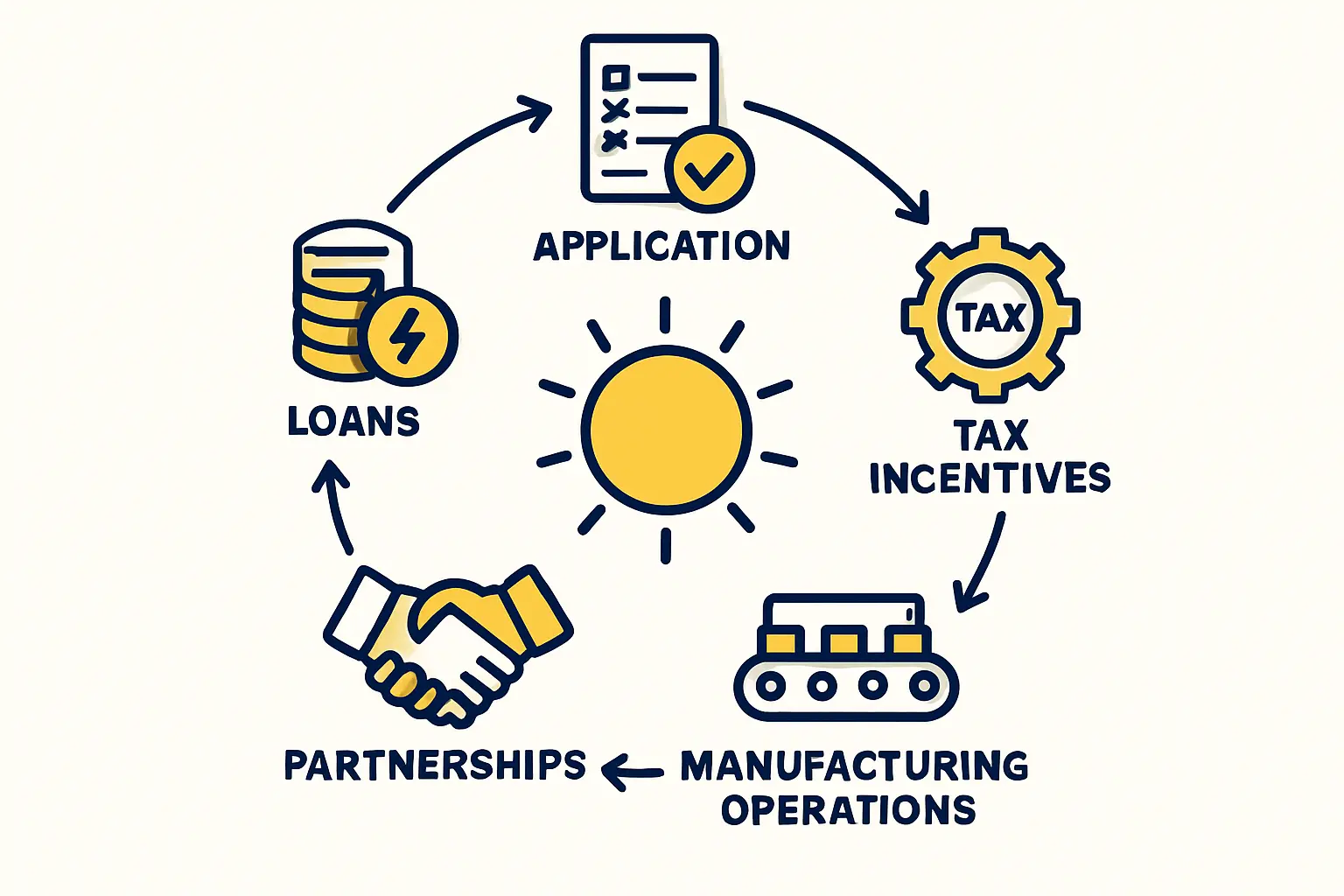
Belize offers a remarkably clear and supportive pathway for entrepreneurs interested in solar manufacturing. The available incentives are not just abstract policies; they are practical tools designed to make large-scale industrial projects financially viable.
For those in the early stages, the logical next step is to develop a preliminary business plan outlining the intended scale of production, target markets, and estimated capital requirements. This foundation enables a more substantive discussion with BELTRAIDE to map out the most effective financial strategy for your venture. A structured approach, like the one taught in the pvknowhow.com e-course, can provide a clear roadmap for this initial planning phase.