An entrepreneur planning a solar module factory often focuses on machinery, labor, and financing. Yet logistics efficiency is a critical—and frequently underestimated—factor. An efficient Cabo Verde import process for raw materials and streamlined export of finished products can make or break the profitability of the entire operation.
For a new venture in an island nation like Cabo Verde, understanding the nuances of its port operations isn’t just an advantage—it’s essential for success. This guide covers the logistics of using Cabo Verde’s key ports, Praia and Mindelo, for solar manufacturing. We explore the strategic advantages, procedural steps, and common challenges investors face, offering a clear framework for planning an effective supply chain.
Table of Contents
The Strategic Position of Cabo Verde in Global Trade
While an archipelago might seem like a logistical challenge, Cabo Verde’s location offers a unique strategic advantage. Positioned at the crossroads of shipping lanes connecting Africa, Europe, and the Americas, it serves as a natural maritime hub.
This position is particularly valuable for a solar module factory aiming to serve the growing West African market (ECOWAS) while maintaining access to European and American technology and markets.
The government has amplified this advantage by investing in Special Economic Zones (SEZs), such as the Zona Económica Especial Marítima (ZEEM) in São Vicente, which provide significant fiscal incentives. These zones are designed to attract foreign investment by offering tax exemptions and simplified customs procedures, making them ideal for import-export manufacturing.
An Overview of Key Ports: Praia and Mindelo
Cabo Verde has two primary international ports that form the backbone of its logistics infrastructure. While both are highly capable, they have distinct characteristics that suit different business strategies.
Porto da Praia
Located in the capital city on the island of Santiago, Porto da Praia is the country’s busiest port.
Key Strengths: As the primary container terminal, it handles the majority of the country’s containerized cargo. Its proximity to the nation’s capital means administrative and government agencies are readily accessible, simplifying paperwork and official approvals.
Best Suited For: Operations requiring frequent container shipments and close coordination with government bodies.
Ready to make big Profits?
The solar Industry is Booming
WE HELP NEWCOMERS to the solar industry start their own solar module production line. Customers can make BIG PROFITS by selling modules and finding investors, without wasting money and time on things they don't need!
Porto Grande (Mindelo)
Situated on the island of São Vicente, Porto Grande is renowned for its deep-water natural harbor, one of the best in the Atlantic.
Key Strengths: It is a major center for transshipment, ship repair, and logistics services. The development of the ZEEM around Mindelo underscores its strategic importance for industrial and export-focused activities.
Best Suited For: A large-scale manufacturing facility focused heavily on exports, leveraging special economic zone incentives and superior maritime infrastructure.
The Import Process: Bringing Raw Materials to Your Factory
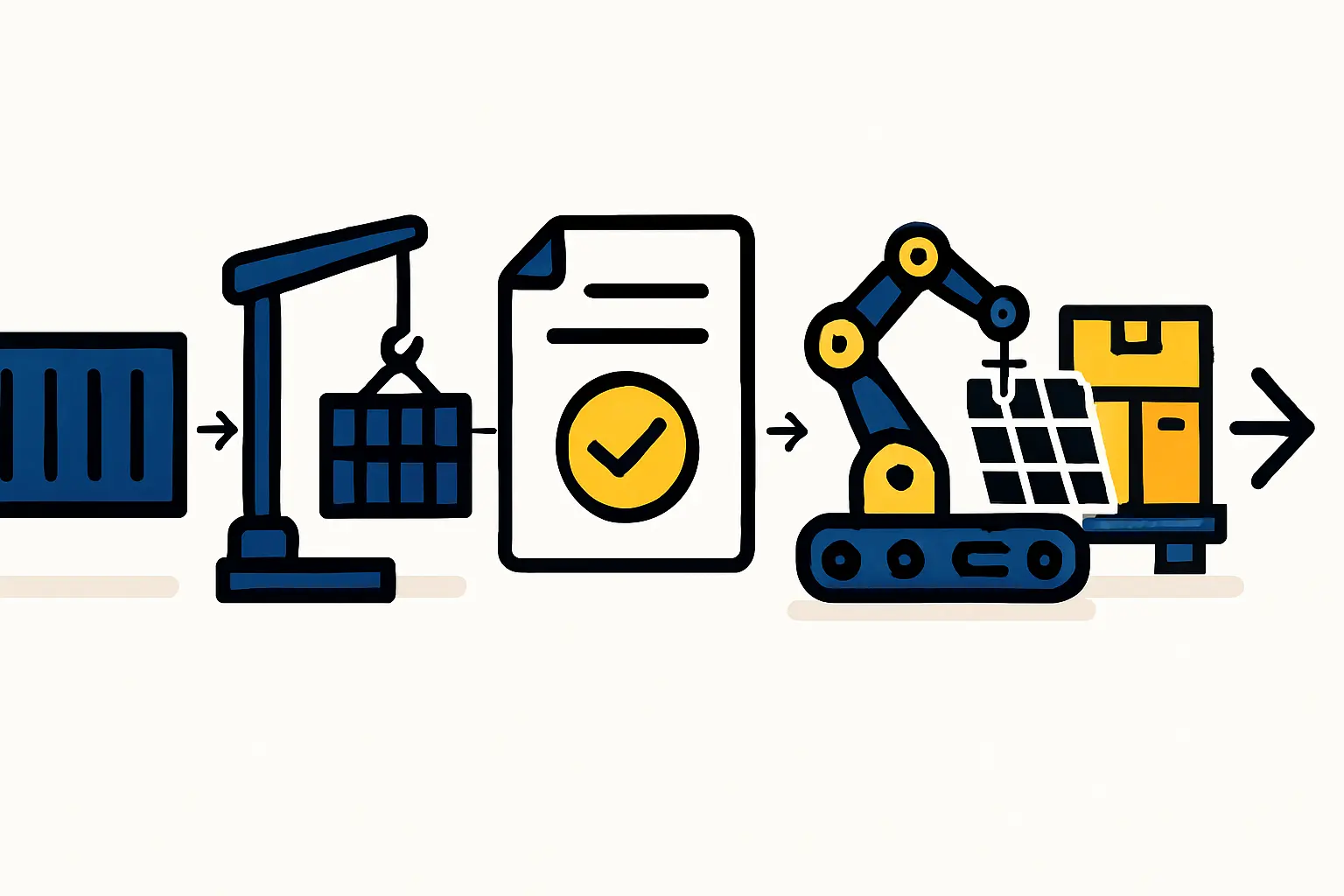
The first half of the supply chain is the Cabo Verde import process for all necessary components. A typical solar panel manufacturing process requires materials such as solar cells, tempered glass, EVA film, backsheets, and aluminum frames. These are almost always sourced internationally from suppliers in Asia or Europe.
The process generally follows these steps:
- Supplier Coordination: The manufacturer places orders and arranges for shipment, typically in 20-foot or 40-foot containers.
- Shipping and Documentation: The supplier provides essential documents, including the Bill of Lading, Commercial Invoice, and Packing List. Accuracy is critical, especially for the description and Harmonized System (HS) codes for all goods.
- Arrival at Port: When the vessel arrives in Praia or Mindelo, the container is offloaded.
- Customs Declaration: A local, licensed customs broker submits a formal customs declaration on the manufacturer’s behalf. This is a mandatory step.
- Inspection and Clearance: Cabo Verdean customs (Direcção Nacional de Receitas do Estado) may select the container for physical inspection. Assuming all paperwork is correct, clearance typically takes 3 to 7 business days.
- Inland Transport: Once cleared, the container is transported by truck from the port to the factory site.
Experience from J.v.G. Technology GmbH’s turnkey projects shows that meticulous documentation is the single most important factor in avoiding costly delays at this stage.
The Export Process: Shipping Finished Modules to Global Markets
Once solar modules are manufactured and pass all quality control and certification checks, they are ready to export from Cabo Verde.
- Packaging: Modules are carefully crated and palletized to prevent damage during transit. The total weight and dimensions are calculated for the shipping manifest.
- Booking Freight: The manufacturer books space on a container vessel destined for the target market.
- Export Documentation: Required documents include a Commercial Invoice, Packing List, and a Certificate of Origin. The Certificate of Origin is crucial for the buyer to benefit from any preferential trade agreements.
- Container Loading and Port Delivery: An empty container is delivered to the factory, loaded with the finished modules, sealed, and transported back to the port.
- Export Customs Clearance: A customs declaration for export is filed. This process is generally faster and simpler than import clearance.
- Shipment: The container is loaded onto the vessel for its journey to the customer.
Navigating Customs, Costs, and Timelines
For any entrepreneur creating a viable solar panel manufacturing business plan, understanding the financial and time implications of logistics is essential.
Customs and Tariffs
Standard import duties and Value-Added Tax (VAT) may apply to raw materials. However, operations established within a designated Special Economic Zone can often benefit from full or partial exemptions. This powerful incentive can significantly reduce operational costs. Engaging with Cabo Verde’s investment promotion agency (Cabo Verde TradeInvest) early in the planning process is essential for clarifying applicable incentives.
Typical Costs
Beyond taxes, an investor should budget for:
- Ocean Freight: Varies significantly based on origin, destination, and market conditions.
- Port Handling Fees: Charges for loading and unloading containers.
- Customs Brokerage Fees: Professional fees for managing the clearance process.
- Inland Transportation: Costs for moving containers between the port and the factory.
- Demurrage/Detention: Fees charged by shipping lines if a container is not cleared and returned within a specified free period—a costly reminder of the price of delays.
Estimated Timelines
- Import Customs Clearance: 3–7 business days (assuming all documents are correct).
- Export Customs Clearance: 1–3 business days.
- Shipping Time: Varies by destination (e.g., 7–12 days to Europe; 5–10 days to West African ports).
While these are planning estimates, a single error on a commercial invoice or packing list can add weeks to the clearance time.
Frequently Asked Questions (FAQ)
Q: Do I need to hire a local customs broker in Cabo Verde?
A: Yes, hiring a local customs broker is mandatory. Only licensed brokers are authorized to submit declarations to customs authorities. An experienced local partner is invaluable for navigating the specific procedures and requirements of Cabo Verdean law.
Q: What are the main advantages of using a Cabo Verde port over a mainland African port?
A: The primary advantages are political and economic stability, a more efficient and less congested port system, and strategic access to multiple continents. For businesses targeting the ECOWAS region, Cabo Verde can serve as a stable ‘nearshore’ manufacturing and distribution hub, mitigating many of the logistical and bureaucratic challenges found in certain mainland ports.
Q: Are there language barriers when dealing with port and customs authorities?
A: The official language is Portuguese. While English is spoken in many business circles, all official documentation and communication with government agencies must be in Portuguese. This underscores why a local customs broker or agent is essential for smooth operations.
Q: How do Special Economic Zones (SEZs) impact the logistics process?
A: SEZs simplify logistics by offering streamlined, ‘one-stop-shop’ administrative services and, most importantly, a more favorable customs regime. Goods moving into and out of an SEZ often face fewer inspections and are exempt from standard import/export duties. This directly lowers costs and shortens timelines.
Next Steps in Your Planning Journey
Successfully navigating the logistics of Praia and Mindelo comes down to careful planning and partnership. While the procedures themselves are standardized, efficient execution hinges on flawless documentation and strong local relationships. This logistical framework is a cornerstone of any successful manufacturing operation in Cabo Verde.
For entrepreneurs beginning this journey, your next step is to integrate these logistical considerations into a comprehensive financial model and operational strategy. A deep understanding of the supply chain is fundamental to building a resilient and profitable solar enterprise.