For an entrepreneur in Honduras, the vast U.S. solar market can seem both promising and impenetrable. News of import tariffs and complex trade regulations often paints a picture of high barriers to entry.
Yet a powerful, often-overlooked strategic tool offers a significant competitive advantage: The Dominican Republic-Central America Free Trade Agreement (CAFTA-DR).
Understanding this agreement is more than a legal formality—it’s a fundamental part of a successful business strategy. For a solar module manufacturer in a member country, CAFTA-DR can transform a potential tariff liability into a decisive market advantage by providing preferential access to one of the world’s largest renewable energy markets. This guide explains the core principles of the agreement and their direct application to solar module manufacturing.
What is the CAFTA-DR Agreement?
The Dominican Republic-Central America Free Trade Agreement is a comprehensive trade agreement between the United States and a group of smaller developing economies: Costa Rica, the Dominican Republic, El Salvador, Guatemala, Honduras, and Nicaragua.
The agreement’s primary purpose is to reduce barriers to trade and investment between the member nations. It achieves this by eliminating tariffs, streamlining customs procedures, and establishing clear, transparent commercial rules. For manufacturers within this bloc, it offers a stable and predictable framework for accessing the U.S. market.
The Strategic Advantage for Solar Manufacturers: Bypassing Tariffs
The U.S. often uses tariffs to manage the import of goods, including solar modules. These duties, such as those imposed under Section 201, can add substantial cost to imported products, making it difficult for foreign manufacturers to compete on price with domestic producers.
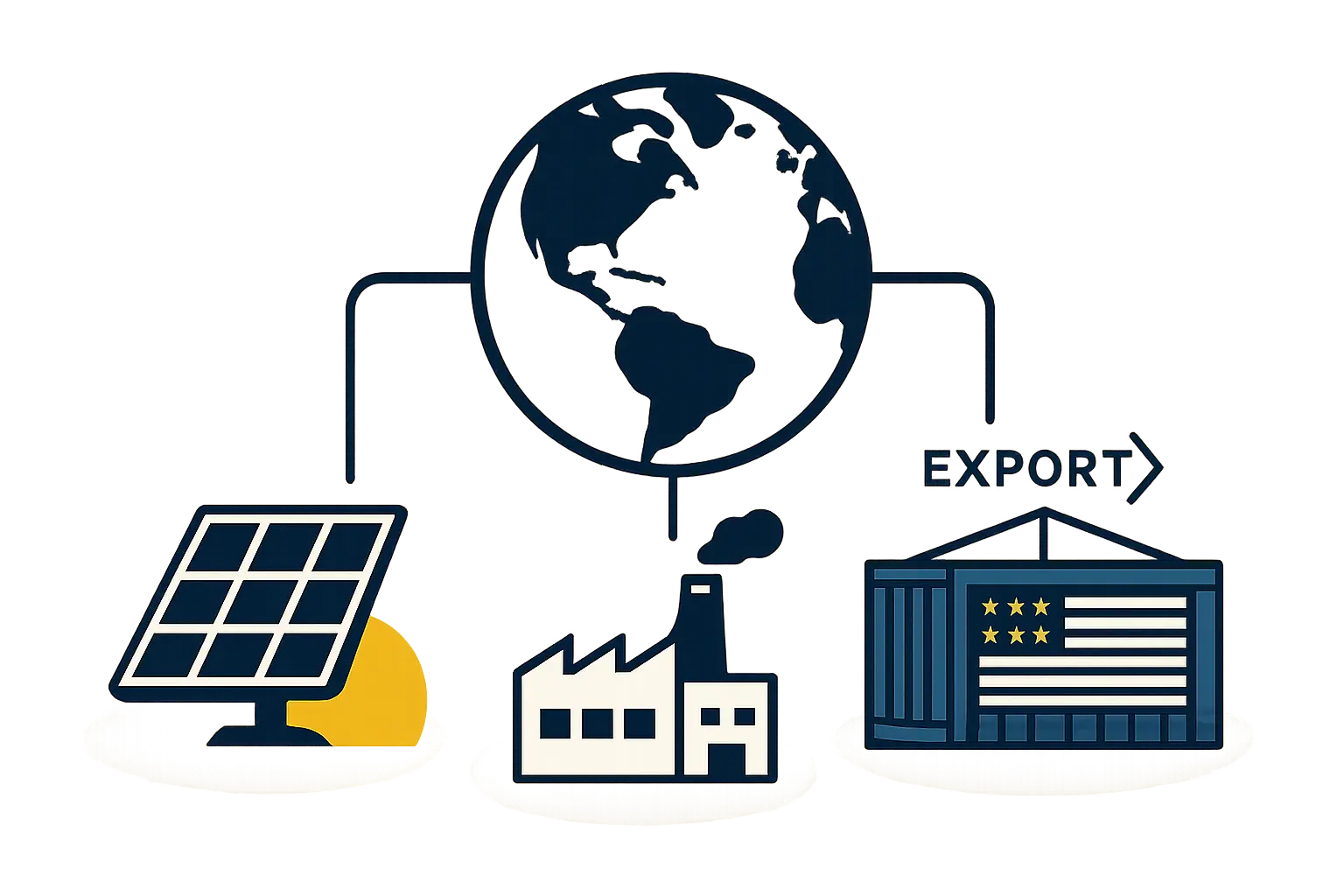
This is precisely the challenge that CAFTA-DR’s most critical benefit addresses. Solar modules that are proven to ‘originate’ from a member country like Honduras are eligible for duty-free entry into the United States. This exemption can create a cost advantage of 10-15% or more compared to modules imported from countries not covered by such an agreement.
For a new manufacturing business, this advantage is foundational to its financial viability and market positioning. Crafting a strong solar panel manufacturing business plan thus requires a thorough analysis of these trade dynamics.
Understanding the ‘Rules of Origin’ for Solar Modules
This duty-free benefit is not automatic; a solar module must meet specific ‘Rules of Origin’ to qualify. These rules ensure the agreement’s benefits go to producers within member countries, preventing other nations from simply transshipping goods through a CAFTA-DR country to evade tariffs.
Ready to make big Profits?
The solar Industry is Booming
WE HELP NEWCOMERS to the solar industry start their own solar module production line. Customers can make BIG PROFITS by selling modules and finding investors, without wasting money and time on things they don't need!
The core concept is ‘substantial transformation,’ which means a product can’t simply be assembled from foreign components within Honduras to qualify. The manufacturing process must fundamentally alter the nature of the materials used.
Think of it like baking a cake. Flour, sugar, and eggs can be imported from outside the CAFTA-DR region. However, the process of mixing, baking, and finishing the cake within Honduras creates a new, distinct product that is considered to be of Honduran origin.
For solar modules, substantial transformation is determined mainly by two tests:
1. The Tariff-Shift Rule
This is the most common test. It requires that non-originating materials used in production undergo a specific change in their tariff classification code. The harmonized system (HS) code for a finished solar module is different from the HS codes for its individual components, such as solar cells, tempered glass, or aluminum frames. The comprehensive solar module manufacturing process—including cell stringing, lamination, and framing—is usually sufficient to meet this tariff-shift requirement.
2. The Regional Value Content (RVC) Rule
In some cases, a product must demonstrate that a certain percentage of its value was added within the CAFTA-DR region. This calculation can be complex, but it essentially requires that the cost of local materials, labor, and overhead meet a minimum threshold. Strategic sourcing of components from within the CAFTA-DR zone helps satisfy this rule.
Designing a Compliant and Competitive Supply Chain
Meeting the Rules of Origin is not an administrative afterthought but a central part of supply chain and operational planning. An aspiring manufacturer must design their entire solar production line and procurement strategy with these rules in mind.
Key considerations include:
-
Strategic Sourcing: While high-value components like solar cells may be sourced globally, sourcing other materials (e.g., glass, backsheets, frames, junction boxes) from suppliers within the CAFTA-DR region can strengthen a claim of origin and simplify compliance.
-
Meticulous Documentation: The burden of proof lies with the exporter. Maintaining detailed records of all raw materials, their country of origin, and the production processes is non-negotiable. This includes supplier declarations, production logs, and cost accounting records.
-
Certification of Origin: The exporter must be prepared to complete a Certificate of Origin for each shipment. This legal document attests that the goods meet the requirements of the CAFTA-DR agreement.
Experience from J.v.G. turnkey projects shows that entrepreneurs who integrate trade compliance into their initial factory planning phase are far better positioned for long-term success.
Frequently Asked Questions (FAQ)
Q: Does this tariff advantage apply to all countries in Central America?
A: No, it applies only to the signatory countries of the CAFTA-DR agreement: Costa Rica, El Salvador, Guatemala, Honduras, and Nicaragua, as well as the Dominican Republic. Panama, for instance, has a separate trade promotion agreement with the U.S. that has its own distinct rules.
Q: What kind of documentation is required to prove origin?
A: While a formal government-issued certificate is not always mandatory, the importer must present a certification upon request. This can be on an invoice or a separate document and must contain specific data elements. The exporter is responsible for maintaining all underlying records for at least five years to substantiate the claim.
Q: Is it difficult to meet the Rules of Origin for a solar module?
A: It requires careful planning and robust record-keeping, but it is a well-established process. The standard lamination and assembly process for a solar module is generally considered a ‘substantial transformation.’ The key challenge is not the technical process itself, but rather the discipline of managing and documenting the supply chain correctly.
Q: How stable is the CAFTA-DR agreement for long-term business planning?
A: CAFTA-DR is a binding international treaty that has been in force since 2006. While all trade agreements are subject to political dynamics, it offers a far more stable and predictable legal framework for business planning than relying on temporary tariff exemptions or annual policy reviews.

The First Step in a Global Strategy
For an entrepreneur in Honduras or a neighboring country, the CAFTA-DR agreement is more than a trade policy; it is a strategic key. It unlocks the door to the U.S. market by providing a durable and significant cost advantage over competitors from non-member nations.
By integrating the Rules of Origin into the earliest stages of planning, a new manufacturer can build a business model that is both operationally sound and strategically positioned for success in the competitive global solar industry. This foresight transforms a geographical location from a simple fact into a powerful commercial asset.