An investor considering a solar module factory in India needs a dated, state specific model. National policy can change eligibility, demand, duties, and timing, while land, power, labor, incentives, and logistics vary by state and site.
Reviewed October 2026.
Scope: This page is the India financial scenario. Use the PV production profit analysis as the general method, then apply current state, policy, customs, tariff and customer inputs. The country pages remain separate because the investment assumptions differ.
Quick answer: which India assumptions must be refreshed before investment?
- Product eligibility: confirm the exact module, cell, certification, ALMM, and tender requirements for the intended customers.
- Incentives: include PLI or state support only after written eligibility, award, milestones, audit rules, and payment timing are known.
- Trade: verify current customs classification, duty, exemptions, origin rules, and currency exposure for every imported input.
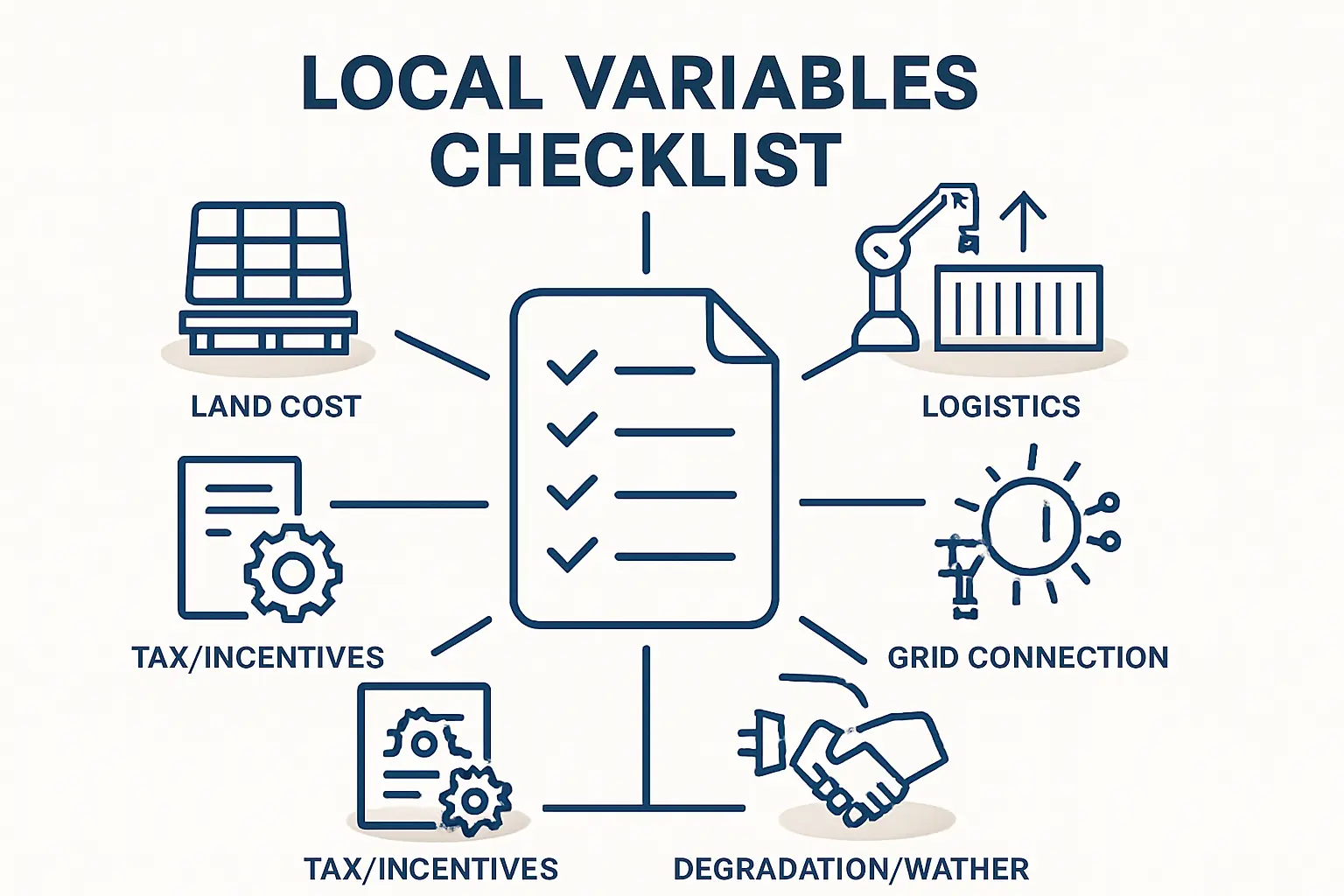
- Site: use current land, power quality, tariff, water, labor, port, freight, tax, and permit quotes for the chosen state.
- Ramp up: model certification, hiring, training, yield, downtime, rework, warranty, and customer qualification before full utilization.
Check current solar manufacturing notices with India’s Ministry of New and Renewable Energy and customs rules with the Central Board of Indirect Taxes and Customs.
Compare with the Bulgaria OPEX method and the guide to starting a module production business.
A financial model that fails to account for these local nuances is not a plan—it is a liability. This article details the critical local variables and assumptions required to build a robust financial projection for a mid-scale solar module assembly plant in India, moving beyond generic figures to pinpoint the factors that will determine the project’s financial viability.
Why a Generic Financial Model Fails in the Indian Context
National targets provide market context but are not factory revenue. A credible model must use current customer demand, procurement rules, product eligibility, price, and timing rather than assuming that a national capacity goal converts into sales.
Key differentiators include:
- Production-Linked Incentives (PLI): The government offers substantial financial incentives based on the efficiency and local value-add of manufactured modules.
- Non-Tariff Barriers: The ‘Approved List of Models and Manufacturers’ (ALMM) effectively restricts government-backed projects to using modules from a pre-approved list of domestic producers.
- Customs Duties: A significant Basic Customs Duty (BCD) is levied on imported solar cells and modules, directly impacting raw material costs and protecting local assemblers from foreign price competition.
Ignoring these elements means miscalculating revenue potential, underestimating competitive advantages, and failing to model one of the most significant streams of potential income.
Core Components of Your Financial Model: An Indian Perspective
While the core structure of a financial model—covering Capital Expenditures (CAPEX), Operational Expenditures (OPEX), and revenue—remains constant, the inputs for each section must be localized for India.
Ready to make big Profits?
The solar Industry is Booming
WE HELP NEWCOMERS to the solar industry start their own solar module production line. Customers can make BIG PROFITS by selling modules and finding investors, without wasting money and time on things they don't need!
Capital Expenditures (CAPEX)
CAPEX covers the initial investment required to establish the facility.
- Machinery and Equipment: The cost of solar manufacturing machines is a primary component. While many machines are imported, the model must factor in import duties, transportation, and local installation support costs. A complete turnkey solar module manufacturing line can provide cost certainty, which is invaluable for accurate modeling.
- Land and Building: Land and building costs are among the most significant location-dependent variables. Land costs in industrial zones near Mumbai, for example, can be several times higher than in a developing industrial area in Gujarat or Tamil Nadu. Construction costs for a building suitable for a 50 MW line also vary depending on local labor and material prices. The building’s factory layout is a critical factor influencing both initial construction cost and long-term operational efficiency.
- Installation and Commissioning: These costs cover setting up the machinery, connecting utilities, and commissioning the production line—a process that often requires specialized engineers.
Operational Expenditures (OPEX)
OPEX covers the recurring costs of running the factory.
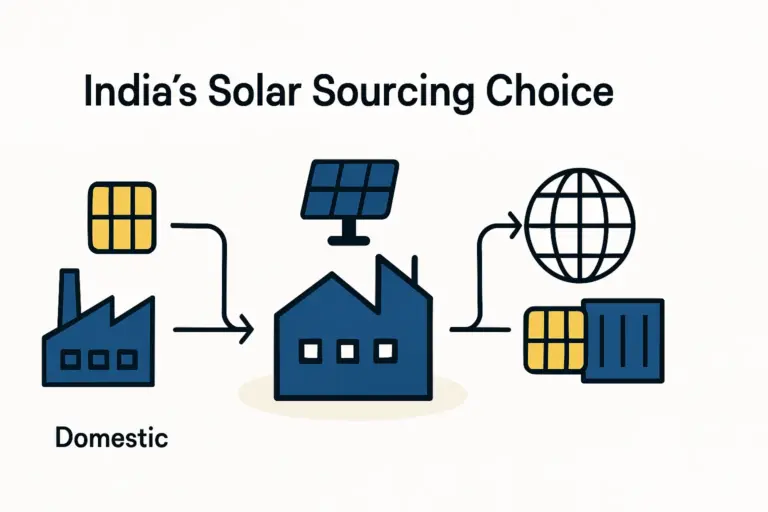
- Raw Materials (Bill of Materials – BOM): The BOM—which includes solar cells, glass, backsheets, aluminum frames, and junction boxes—accounts for the largest portion of OPEX. A key decision involves sourcing:
- Imported Cells: Importing high-efficiency cells is common, but the model must accurately reflect the prevailing Basic Customs Duty (BCD), which can significantly inflate their cost.
- Local Sourcing: Sourcing other components locally can reduce logistical costs and currency fluctuation risks but requires carefully vetting local suppliers for quality and reliability.
- Labor: India offers a significant labor cost advantage, but this varies by state and skill level. The model should differentiate between wages for unskilled line operators, skilled technicians, and plant management. States like Gujarat have a well-developed ecosystem of trained industrial labor, which affects both availability and cost.
- Utilities: Power is a major operational cost, and electricity tariffs for industrial consumers vary widely across India. States with reliable, affordable power are therefore advantageous. Many plants also invest in their own rooftop solar installations to control energy costs. While this expense is part of the initial CAPEX, it pays off by reducing long-term OPEX.
- Logistics and Supply Chain: Location profoundly impacts logistics. Establishing a plant near a major port like Mundra in Gujarat or Chennai in Tamil Nadu drastically reduces costs for importing raw materials and exporting finished modules. A landlocked location may offer cheaper land but will incur higher ongoing transportation costs.
Turn policy into auditable model inputs
Policy support belongs in the model only after the project has matched the current rule to its product, legal entity, site, customer group, and commissioning date. Use the current notice from India’s Ministry of New and Renewable Energy for manufacturing and ALMM requirements, and the current customs classification from the Central Board of Indirect Taxes and Customs for imported inputs.
| Input | Evidence required | Downside case |
|---|---|---|
| PLI or state incentive | Written eligibility, award, milestones, audit method, payment timing | Zero incentive until written conditions are met |
| ALMM and customer eligibility | Exact product, cell and module requirements for the intended tender or buyer | Sales limited to customers for which the product is eligible |
| Customs duty and origin | Current tariff classification, origin rule, exemption and landed cost per input | No exemption and adverse currency movement |
| State support | Site specific approval, validity period, cap and reimbursement schedule | Delay or nonpayment during ramp up |
Run the base case without unconfirmed support. Add each benefit only after its evidence is attached to the model.
A financial model for an Indian solar plant is incomplete without a detailed section on government policies. These are not minor adjustments; they are foundational assumptions that can define the project’s success.
The Production Linked Incentive (PLI) Scheme
This is arguably the most important policy for new manufacturers. The PLI scheme provides a direct financial incentive to domestic manufacturers for sales of high-efficiency solar modules. The incentive is calculated based on production volume, module efficiency, and the extent of local value addition. The financial model must project production timelines and module specifications to accurately forecast potential PLI revenues. Do not treat PLI as modelled income until the applicable scheme documents, written eligibility, award, milestones, audit rules, and payment timing are confirmed. Until then, show it only as an upside case, not in the base case.
Approved List of Models and Manufacturers (ALMM)
ALMM eligibility is product and customer specific. The model must use the current list and the exact requirements that apply to the intended buyer or tender. Include inspection, testing, documentation, timing, and a downside case in which sales begin before the planned listing is available.
Basic Customs Duty (BCD)
The BCD on imported solar cells and modules is a protective tariff. For a module manufacturer in India, this means the primary raw material (cells) will be more expensive if imported. A duty on imported inputs does not guarantee a protected selling price. Customers may change specifications, suppliers, volumes, or procurement routes. Test landed input cost, competing module prices, currency exposure, and customer acceptance in separate scenarios. An accurate financial model must analyze the trade-off between importing higher-cost, high-efficiency cells and using locally available options.
Common Pitfalls in Financial Projections for Indian Solar Plants
Based on experience from J.v.G. turnkey projects, several common errors can undermine financial models for solar plants in India:
- Underestimating Working Capital: Delays in subsidy payments (like PLI) or long payment cycles from customers can strain cash flow. The model must allocate a sufficient buffer for working capital.
- Ignoring Currency Risk: With key raw materials like solar cells often priced in USD, fluctuations in the INR/USD exchange rate can dramatically impact OPEX. Hedging strategies or financial buffers must be considered.
- Omitting Certification Costs: Achieving necessary national (BIS) and international (IEC) certifications involves significant cost and time. These are not optional expenses and must be budgeted for within the initial project timeline.
- Assuming Ideal Timelines: The model should incorporate realistic, not optimistic, timelines for plant construction, machine commissioning, regulatory approvals, and reaching full production capacity.
Frequently Asked Questions (FAQ)
Q1: What is a realistic Return on Investment (ROI) for a 50 MW plant in India?
A: There is no defensible single figure without current quotations and customer evidence. Calculate ROI from the selected product, qualified demand, bill of materials, achieved yield, ramp up, working capital, finance terms, taxes, duties, incentives, and downside cases. Report the result as a range, not as one promised payback period.
Q2: How does the PLI scheme actually pay out?
A: Payment terms depend on the applicable scheme documents, award, eligibility, audited performance, and current government notices. Model no incentive until the project’s written eligibility and payment conditions are confirmed.
Q3: Is financing readily available from Indian banks for such projects?
A: Financing is project specific. Lenders will test sponsor equity, contracts, technology, suppliers, permits, working capital, price risk, and downside cases. Do not assume availability from policy support alone.
Q4: How important is a local partner for a foreign investor?
A: While not mandatory, a local partner can be invaluable for navigating the complexities of land acquisition, state-level permits, and regulatory compliance. Their expertise can de-risk the project and accelerate timelines.
Decision gate before the model is presented to investors
Do not present the model as bankable until every material assumption has an owner, source date, document, base case, and downside case. Reconcile the customer pipeline with monthly output, test landed bill of materials against the intended selling price, include yield and downtime during ramp up, and show the peak working capital month.
The result is a decision tool, not a promise. If one unconfirmed incentive, tariff exemption, utilization rate, or selling price changes the investment decision, mark that item as an open gate and obtain written evidence before financial close.
Building a solar module factory in India presents a compelling business opportunity, backed by one of the world’s most ambitious renewable energy programs. However, success is not guaranteed by the market’s potential alone. It is achieved through meticulous planning, grounded in a financial model that is deeply attuned to the specific realities of the Indian economic and policy landscape.
The difference between a profitable venture and a failed investment often lies in the quality of these initial assumptions. By focusing on local variables related to location, policy, and supply chain, investors can create a financial projection that serves as a true roadmap for success in India’s dynamic solar manufacturing sector.
Download the PDF guide for financial modeling of a 50 MW solar plant in India.