For entrepreneurs considering a new venture in Saint Kitts and Nevis, the nation’s goal of achieving 100% renewable energy by 2030 presents a clear opportunity. With electricity costs among the highest in the Caribbean, local solar module production is not just viable but a strategic imperative.
Yet a critical question soon arises: In a country with no existing solar manufacturing industry, where does one find the skilled personnel to operate a modern production facility?
This question often poses a significant barrier for investors, who assume that a lack of a pre-existing talent pool makes such a high-tech venture unfeasible. The reality, however, is more nuanced. Building a competent local workforce is a structured, manageable process that, when executed correctly, becomes a powerful competitive advantage. This article outlines a practical framework for developing the human capital needed for a solar module production line in Saint Kitts and Nevis.
Analyzing the Local Labor Landscape
Success begins with a clear understanding of the available human resources. While Saint Kitts and Nevis is a small island nation of approximately 53,000 people, it possesses several foundational strengths ideal for establishing a light manufacturing operation.
-
High Literacy and Trainability: With a 98% national literacy rate, the population is well-equipped to learn new technical skills through structured training programs.
-
Existing Industrial Experience: Alongside its dominant tourism sector, the nation’s economy has a history of light manufacturing. This means a segment of the 25,000-strong labor force is already familiar with industrial work environments, production schedules, and safety protocols.
-
Strong Educational Institutions: Established vocational training centers are a critical asset. Institutions like the Clarence Fitzroy Bryant College (CFBC) and the Advanced Vocational Education Center (AVEC) produce a steady stream of graduates with foundational technical knowledge.
The key challenge, then, is not a lack of capable workers but a deficit of specialized experience. The goal is not to import an entire workforce but to build a bridge between existing local skills and the specific demands of solar PV manufacturing.
Core Roles in a Solar Module Production Line
A common misconception is that a solar factory needs a large team of highly qualified engineers. In reality, a typical small-to-medium-scale facility (20-50 MW) runs efficiently with a team of 25 to 40 well-trained individuals. The roles are distinct, each requiring specific, learnable skills.
Key positions on the production floor include:
Ready to make big Profits?
The solar Industry is Booming
WE HELP NEWCOMERS to the solar industry start their own solar module production line. Customers can make BIG PROFITS by selling modules and finding investors, without wasting money and time on things they don't need!
-
Production Manager: Oversees the entire production process, manages schedules, and ensures output targets are met.
-
Quality Control (QC) Inspector: Monitors quality at every stage, from incoming raw materials to final module testing, ensuring compliance with international standards like IEC.
-
Machine Operators: Specialized roles for each key stage of the solar module manufacturing process, including operators for the cell stringer, layup station, laminator, and framing machine.
-
Maintenance Technician: A crucial role responsible for the upkeep, calibration, and repair of production machinery to minimize downtime.
While each of these roles requires dedicated training, the prerequisite is not necessarily an engineering degree. Instead, the key attributes are technical aptitude, attention to detail, and a disciplined approach to standardized procedures.

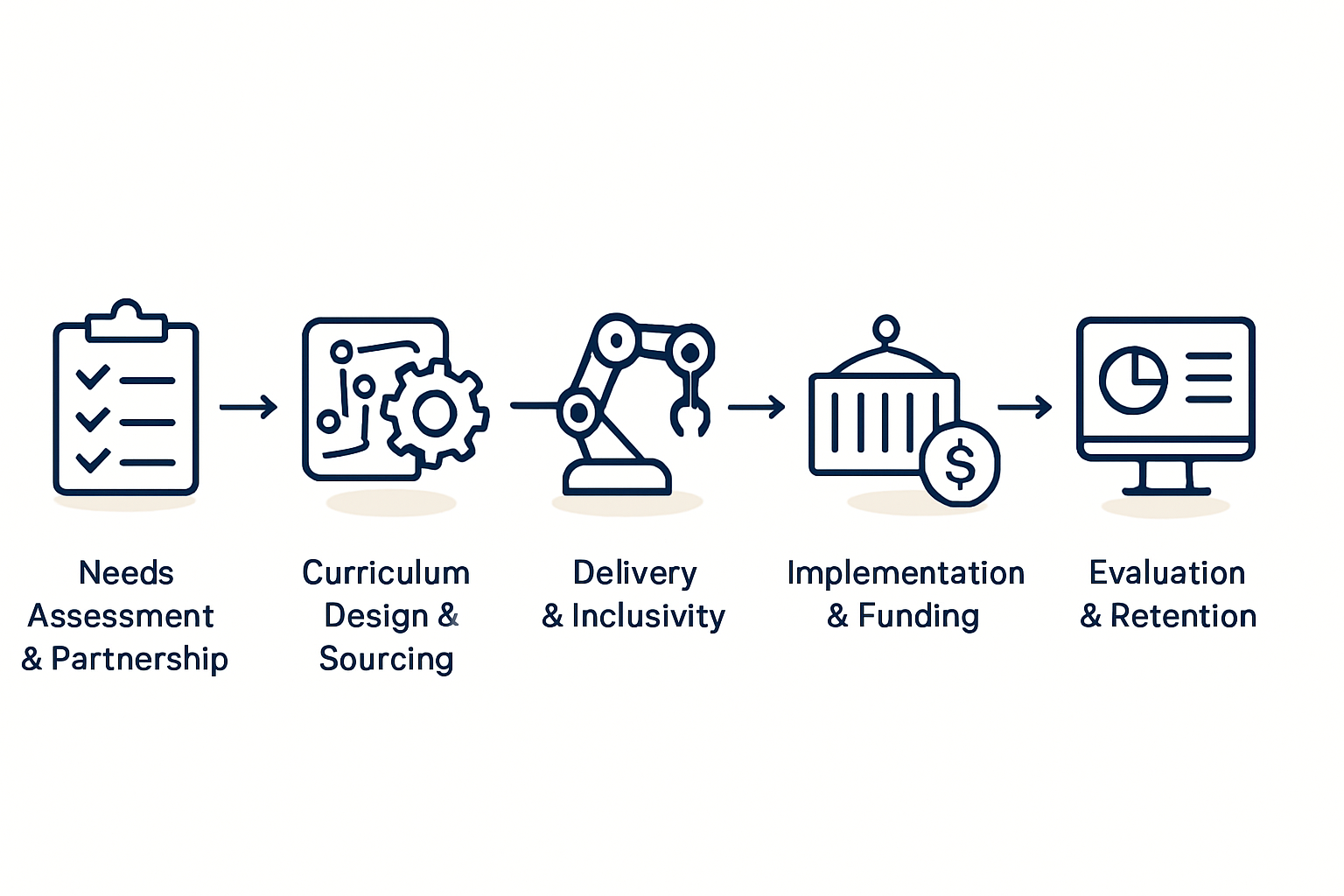
A Three-Phase Framework for Workforce Development
A structured training program, developed from experience with J.v.G. Technology GmbH turnkey projects, can effectively bridge the skills gap. This process is typically integrated into the factory setup timeline itself.
Phase 1: Foundational Recruitment and Selection
The initial phase focuses on identifying individuals with the right potential. The primary recruitment pool would be graduates from CFBC and AVEC’s technical programs or individuals with prior experience in electronics assembly, mechanics, or other light manufacturing sectors. The selection criteria should prioritize:
-
Technical Aptitude: A demonstrable ability to understand mechanical and electrical concepts.
-
Attention to Detail: Crucial for quality control and process adherence.
-
Problem-Solving Skills: The ability to identify and troubleshoot minor issues on the production line.
-
Work Ethic: Reliability and a commitment to safety and quality standards.
Phase 2: Classroom and Theoretical Training
Once the core team is selected, they undergo foundational training that can be conducted locally. This phase covers the ‘why’ behind the ‘how,’ ensuring the team understands the context of their work. Key topics include:
-
Fundamentals of Photovoltaics: How a solar cell works and how modules generate electricity.
-
Manufacturing Process Overview: A step-by-step review of the entire production line.
-
Quality Standards and Material Science: Understanding why certain materials are used and what quality benchmarks (like IEC 61215) mean for the final product.
-
Workplace Safety Protocols: Specific training for handling glass, operating machinery, and electrical safety.
Phase 3: Specialized, On-the-Job Training
This is the most critical phase, where theoretical knowledge is translated into practical skill. For a new factory, this is often implemented using a ‘Train-the-Trainer’ model—a core component of a well-managed turnkey solar production line project.
-
Identify Key Personnel: The Production Manager and a lead Maintenance Technician are selected to receive intensive, hands-on training.
-
External Training: These key individuals travel to an equipment manufacturer’s facility or an operational reference factory to learn how to operate, calibrate, and maintain each piece of machinery under the guidance of experienced engineers.
-
Knowledge Transfer: Upon their return, these newly certified trainers lead on-the-job training for the rest of the local team as the new factory’s machines are installed and commissioned.
This approach is highly efficient. It concentrates the most intensive training on a few key people, who then become long-term knowledge assets for the company, capable of training new hires as the operation expands. This model fosters local leadership and reduces long-term reliance on external experts.
Frequently Asked Questions (FAQ)
How many employees are typically needed to start a solar module factory?
For a semi-automated production line with an annual capacity of 20-50 MW, a workforce of approximately 25 to 40 employees is typical, covering production, quality control, maintenance, and basic administration across one or two shifts.
What educational background is required for machine operators?
A technical diploma from a vocational school like AVEC or CFBC is advantageous but not strictly necessary. The most important factor is successfully completing the specialized on-the-job training program. Aptitude and discipline are more critical than formal academic qualifications for these roles.
How long does the workforce training process take?
The entire process, from recruitment to the team being ready for full production, can be aligned with the factory setup timeline. The intensive training phase (Phase 3) for key personnel typically takes two to four weeks, with the subsequent local team training occurring during the two to three months of machine installation and commissioning.
Is it necessary to hire experienced staff from other countries?
Hiring an experienced expatriate for a senior role like the initial Plant Manager can be a valuable strategy to accelerate the launch and mentor the local management team. However, the long-term goal should be to develop local talent for all key positions. A sustainable operation relies on a well-trained local workforce, which is more cost-effective and beneficial to the local economy.
How does workforce planning fit into the overall business strategy?
Workforce development is a critical pillar of a successful venture. A detailed staffing and training plan should be an integral part of the initial business plan for solar panel manufacturing. It directly impacts operational efficiency, product quality, and long-term profitability.

Conclusion: From Local Potential to Production Excellence
Establishing a solar module factory in Saint Kitts and Nevis is not constrained by the lack of a pre-existing PV workforce. The nation’s high literacy rate and vocational training infrastructure provide a solid foundation for such a venture.
By implementing a structured, three-phase development program—focusing on careful selection, theoretical grounding, and specialized on-the-job training—a world-class manufacturing team can be built locally. This approach transforms a perceived challenge into a strategic advantage, creating high-value employment and directly supporting the nation’s renewable energy ambitions. A thoughtful investment in people is as critical as the investment in high-quality solar panel manufacturing machines.