For an entrepreneur exploring new frontiers in manufacturing, the question is often not what to build, but where. While established hubs in Asia and Europe dominate headlines, significant opportunities are emerging in regions poised for rapid growth. Suriname is one such location; its strategic position and stable economic environment make a compelling case for investment in renewable energy manufacturing.
This article lays out a practical feasibility model for establishing a 25 MW solar module production line in Suriname’s Wanica District. We detail the estimated investment, operational costs, and logistical advantages, offering a data-driven blueprint for entrepreneurs evaluating entry into the solar industry. The analysis serves as a concrete example of the business environment assessment crucial for any new venture.
The Strategic Rationale: Why Consider Suriname for Solar Manufacturing?
Before examining specific figures, it’s important to understand the foundational advantages Suriname offers. Location is paramount in business, and Suriname’s attributes grant it a unique strategic position.
Economic Stability and Growth
With projected GDP growth and a commitment to sustainable development, Suriname provides a stable economic climate for long-term investment. The government’s focus on diversifying the economy opens doors for new industries like renewable energy.
Gateway to CARICOM
As a member of the Caribbean Community (CARICOM), Suriname offers duty-free access to a single market of 15 member states. This transforms a local factory into a regional supply hub capable of serving millions of customers.
Proximity to High-Demand Markets
Bordering Guyana, a nation experiencing an unprecedented economic boom, a Surinamese factory is perfectly positioned to supply the surging demand for energy infrastructure next door. Proximity to Brazil and French Guiana further expands its potential market reach.
These factors create an environment where a manufacturing investment is not just viable, but strategically sound.
A Practical Case Study: A 25 MW Factory in the Wanica District
To make this opportunity tangible, let’s look at a specific model: a 25 MW semi-automated solar module assembly line. This capacity is a common and effective entry point for new manufacturers. It is large enough for economies of scale but small enough to maintain flexibility and a manageable initial investment.
The chosen location, the Wanica District, is Suriname’s industrial heartland. It surrounds the capital, Paramaribo, and offers excellent infrastructure, a skilled labor pool, and direct access to the nation’s primary seaport.
Ready to make big Profits?
The solar Industry is Booming
WE HELP NEWCOMERS to the solar industry start their own solar module production line. Customers can make BIG PROFITS by selling modules and finding investors, without wasting money and time on things they don't need!
Estimated Capital Expenditure (CapEx) for a Turnkey Setup
The initial investment, or CapEx, is a primary concern for any new venture. Based on data from similar turnkey projects managed by J.v.G. Technology GmbH in emerging markets, a 25 MW line requires an investment in the range of $3.5 to $5 million USD.
This figure breaks down into three main categories:
Production Machinery
This is the largest portion of the initial investment, covering essential equipment for cell stringing, bussing, lamination, framing, and testing. For those new to the process, understanding What Machines Are Needed to Produce a Solar Panel provides a clear breakdown of a typical production line.
Building and Infrastructure
A 25 MW production line needs a facility of approximately 2,500 square meters (around 27,000 square feet). This space accommodates the production line, raw material storage, a finished goods warehouse, and administrative offices. While the answer to How Much Land is Needed for a Solar Panel Factory depends on future expansion plans, a plot of 5,000 to 10,000 square meters is a standard starting point.
Initial Working Capital
This allocation covers the first shipment of raw materials like solar cells, glass, EVA, backsheets, and frames. It also includes operational cash flow and costs for training and initial certifications.
Projected Operational Expenditure (OpEx)
Beyond the initial setup, ongoing operational costs determine a factory’s long-term profitability. The primary OpEx components include:
Labor Costs
A semi-automated 25 MW line typically requires a workforce of 25 to 30 employees, including operators, technicians, and quality control staff. Suriname’s competitive labor market is a significant advantage in managing these costs. This scale offers a good balance between automation and human oversight, clarifying How Many Employees Are Needed for a Solar Panel Factory.
Raw Materials
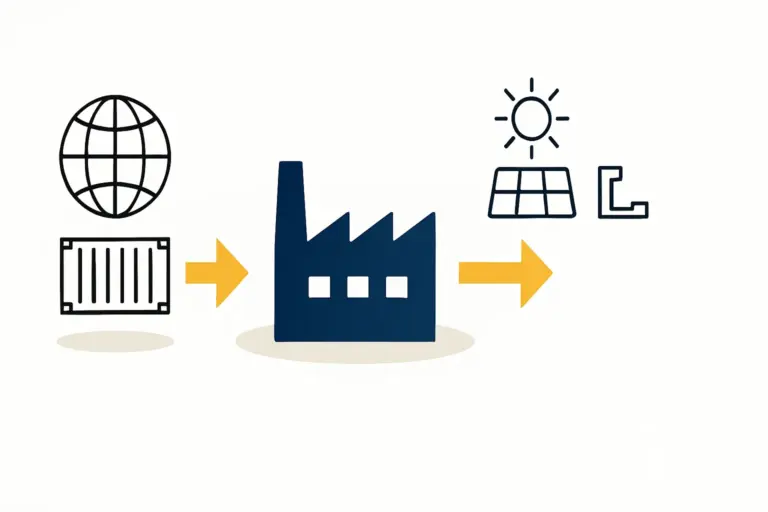
As the most significant recurring expense, establishing reliable supply chains is critical. The Wanica District’s proximity to the Port of Paramaribo is a major logistical benefit, simplifying the import of raw materials from global suppliers.
Utilities and Overheads
This includes electricity, water, facility maintenance, insurance, and administrative salaries. While electricity costs are a key consideration, the consistent output of a well-run factory allows for predictable financial modeling.
Logistical Advantages of the Wanica District
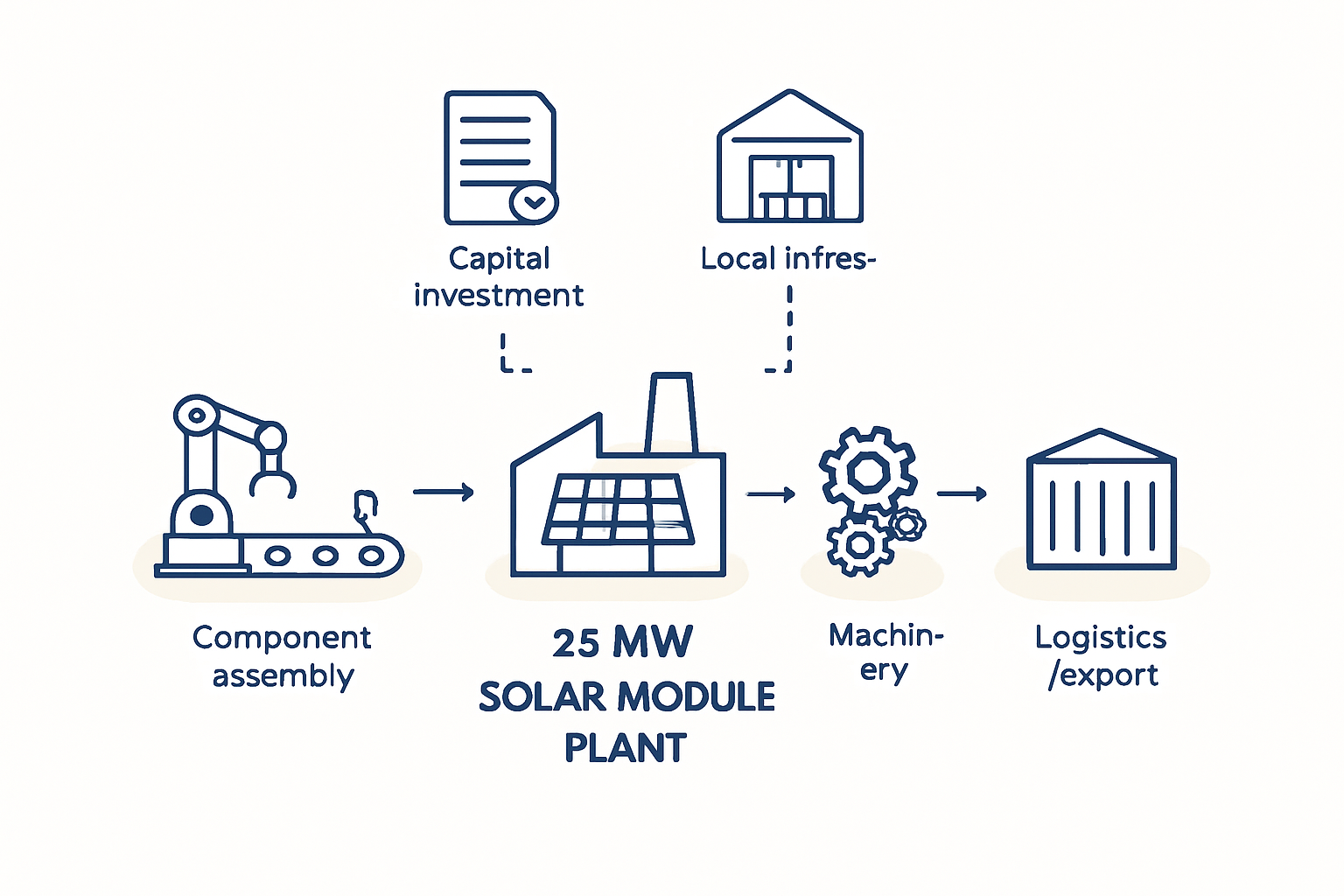
The strategic importance of Wanica cannot be overstated. Its proximity to the Julius Adolf Pengel International Airport and the Port of Paramaribo creates an efficient logistics corridor. This reduces lead times and transportation costs for both importing raw materials and exporting finished modules to CARICOM nations and beyond.
The district’s established road network also facilitates overland transport to neighboring French Guiana, Guyana, and Brazil. This infrastructure mitigates a key risk in manufacturing: supply chain friction. A factory in Wanica is not an isolated outpost but an integrated part of a national and regional logistics network.
Market Opportunity: Serving Local and Regional Demand
A manufacturing facility in Suriname can serve two key markets. Locally, it can support the country’s national goals for advancing renewable energy generation. Regionally, it can become a key supplier to the entire CARICOM bloc.
By producing locally, the factory can offer faster delivery times, lower shipping costs, and better customer service to regional clients compared to distant manufacturers in Asia. This ‘nearshoring’ advantage is a powerful market differentiator, especially for commercial and industrial projects where timelines are critical.
Frequently Asked Questions (FAQ)
What is the typical timeline for setting up such a factory?
From project confirmation to the first module output, a turnkey setup of this scale typically takes 9 to 12 months. This includes machinery procurement, shipping, installation, commissioning, and staff training.
Is a technical background required to start this business?
No. Many successful factory owners come from business, finance, or other industrial backgrounds. The key is to have a solid business plan and partner with experienced technical consultants and turnkey providers to manage the engineering aspects.
How does this model compare to larger-scale gigafactories?
A 25 MW facility is designed for market agility. Unlike gigafactories that rely on massive volume, this model focuses on serving specific regional markets with greater flexibility. The initial investment is significantly lower, reducing financial risk and allowing for a faster path to profitability.
What are the main risks to consider?
As with any manufacturing venture, risks include global fluctuations in raw material prices, the need to develop a skilled local workforce, and potential changes in regional trade policies. A thorough risk assessment is a critical part of a comprehensive business plan.
Conclusion: From Feasibility Sketch to Business Plan
This feasibility model shows that establishing a 25 MW solar module factory in Suriname’s Wanica District is not only plausible but strategically advantageous. The combination of a stable economy, regional market access, and strong logistical infrastructure builds a compelling investment case for entrepreneurs looking to enter the renewable energy sector.
This overview serves as a starting point. For any serious investor, the next step is to develop these concepts into a detailed Business Plan for Your Solar Panel Factory. Such a document will expand on these estimates with financial projections, market analysis, and an operational strategy, transforming a promising idea into an actionable investment project.