All data points are realistic but simplified for clarity and educational purposes.
An entrepreneur looking at a map of Indonesia might see a paradox. Sumatra, an island rich in agricultural resources and economic potential, is often held back by an energy infrastructure that struggles to keep pace. For the region’s vital industries—from palm oil mills to processing plants—unreliable power isn’t just an inconvenience; it’s a direct constraint on growth.
Yet this same challenge presents a significant opportunity for investors who see the solution: local, resilient, and independent power generation through solar manufacturing.
This article outlines a strategic framework for establishing a 100 MW solar module factory in Sumatra through a foreign-local joint venture. It offers a blueprint for structuring the partnership, navigating Indonesian investment law, and selecting the right technology to meet the region’s unique demands. The goal is not merely to build a factory but to create a sustainable business model that addresses a critical market need.
The Indonesian Opportunity: Why Local Manufacturing in Sumatra?
Indonesia has set an ambitious goal for renewable sources to account for 23% of its energy mix by 2025. While the state utility, PLN, is working to modernize the grid, the most immediate and fastest-growing demand for stable electricity comes from the commercial and industrial (C&I) sector.
Businesses cannot afford to wait for grid upgrades; they need reliable power now. The result is a surge in demand for ‘captive power’ solutions—on-site generation that an enterprise controls for its own use.
For several reasons, Sumatra is an ideal location for a C&I-focused solar module plant:
- Agricultural Demand: The island is the heart of Indonesia’s agricultural industry. Palm oil mills, rubber processing facilities, and coffee plantations are energy-intensive operations often located in areas with weak grid access. Solar power provides a reliable, cost-effective energy source to improve operational efficiency.
- Government Support: Recent regulations, such as Presidential Regulation No. 112 of 2022, are designed to accelerate renewable energy investment, creating a more favorable environment for projects like this.
- Economic Logic: Manufacturing modules locally bypasses import tariffs and logistical hurdles, offering a competitive advantage over imported panels. It also creates skilled local employment and strengthens the regional supply chain.

The Joint Venture Model: A Strategic Imperative
For a foreign investor, entering the Indonesian market alone can be a formidable challenge. The country’s regulatory landscape, business culture, and land acquisition processes require deep local knowledge, making a joint venture (JV) not just a strategic choice, but often the most effective path to success.
A well-structured partnership between a foreign investor and a local Indonesian entity creates a powerful synergy. The foreign partner typically brings capital, access to advanced technology, and international management standards. The local partner contributes invaluable assets:
Ready to make big Profits?
The solar Industry is Booming
WE HELP NEWCOMERS to the solar industry start their own solar module production line. Customers can make BIG PROFITS by selling modules and finding investors, without wasting money and time on things they don't need!
- Regulatory Navigation: Expertise in managing the requirements of the Indonesian Investment Coordinating Board (BKPM).
- Land and Permits: The ability to secure suitable land and navigate the complex local permitting process.
- Market Access: Established relationships with local industries, government bodies, and potential customers.
- Operational Management: A deep understanding of the local labor market and business customs.
This combination de-risks the investment and significantly shortens the timeline from planning to production.
Blueprint for a Foreign-Local Partnership
Structuring the joint venture correctly from the outset is critical. The legal entity for such a partnership is a Foreign-Owned Company, known as a PT PMA (Perseroan Terbatas Penanaman Modal Asing). This structure clarifies ownership and governance while defining the specific contributions of each party.
The Foreign Investor’s Role
The foreign entity is the catalyst for the project, providing the foundational elements that require international expertise. Key contributions include:
- Capital Investment: Providing the majority of the financing for machinery, buildings, and initial operational costs. A clear understanding of the full investment requirements for a solar factory is essential.
- Technology Transfer: Sourcing and implementing a state-of-the-art manufacturing line and ensuring technical know-how is transferred to the local team.
- International Standards: Implementing best practices in quality control, financial reporting, and corporate governance.
The Local Partner’s Contribution
The local partner is the anchor of the project, grounding the operation in the Indonesian context. Their role is to manage the on-the-ground complexities that foreign investors often find most difficult. This includes:
- Permitting and Licensing: Securing all necessary business licenses, environmental permits (AMDAL), and other approvals from national and regional authorities.
- Land Acquisition: Identifying and securing a suitable plot of land for the factory, a process that is often complex for foreign entities.
- Government and Community Relations: Building and maintaining positive relationships with local government agencies and the surrounding community.
Structuring Equity and Governance
A common and effective equity structure for a PT PMA in this sector involves the foreign investor holding a majority stake (e.g., 67%) and the local partner holding a significant minority stake (e.g., 33%). This reflects the foreign partner’s larger capital contribution while ensuring the local partner is fully invested in the long-term success of the venture.
A comprehensive Shareholders’ Agreement is paramount. This legal document should clearly define:
- The roles and responsibilities of each party.
- The composition of the Board of Directors and Board of Commissioners.
- Decision-making processes for key operational and strategic issues.
- Protocols for profit distribution and future financing.
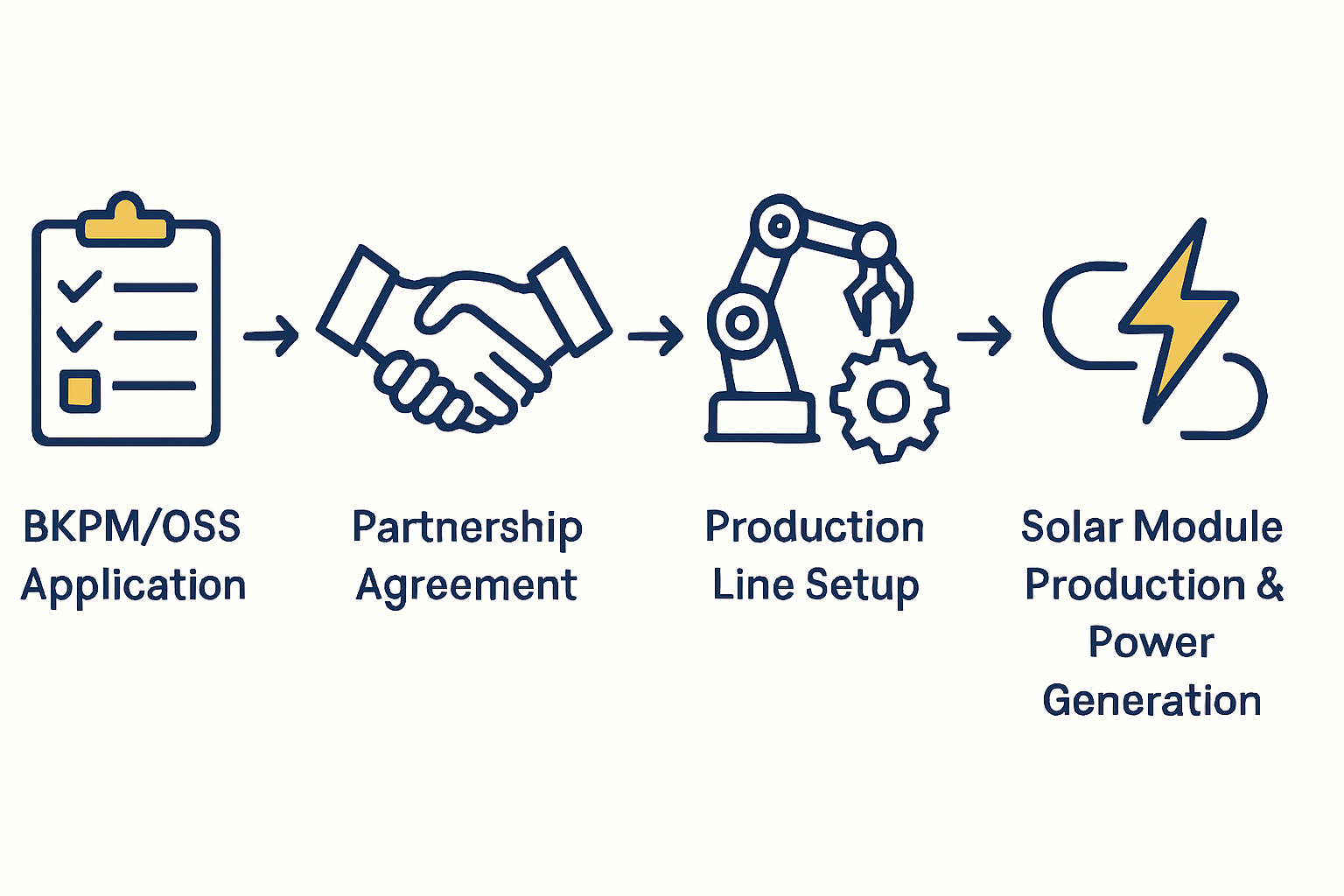
The Technical Core: A 100 MW Production Line
The heart of the joint venture is the physical plant. A 100 MW capacity is a strategic size—large enough to achieve economies of scale and serve the C&I market effectively, yet manageable for a new market entrant.
The most efficient way to establish such a facility is with a turnkey solar module manufacturing line. This approach provides a fully integrated solution—from machinery selection and factory layout to installation and staff training—all managed by a single experienced provider.
Given Sumatra’s hot and humid climate, the choice of module technology is critical. Standard modules can degrade quickly in these conditions, which leads to underperformance. The factory should therefore be configured to produce modules specifically designed for this environment. The DESERT+ solar module technology is an example of a robust design that uses specialized materials to resist performance degradation from high heat, humidity, and potential-induced degradation (PID), ensuring a long-term energy yield for agricultural customers.

Bridging the Gaps: The Importance of Expert Guidance
Even with a strong local partner, a foreign investor entering a new industry in a new country requires specialized guidance. An external technical and business consultant can bridge critical gaps in knowledge and experience.
Technical and Operational Planning
The role of the technical partner is to ensure the manufacturing facility is planned and executed to international standards. This involves factory layout design, equipment specification, supply chain setup, and training of the local engineering team. Understanding the role of a technical partner is crucial for investors without a deep background in photovoltaic manufacturing.
Navigating Cultural and Legal Complexities
Structuring the JV agreement requires more than just legal expertise; it requires an understanding of both international business norms and Indonesian commercial culture. Experienced consultants can facilitate negotiations between partners, help structure the PT PMA to comply with all BKPM regulations, and ensure the final agreement is fair, clear, and built for long-term stability. This guidance is what transforms a promising proposal into a functional and profitable enterprise.
Frequently Asked Questions (FAQ)
Why is local production better than importing modules into Indonesia?
Local production offers several advantages: it avoids import tariffs and taxes, reduces supply chain risks and transportation costs, allows for customization to meet local needs, and contributes to the local economy by creating jobs.
What are the main challenges with Indonesian foreign investment law?
The primary challenges involve navigating the BKPM bureaucracy, understanding the specific requirements for different business sectors (the ‘Positive Investment List’), and ensuring full compliance with local labor and environmental laws. A knowledgeable local partner is essential to navigate this process.
How long does it typically take to set up a 100 MW solar module plant?
From the finalization of the joint venture agreement and securing of financing, the process typically takes 12 to 18 months. This includes factory construction or retrofitting, machinery delivery and installation, staff hiring and training, and the first production runs.
What exactly is a PT PMA company?
A PT PMA (‘Perseroan Terbatas Penanaman Modal Asing’) is the legal entity required for foreign direct investment in Indonesia. It allows foreign nationals or companies to own shares in an Indonesian-registered company, subject to regulations set by the BKPM.
Next Steps in Your Investment Journey
Establishing a solar module factory in a market like Sumatra is a significant undertaking, but one with immense potential. The key to success lies not in technology alone, but in a carefully constructed business structure.
A successful venture is built on three pillars: a committed local partner who can navigate the operational landscape, proven technology designed for the region’s climate, and expert guidance to bridge the technical and cultural gaps. Focusing on this tripartite structure allows an investor to move forward with confidence, turning a strategic vision into a tangible and profitable reality that powers local industry.
Download the 100 MW Sumatra Solar Joint Venture Case Study (PDF)
Author: This case study was prepared by the
turnkey solar module production specialists at J.V.G. Technology GmbH
It is based on real data and consulting experience from J.v.G. projects
worldwide, including installations ranging from 20 MW to 500 MW capacity.