Senelec and TotalEnergies Launch the Senegal solar plant in Thiès
Senegal has taken a monumental step forward in its renewable energy journey with the official launch of a new 100 MW solar photovoltaic power plant in the Thiès region. This landmark project, a collaboration between Senegal’s national electricity company, Senelec, and global energy giant TotalEnergies, marks a significant boost to the nation’s clean energy capacity and a critical component of its strategy for sustainable development.
The plant, an expansion of the existing Taiba Ndiaye facility, underscores the success of public-private partnerships in accelerating Africa’s energy transition. Inaugurated in late 2025 and ramping up to full commercial operation in early 2026, the facility is set to play a pivotal role in powering Senegal’s future.
Project Deep Dive: Technology and Impact of the Senegal solar plant
Located approximately 50 kilometers east of Dakar, the Thiès plant leverages one of the region’s most abundant resources: sunshine. The site benefits from high solar irradiance, making it an ideal location for a project of this scale.
The plant utilizes advanced technology to maximize efficiency, featuring 100 MWp (megawatt-peak) of bifacial photovoltaic panels mounted on single-axis trackers. This setup allows the panels to capture sunlight from both sides while tracking the sun’s path across the sky, significantly increasing energy generation.
The project’s key metrics are impressive:
| Aspect | Details |
| —————-ார்கள் | ———————————————————– |
| Annual Output | ~210 GWh (enough to power around 190,000 households) |
| CO₂ Reduction | Avoids approximately 120,000 tons of CO₂ emissions annually |
| Jobs Created | 400 during construction; 20 permanent O&M roles |
| Total Investment | Approximately €80-100 million |
The project’s financing was supported by a consortium of key financial partners, including the African Development Bank (AfDB) and Proparco, highlighting strong international confidence in Senegal’s renewable energy sector.
Strategic Importance for the Senegal solar plant in Senegal
This 100 MW plant is more than just an infrastructure project; it is a cornerstone of Senegal’s national energy strategy. It directly supports the ambitious goals outlined in the Plan Sénégal Émergent (PSE), which aims to achieve a 30% share of renewables in the country’s energy mix by 2030.
With electricity demand growing at a rate of about 8% per year, the new plant provides a crucial injection of stable, clean, and cost-competitive power. Under a 25-year power purchase agreement (PPA), Senelec will integrate the electricity into the national grid, reducing the country’s heavy reliance on thermal power plants, which currently constitute 70% of the energy mix. The project is expected to boost Senegal’s renewable energy share to nearly 25% by 2026.
Furthermore, the plant’s development aligns with broader regional environmental goals, such as the Great Green Wall initiative, which aims to combat desertification in the Sahel.
A Model for Public-Private Partnership: The Senegal solar plant
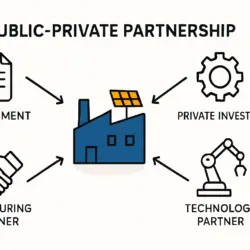
The successful delivery of the Thiès solar plant exemplifies a powerful model for energy development in West Africa. TotalEnergies, acting as the lead developer, expands its renewable portfolio in Africa, which now exceeds 3 GW. For Senelec, the partnership secures a long-term supply of affordable electricity, with a levelized cost estimated at around $0.04/kWh.
This collaboration demonstrates how strategic partnerships can de-risk major investments, deploy cutting-edge technology, and deliver tangible benefits in the form of energy security, economic growth, and climate action. As noted in official reports from partners like the AfDB and data from the International Renewable Energy Agency (IRENA), this project is set to significantly increase Senegal’s installed solar capacity, providing a scalable model for neighboring countries like Mauritania and Mali to follow.
For more detailed information, stakeholders can refer to official press releases from TotalEnergies and statements on the Senegalese government portal.