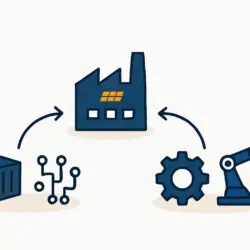
Czech utility giant ČEZ Group is pioneering a novel solution to a persistent challenge in renewable energy development: how to install solar panels on the unstable ground of former mining sites. In a creative feat of circular engineering, the company is repurposing steel structures from retired conveyor belts once used in strip coal mines to serve as robust foundations for new solar arrays. The innovative technology is currently being tested in pilot projects on reclaimed land near northern Czechia’s Bílina Mine.
The concept, developed by ČEZ Group subsidiary PRODECO, tackles the issue of subsoil that is too loose and unsettled for traditional anchoring methods. Spoil heaps and waste ponds can take decades to stabilize, and standard foundations risk causing solar panel frames to jam or crack as the ground shifts. Instead of driving supports deep into the earth, PRODECO’s method utilizes the central sections of long-distance conveyor belts which are already designed for heavy-duty operation.
“These sections offer several advantages: they are robust, designed for heavy-duty operation, and have side rails used for transport,” explained Luboš Straka, Chairman of the Board of Directors and CEO of PRODECO. The surface-mounted structures are inherently stable and non-invasive. As the ground material beneath settles over time, the entire structure tilts as a single unit, which prevents damaging stress from being transferred to the delicate photovoltaic cells.
This initiative is a cornerstone of the company’s “Clean Energy for Tomorrow” strategy, which outlines a goal to build 6 GW of new renewable capacity by 2030. According to a company announcement, this approach prioritizes developing photovoltaic plants on brownfields and infertile land where industrial mining has ceased. “Before life returns to such regions, they can be used to generate sustainable solar energy,” stated Jan Kalina, a ČEZ Board of Directors member. “Our goal is to act sustainably while not unnecessarily increasing our carbon footprint.”
Initial results from the Bílina Mine pilot site are promising. After a year of testing, experts observed that the panels successfully withstood the subsoil movement and maintained their energy output. Despite this success, the company is continuing to refine the technology. “For unstable subsoils, alternative technologies may be more suitable than conventional silicon panels,” Kalina added, suggesting that thin-film panels, where the semiconductor is applied directly to glass, are under consideration for future development.
As coal mining is phased out, thousands of these conveyor modules will become available from the Bílina Mine alone, offering a vast resource for sustainable energy conversion. By giving retired mining equipment a second life, ČEZ Group is not only accelerating its transition to clean energy but also creating a powerful model for the circular economy, turning industrial liabilities into assets for a greener future and securing the next generation of solar panels.
Sources
- ČEZ Group develops solution to build solar power plants on former …
- [PDF] One Earth Solar Farm – Planning Inspectorate
- ČEZ Group develops unique solution for securing photovoltaic …
- Press releases | Skupina ČEZ
- Retired mining equipment gets second life in new solar plants
- Czech utility unveils tech to secure solar panels in unstable subsoil
- Czechia – Page 4 – pv magazine International