
An investor is weighing two potential sites for a new solar module factory. The first is a large, undeveloped plot on the city’s outskirts—a blank canvas at an attractive price. The second is a decommissioned warehouse in an established industrial park, structurally sound and with existing road and utility access. On the surface, the choice is between creative freedom and practical convenience. But the financial implications run much deeper.
This decision—whether to build new on a Greenfield site or adapt an existing Brownfield facility—is one of the most critical an entrepreneur can make. It fundamentally shapes the project’s Capital Expenditure (CAPEX), timeline, and operational future. Here, we offer a structured framework for comparing these two paths, focusing on the unique challenges and opportunities in emerging markets.
Understanding the Core Concepts: Greenfield and Brownfield Sites
Before comparing costs, it’s essential to have a clear definition of each site type and its inherent characteristics.
What is a Greenfield Site?
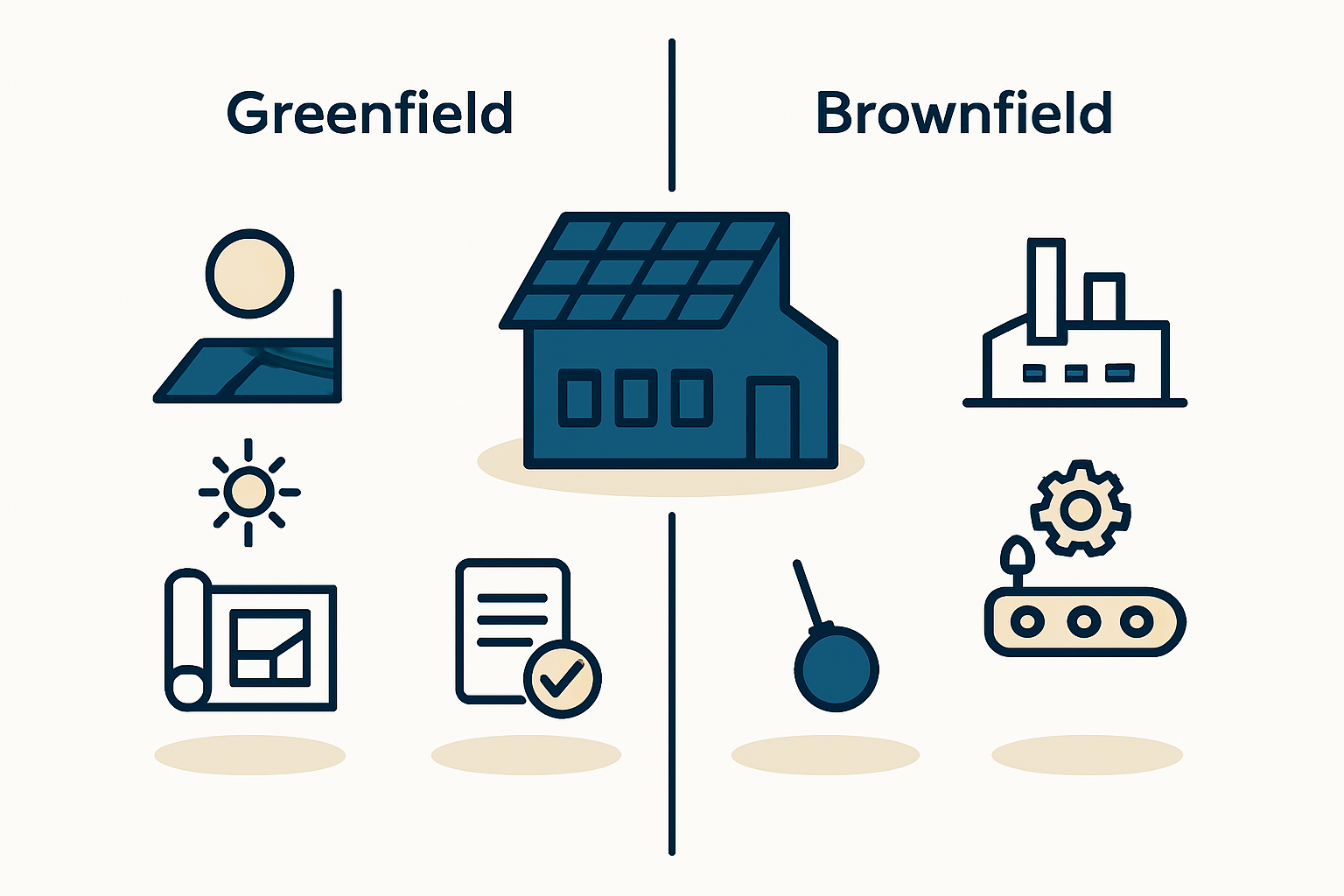
A Greenfield site is undeveloped land, often agricultural or unused, with no history of industrial or commercial construction. It offers a blank slate to design and build a facility from the ground up, tailored precisely to a project’s needs.
- Advantages: You get complete design freedom for an optimized production layout, can specify modern infrastructure, and avoid any legacy issues from previous occupants.
- Disadvantages: This path typically involves higher upfront construction costs and longer permitting timelines. For instance, a 2022 World Bank study noted that inadequate infrastructure, especially reliable electricity and transport, increases initial project costs by an average of 15-20% for new industrial facilities in sub-Saharan Africa.
What is a Brownfield Site?
A Brownfield site is a piece of land that has been previously developed. It often contains an existing structure, like a former factory or warehouse, that can be repurposed.
- Advantages: The primary benefits are a potentially faster route to operation, existing infrastructure connections, and often a lower land acquisition cost.
- Disadvantages: The project is constrained by the existing building’s layout. There is also a significant risk of hidden costs from environmental remediation, structural repairs, or outdated utilities. Data from industrial real estate firm JLL shows just how unpredictable these costs can be, with ‘surprise’ structural or environmental issues inflating budgets by up to 30% in over half of studied projects in emerging markets.
A Structured CAPEX Comparison for Solar Module Manufacturing
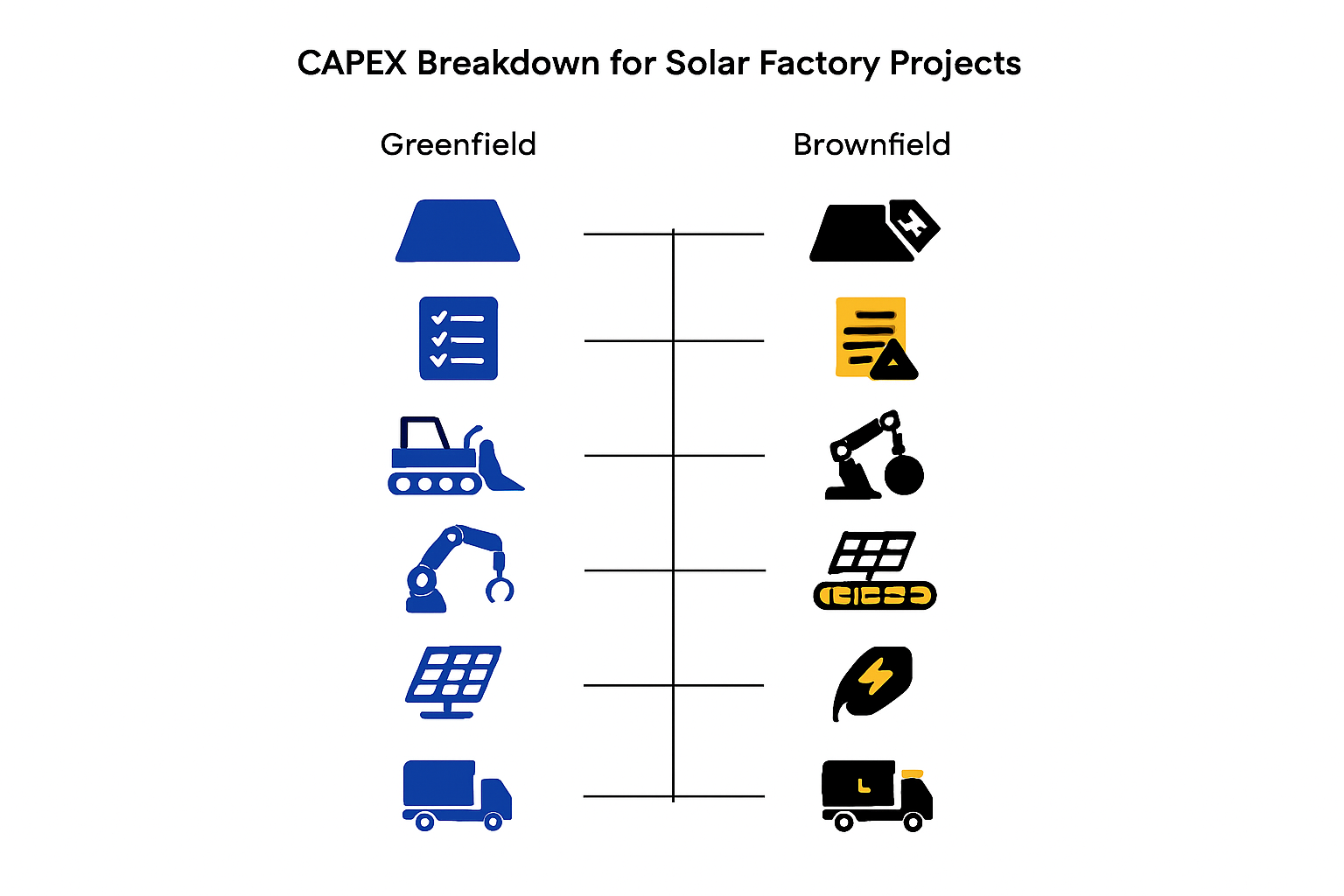
A direct comparison of key investment areas reveals the financial trade-offs between the two approaches. The investment required to start a solar panel factory is heavily influenced by these early decisions.
Land Acquisition & Site Preparation
- Greenfield: While rural land can be inexpensive, prime undeveloped plots near urban centers are often costly. Site preparation also requires significant CAPEX for land grading, soil stabilization, and constructing access roads.
- Brownfield: The initial purchase price might be lower, but that figure can be misleading. Costs for demolishing unusable structures or, more critically, environmental remediation can quickly offset any savings. The UN Environment Programme (UNEP) confirms this, noting that soil contamination from previous industrial use is common and can lead to remediation costs ranging from negligible to millions of dollars, creating major financial uncertainty.
Building & Construction
- Greenfield: The cost of new construction is high, but it ensures the facility is perfectly suited for a modern solar panel production line. This means achieving the ideal ceiling heights, floor load capacity for heavy machinery, and cleanroom specifications without compromise.
- Brownfield: Renovation can be much cheaper than new construction—if the existing structure is suitable. However, major retrofitting like reinforcing floors, raising the roof, or installing specialized HVAC systems can quickly escalate costs and negate those initial savings.
Utilities & Infrastructure
- Greenfield: This is often the most underestimated expense. Establishing new, high-capacity connections for electricity, water, gas, and waste disposal is a capital-intensive undertaking. According to the International Energy Agency (IEA), setting up a new high-capacity grid connection for an industrial facility in a developing nation can take 12-24 months and consume a huge portion of the infrastructure budget.
- Brownfield: Here lies a key advantage. Existing connections may only need upgrades rather than entirely new installations, saving considerable time and money. The critical step, however, is verifying that the existing utility capacity can power modern, automated solar manufacturing machines.
Permitting & Regulatory Timelines
- Greenfield: The permitting process is typically longer and more complex, often involving comprehensive environmental impact assessments, potential zoning changes, and a full suite of new construction permits.
- Brownfield: Renovation permits may be faster to obtain, but the discovery of environmental contamination during due diligence can trigger complex regulatory processes that halt a project indefinitely. Based on experience from J.v.G. turnkey projects, navigating permits for Greenfield sites in North Africa or the Middle East can add six to nine months to a project timeline compared to a straightforward Brownfield conversion.
Beyond CAPEX: Critical Operational Considerations
Site selection impacts more than just the initial investment—it has long-term consequences for Operational Expenditure (OPEX).
- Logistics & Supply Chain: A remote Greenfield site chosen for its low land cost can lead to persistently high transportation expenses for both raw materials and finished goods. Proximity to ports, railways, and major highways is a critical long-term advantage.
- Labor Force: A factory is nothing without its workforce. Is the site near a population center with access to skilled or trainable labor? A remote location might require additional investment in employee transportation or even housing.
- Future Expansion: A well-planned Greenfield site offers clear and straightforward potential for future expansion. A Brownfield site, especially in a dense industrial zone, may be physically constrained, limiting growth.
Frequently Asked Questions (FAQ)
Is a Greenfield site always more expensive?
Not necessarily. While upfront construction costs are higher, the total project cost can be more predictable. A Brownfield site with extensive, unforeseen structural or environmental problems can ultimately cost more than building new.
What is the single biggest hidden cost in Brownfield projects?
Environmental contamination and major structural deficiencies are the two most common and costly surprises. Problems like contaminated soil from a former chemical plant or a foundation that can’t support heavy machinery can derail a budget and timeline. Thorough due diligence is the only way to mitigate this risk.
How does local government support influence the decision?
It’s a critical factor. Governments often offer substantial incentives to influence this choice. For instance, they might provide tax breaks and subsidized infrastructure to encourage development in new special economic zones (favoring Greenfield) or offer grants for regenerating old industrial areas (favoring Brownfield).
For a small-scale (20-50 MW) factory, which option is usually better?
For entrepreneurs just entering the solar manufacturing industry, a well-vetted Brownfield site often presents a lower barrier to entry. It typically offers a faster path to production by reducing complex variables like developing entirely new infrastructure.
Conclusion: Making an Informed Decision
The choice between Greenfield and Brownfield isn’t about finding the cheapest plot of land. It’s about understanding the total, risk-adjusted capital expenditure and the realistic timeline to begin production. The cheaper option on paper is rarely the most cost-effective in the long run.
Comprehensive due diligence isn’t an optional expense—it is an essential risk mitigation strategy. Professional geotechnical surveys, environmental site assessments, structural engineering reports, and utility capacity studies provide the data needed to make a sound financial decision. A structured approach to site selection is the foundational first step toward building a successful and sustainable solar manufacturing business. For those seeking to build this foundational knowledge, planning resources such as the e-courses available on pvknowhow.com can provide a guiding framework for these and other critical early-stage decisions.