Albania is at an exciting turning point, blessed with abundant sunshine and a growing drive to diversify its energy mix. While hydropower has long been the nation’s workhorse, a clear, strategic shift toward solar energy is now underway, opening promising avenues for investors and entrepreneurs.
As the country gears up for significant growth in solar capacity, setting up local solar module production lines is becoming an increasingly attractive prospect. However, success hinges on a solid understanding of Albania’s labor landscape and a strategy for building strong local supply chains.
So, if you’re mulling over the idea of setting up solar manufacturing in Albania, what do you really need to know? Let’s dive into these crucial operational factors, drawing on insights from industry reports and market assessments. We’ll explore what it takes to build a thriving solar factory in this promising Balkan nation, helping you get a clearer picture.
Table of Contents
The Albanian Labor Force: Who Will Power Your Solar Production?
Any successful manufacturing plant relies on a skilled and adaptable workforce. For solar PV production in Albania, several aspects of the labor market stand out:
Workforce Availability and Demographics: Finding Your Team
The good news is that Albania’s labor pool includes unskilled and semi-skilled workers well-suited for assembly lines and general factory operations. For solar manufacturing, however, the key is the availability of specialized skilled labor—engineers, technicians, and seasoned manufacturing professionals.
Reports from the European Training Foundation (ETF) indicate that while a general workforce is on hand, developing specific skills for the renewable energy sector is a work in progress. Investors will need to focus on these niche skill sets beyond broad unemployment and labor participation figures.
Wage Structures and Labor Costs: What to Expect
Albania often catches the eye with its competitive labor costs compared to many Western European countries. While the average monthly salary provides a baseline, wages in manufacturing—particularly for the skilled technical roles a solar factory requires—warrant a closer look.
A firm handle on minimum wage laws, benefits, and social security is vital for accurate financial planning and fair labor practices. For context, data showed the average gross monthly wage was around ALL 70,469 (roughly €670-€700) in late 2023, but this can vary significantly by sector and skill.
Education, Skills, and Training: Building Expertise
A skilled workforce is forged by the nation’s education and training systems. Albania has vocational schools and universities offering programs in engineering and technical fields, which is a great starting point.
The challenge—and opportunity—lies in aligning these programs more closely with the specific needs of the solar manufacturing industry. The ETF has highlighted that enhanced vocational training and industry collaboration are crucial for bridging potential skill gaps. Initiatives to upskill the workforce, alongside on-the-job training, will be key to the long-term health of any local Albania factory.
Ready to make big Profits?
The solar Industry is Booming
WE HELP NEWCOMERS to the solar industry start their own solar module production line. Customers can make BIG PROFITS by selling modules and finding investors, without wasting money and time on things they don't need!
Labor Regulations and Environment: Navigating the Rules
Understanding local labor laws is fundamental when setting up shop anywhere, and Albania is no exception. This means becoming familiar with regulations on employment contracts, working hours, employee rights, health and safety standards, and the procedures for work permits if you’re bringing in expatriate expertise. Ultimately, a stable and predictable labor environment encourages investment, making this an area worth your full attention.
Want to learn more or need expert help? Visit our free e-course or explore our services. Or, if you’re ready to dive deeper, our Premium Business Plan E-Course offers personalized guidance to get your venture off the ground. Let’s make your solar journey smooth and successful.
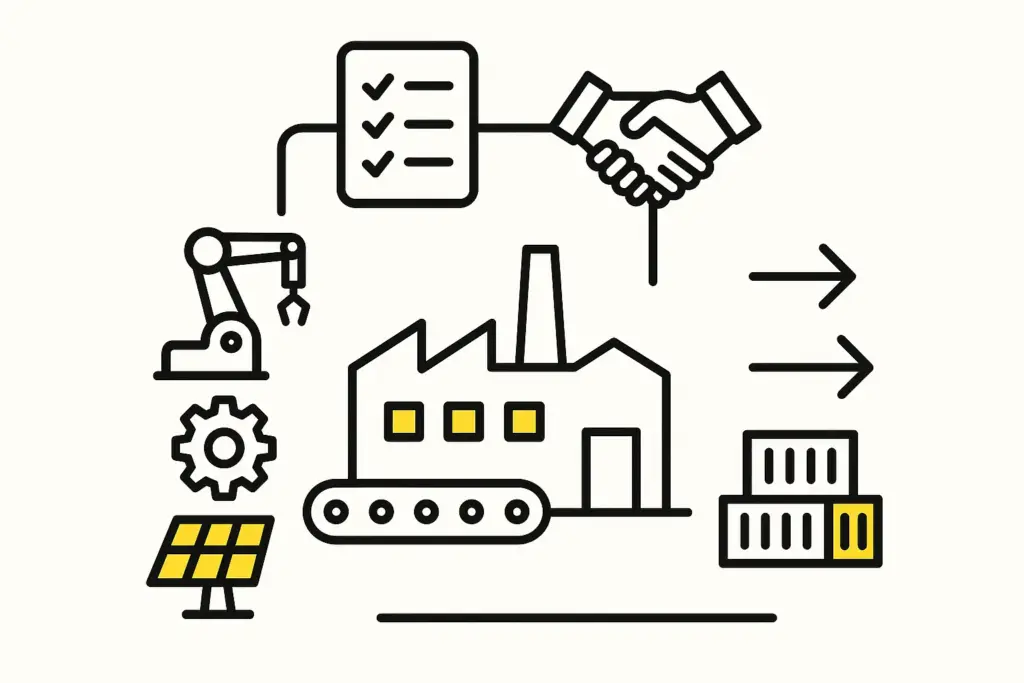
Developing the Supply Chain for Solar Modules in Albania: Getting Your Materials
While your team is critical, efficient solar module production also depends on a steady, reliable supply of raw materials and components.
Raw Materials and Component Sourcing: Where Will It All Come From?
Solar module manufacturing relies on a specific list of materials: silicon wafers, solar glass, aluminum frames, encapsulants (like EVA), and backsheets. Currently, Albania has limited domestic production of these specialized items for the solar industry. In practice, this means manufacturers will likely need to import most, if not all, of these critical inputs. Building strong relationships with international suppliers and thoroughly understanding import logistics will be high on your to-do list. Encouragingly, the International Renewable Energy Agency (IRENA) has noted Albania’s efforts to develop its renewable sector, which naturally extends to tackling supply chain logistics.
Local Manufacturing Potential: Can Some Parts Be Made In-Country?
While producing high-tech components like solar cells locally might be a longer-term goal, there is definite potential to develop local capacity for other parts. Albania’s existing industries include metal fabrication (ideal for aluminum frames), plastics, and some basic electronics assembly. These could be tapped as suppliers for less complex components like junction boxes or frames. Encouraging local businesses to adapt and meet the quality standards of the solar industry could gradually reduce reliance on imports for certain items. The presence of TÜV Rheinland in Albania, offering PV supply chain services, is a positive sign of a growing ecosystem ready to support quality and standards.
Infrastructure and Logistics: Moving Goods Efficiently
Smooth logistics are non-negotiable. This means taking a hard look at the quality and capacity of Albania’s transportation infrastructure—its ports (like the key hub of Durrës), road networks, and rail connections—for handling both imported raw materials and exported finished modules. Don’t forget about suitable industrial zones with reliable utilities like electricity and water; these are a crucial piece of the puzzle when choosing a factory location. Large-scale energy projects, like the KESH Belshi Solar PV Project detailed by the European Bank for Reconstruction and Development (EBRD), often provide valuable clues about logistical and infrastructure considerations in the region.
Government Policies and Incentives for Local Supply Chains: What Support is Available?
The Albanian government is clearly committed to increasing solar energy production, as seen in various national strategies and project approvals. This commitment may well extend to supporting local manufacturing and supply chains. It’s worth investigating what incentives might be available, such as favorable tax regimes for manufacturing, customs duty exemptions for raw materials, or support for setting up operations in designated economic zones. These could offer significant benefits. IRENA’s Renewable Readiness Assessment for Albania is often a good place to start digging for details on policies that could influence local manufacturing.
Key Operational Insights for Factory Planning: Putting It All Together
Considering these labor and supply chain dynamics, what are the key takeaways for planning a solar manufacturing facility in Albania? Let’s break it down:
- Strengths to Leverage: You’re looking at competitive labor costs, a government keen on expanding solar energy, and Albania’s strategic location in the Balkans. These are strong foundations.
- Weaknesses/Challenges to Address: Be prepared for a skills gap in highly specialized solar manufacturing roles and plan for a heavy reliance on imported raw materials, as the local supply chain for solar-specific parts is still in its infancy.
- Opportunities to Seize: There is significant potential to develop a skilled workforce through targeted training, foster local suppliers over time, and serve both the growing domestic market and regional ones.
- Threats to Mitigate: Keep an eye on global supply chain disruptions, which can affect material costs and availability. Competition from established global manufacturers is also a reality, and developing local expertise will take time and investment.
In terms of costs, your main drivers will likely be imported materials, labor wages and training, energy for production, and the logistics of both inbound materials and outbound products.
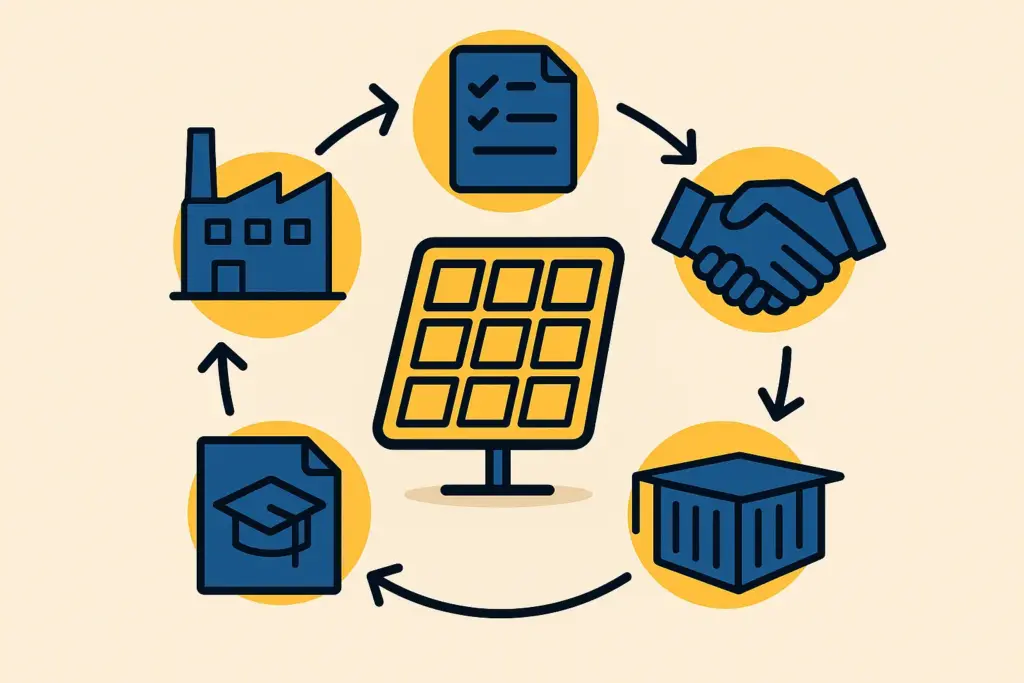
Building Albania’s Solar Manufacturing Future: A Bright Outlook
Albania’s move into solar module manufacturing holds exciting potential, strongly supported by its abundant solar resources and clear strategic energy goals. While challenges exist, particularly in workforce development and supply chain maturation, they are far from insurmountable. A proactive approach—involving thorough due diligence, smart partnerships for training and sourcing, and alignment with government initiatives—can pave the way for successful solar production ventures.
These operational insights into labor and supply chains are crucial first steps on your journey. Ready to turn potential into profit? We at PVknowhow.com are dedicated to your success in Albania’s solar sector. Our comprehensive ‘Solar Manufacturing Opportunities in Albania: A PVknowhow.com Report‘ is your expert guide through every stage of planning and launching your solar factory. Let’s build Albania’s solar future together!
Frequently Asked Questions (FAQs)
Q1: What are the general labor costs for manufacturing in Albania?
A: While exact figures will vary by the specific skills you need, Albania generally offers a competitive edge on labor costs compared to many Western European nations. As of late 2023, the average gross monthly wage was around €670-€700. However, you will want to conduct a detailed analysis for the specific manufacturing roles you’re looking to fill.
Q2: Can I easily find skilled technicians for solar panel production in Albania?
A: A general technical workforce is available, which is a good starting point. For the highly specialized skills unique to solar PV manufacturing, however, you may find that targeted training and development initiatives are needed. The good news is that efforts are underway, as noted by bodies like the ETF, to upskill the labor force specifically for the renewable energy sector. It’s an evolving picture with positive momentum.
Q3: Is it possible to source solar panel components locally in Albania?
A: Currently, for most specialized solar components like solar cells, specialty glass, and encapsulants, you would likely need to plan for imports. However, there is exciting potential to develop local sourcing over time for items like aluminum frames or junction boxes by working with and helping adapt existing manufacturing industries in Albania.
Q4: How is the Albanian government supporting solar manufacturing?
A: The Albanian government is actively promoting solar energy, which is great news for potential manufacturers. This support can come in various forms, such as favorable policies for renewable energy projects, potential investment incentives, and general measures to improve the ease of doing business. It is worth digging into specific manufacturing incentives. Reports from organizations like IRENA can often offer good context on this.
Q5: What are the biggest logistical hurdles I might face setting up a solar factory in Albania?
A: Planning for logistics is key. Potential challenges include managing the import of raw materials efficiently (customs, shipping times), ensuring smooth internal transport and warehousing, and developing robust outbound logistics for your finished products. The quality of existing infrastructure, particularly port facilities like Durrës and the road networks, will be a key factor in your planning. You can sometimes find useful insights in EBRD project details for similar large-scale ventures.
References
All references
- European Training Foundation (ETF). (2022). Future skills needs in the Albanian energy sector. Retrieved from https://www.etf.europa.eu/sites/default/files/2022-01/fow_albania_energy_sector_final_en.pdf
- International Renewable Energy Agency (IRENA). (2021). Renewables Readiness Assessment: Albania. Retrieved from https://www.irena.org/-/media/Files/IRENA/Agency/Publication/2021/March/IRENA_RRA_Albania_2021.pdf
- PVknowhow.com. Solar Report: Albania. Retrieved from https://www.pvknowhow.com/solar-report/albania/
- European Bank for Reconstruction and Development (EBRD). KESH Belshi Solar PV Project (redacted). Retrieved from https://www.ebrd.com/content/dam/ebrd_dxp/documents/project/54350/KESH%20Belshi%20Solar%20PV%20Project%20(redacted)_final.pdf
- TÜV Rheinland. PV Supply Chain Services Albania. Retrieved from https://www.tuv.com/albania/en/pv-supply-chain-services.html
- ResearchGate. The Role of Solar Energy in Albania’s Economic Transformation. (General background). Retrieved from https://www.researchgate.net/publication/390365888_The_Role_of_Solar_Energy_in_Albania's_Economic_Transformation