When considering a major capital investment like a solar module factory, investors naturally scrutinize market demand first. Seasoned entrepreneurs, however, know that long-term success is built not on market hype, but on a stable and predictable business environment.
While some regions offer rapid growth potential, they may also carry underlying volatility. Austria presents a compelling alternative: a mature, highly stable economy that provides a solid foundation for sustainable manufacturing growth.
This article analyzes Austria’s business climate, examining the economic, legal, and operational factors that make it a strategic choice for investors in the solar manufacturing sector. It goes beyond surface-level statistics to explain why these elements are so crucial for the success of a new industrial venture.
The Foundation of Stability: Austria’s Economic Landscape
For any manufacturing project, economic predictability is paramount, influencing everything from financing costs to long-term profitability forecasts. Austria distinguishes itself with a remarkably stable macroeconomic environment, marked by consistent GDP growth and low inflation, even during turbulent global times. Its top-tier AAA credit rating from major agencies like Standard & Poor’s reinforces this position, signaling exceptional financial reliability.
This stability is not a recent development but the result of decades of prudent economic policy. For an investor, this translates into several key advantages:
- Reduced Financial Risk: Stable economic conditions lead to more predictable interest rates and easier access to capital from financial institutions.
- Predictable Operating Costs: Low and stable inflation allows for more accurate budgeting and forecasting, minimizing unforeseen cost escalations.
- Investor Confidence: A strong credit rating instills confidence not only in the primary investor but also in potential partners and suppliers.
Streamlined Operations: Legal Security and the Ease of Doing Business
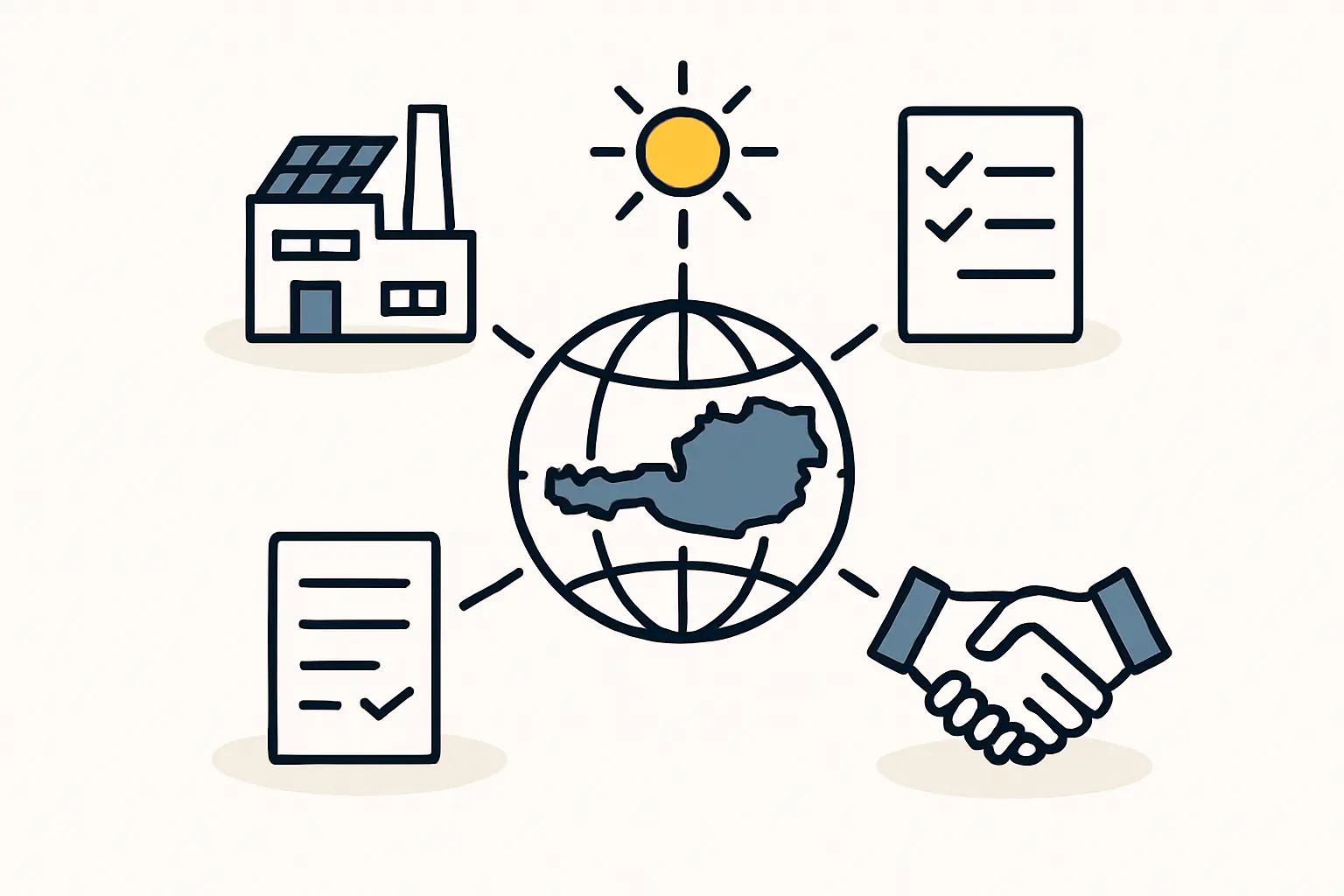
A favorable business climate is about more than just economic figures; it extends to the ease and security of day-to-day operations. Austria consistently ranks high in global ‘Ease of Doing Business’ indices (27th worldwide in the last World Bank report), reflecting its efficient bureaucracy and robust legal framework.
A unique feature of the Austrian system is its long-standing ‘social partnership’—a formal system of cooperation between employers, employees, and government bodies. While this may sound abstract, its practical benefit is significant: it fosters one of the lowest strike rates in Europe and a collaborative, rather than confrontational, relationship between management and labor.
This social stability creates a secure and predictable operational environment—a critical asset when managing a large-scale manufacturing workforce. For new entrants, this means less time navigating complex labor disputes and more time focused on production and growth.
A Strategic Hub: Location, Infrastructure, and EU Market Access
Austria’s geographical position in the heart of Europe is a core strategic advantage. It serves as a natural gateway between Western, Southern, and the rapidly growing markets of Central and Eastern Europe. This central location is backed by a world-class logistics infrastructure, including a dense network of highways, railways, and efficient freight terminals.
For a solar module manufacturer, this translates into tangible benefits:
- Efficient Supply Chains: Proximity to major European industrial suppliers in Germany and Italy can reduce lead times and transportation costs for raw materials and essential solar manufacturing equipment.
- Market Reach: As a member of the European Union, an Austrian-based factory has frictionless, tariff-free access to the entire EU solar market, one of the largest and most advanced in the world.
- Logistical Excellence: The reliability of Austrian logistics ensures that finished products can be delivered to customers across the continent on time and on budget.
Financial Incentives and a Supportive Tax Environment
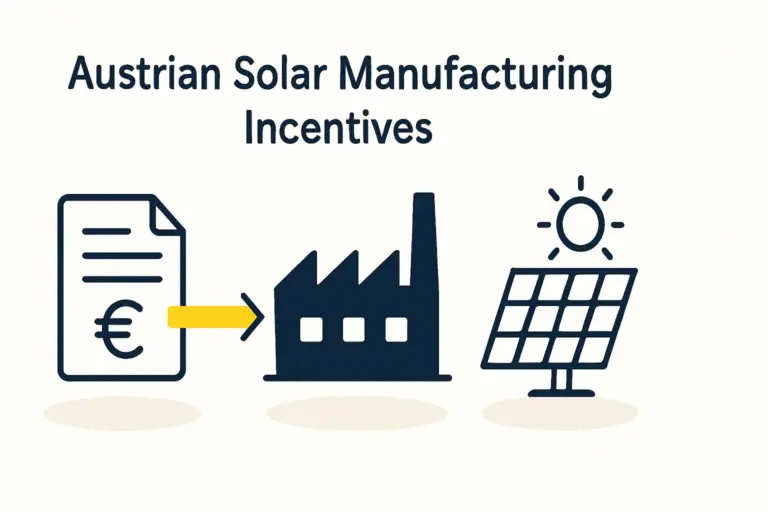
Austria actively encourages industrial investment through a competitive and transparent tax system. The corporate tax rate, recently lowered to a competitive 24% (as of 2024), stands out within the EU. The most compelling incentive, however, particularly for a technology-focused industry like solar manufacturing, is the research premium.
Businesses can claim a 14% cash premium on their research and development (R&D) expenditures. This is not a mere tax deduction but a direct cash-back payment from tax authorities, significantly lowering the effective cost of innovation. For a solar manufacturer investing in process optimization or new module technologies, this premium is a powerful financial tool.
In addition, public funding agencies like the Austrian Research Promotion Agency (FFG) and Austria Wirtschaftsservice (AWS) offer a range of grants and subsidized loans for industrial projects. Understanding these financial nuances is a critical step in planning the total investment for a solar factory.
Access to Talent and a Culture of Innovation
A factory is only as good as the people who run it. Austria’s renowned dual education system, which combines classroom instruction with on-the-job apprenticeship, produces a steady supply of highly qualified technicians and engineers. This creates a deep pool of the skilled workforce in solar manufacturing needed to operate and maintain sophisticated production lines.
Key advantages of the Austrian talent pool include:
- High Technical Proficiency: The workforce is well-versed in advanced manufacturing and engineering principles.
- Strong English Skills: English is widely spoken in the business and technical communities, simplifying communication for international management teams.
- Collaborative R&D: Close ties between universities, research institutions, and private industry foster a vibrant ecosystem for innovation, allowing manufacturers to stay at the cutting edge of solar technology.
Experience from J.v.G. turnkey projects shows that securing a competent local team for key operational roles is one of the most critical factors for a successful launch in a new country. Austria’s educational infrastructure is built to support this need.
Frequently Asked Questions (FAQ)
Q1: What exactly is the ‘social partnership’ in Austria?
A1: The social partnership is a formal system where major economic interest groups (representing industry, labor, and agriculture) negotiate on a national level on wages, prices, and social policies. For a business owner, its primary benefit is a stable and predictable labor market with very few industrial disputes or strikes.
Q2: How does EU membership directly benefit a solar manufacturer in Austria?
A2: EU membership provides two main advantages. First, the EU Single Market allows for the free movement of goods, capital, and labor. This means no tariffs or complex customs procedures when exporting modules to Germany, France, or any other EU country. Second, products certified in Austria (e.g., with CE marking) are automatically accepted across the entire EU, simplifying market access.
Q3: Are there significant language barriers for conducting business?
A3: While German is the official language, English is widely and fluently spoken in the Austrian business community, especially among professionals and younger generations. For an international investor, it is entirely feasible to conduct high-level negotiations, manage legal paperwork, and run a company using English.
Q4: What is the typical first step to register a company in Austria?
A4: The most common legal form for a new manufacturing enterprise is a Limited Liability Company (GmbH). The process typically involves drafting articles of association, appointing a managing director, and registering the company in the commercial register. This process is standardized and can be completed efficiently with the help of a local notary and legal counsel.
Conclusion: A Strategic Choice for Long-Term Success
While the global solar market offers many opportunities, Austria presents a uniquely compelling proposition. It combines robust and growing domestic demand for renewable energy with a business climate defined by stability, security, and strong institutional support.
For the international investor looking to build a lasting and profitable manufacturing enterprise, Austria is not just a location—it is a strategic partner. This combination of economic predictability, logistical advantages, and a skilled workforce creates an environment where a solar manufacturing business can thrive for decades. The next logical step involves a detailed exploration of site locations, supply chains, and workforce planning to bring your project to life.