An entrepreneur secures a contract for state-of-the-art solar module manufacturing equipment from a supplier in Germany. The engineering is precise, the production capacity ideal, and the price is set. But a critical phase of the project is just beginning: getting this high-value machinery from a European port to a factory floor in Gaborone.
This process involves a complex web of customs regulations, international freight, and local logistics. Without careful management, these factors can significantly impact project timelines and budgets.
This guide walks through the key considerations for importing capital goods into Botswana, focusing on customs duties, freight logistics, and the essential documentation needed for a smooth, predictable process.
Table of Contents
The Strategic Context: Botswana’s Position in Southern Africa
Botswana’s geographic position as a land-linked country is a defining factor in its logistics strategy. For importers, the single most important factor is its membership in the Southern African Customs Union (SACU) – alongside South Africa, Namibia, Lesotho, and Eswatini.
SACU operates a Common External Tariff (CET), meaning goods imported from outside the union are subject to the same set of tariffs and duties, regardless of which member country they first enter. Once goods have cleared customs in one SACU country—at the port of Durban, for instance—they can generally move freely to another member country like Botswana without incurring additional customs duties. This arrangement simplifies cross-border trade but places immense importance on the initial port of entry.
Understanding the Customs Framework: BURS, Tariffs, and Taxes
The Botswana Unified Revenue Service (BURS) is the official body responsible for collecting customs duties and taxes. For any business planning to import machinery, understanding how BURS operates is fundamental.
Harmonized System (HS) Codes and Duty Rates
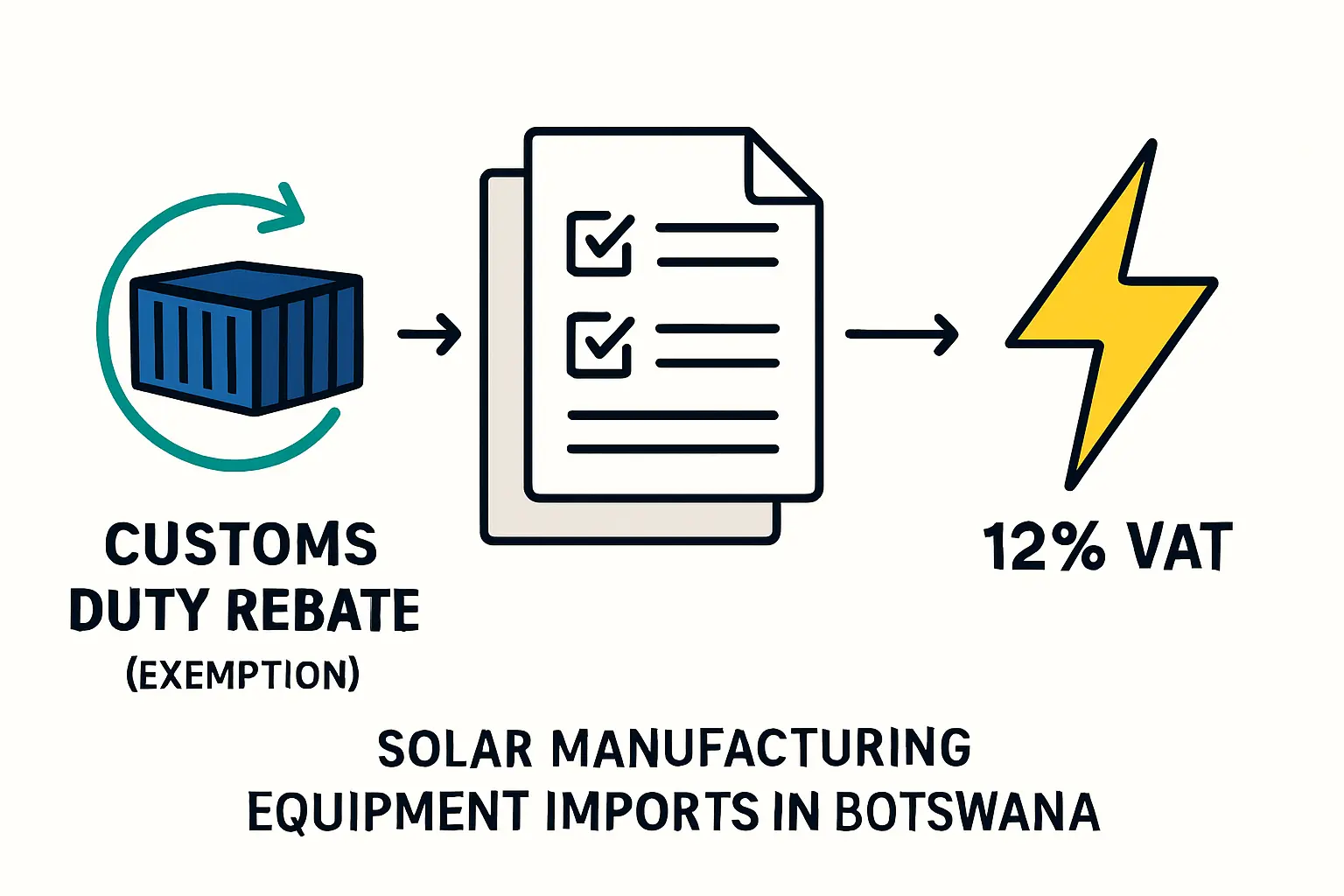
All imported goods are classified using the international Harmonized System (HS) code, which determines the applicable duty rate. A key advantage for investors in the manufacturing sector is that capital equipment and machinery for production often fall under classifications with a 0% customs duty rate.
However, verifying the specific HS code for your solar manufacturing equipment with a licensed customs broker is crucial. An incorrect classification can lead to unexpected charges and significant delays.
Value Added Tax (VAT)
While customs duties may be zero, Value Added Tax (VAT) is nearly always applicable. The Botswana VAT rate is levied at a standard percentage (e.g., 14%) and is calculated on the total landed cost of the goods, which includes:
- The Equipment’s Invoice Value: The price listed on the commercial invoice.
- Insurance: The cost of insuring the goods during transit.
- Freight: The shipping cost to the port of entry.
- Any Applicable Customs Duties: Even if the duty is 0%, it forms part of the calculation base.
This means VAT can be a substantial upfront cost that must be factored into the project’s financial planning and business plan.
Calculating Your Landed Cost: A BURS Duty & VAT Example
To illustrate, consider a shipment of solar laminators valued at €500,000. The final cost upon arrival at a Gaborone facility will be considerably higher.
| Description | Amount |
|---|---|
| Equipment Invoice Value (Cost) | €500,000 |
| Ocean Freight & Insurance (CIF to Durban) | €30,000 |
| Total CIF Value (Customs Value) | €530,000 |
| Customs Duty | Assumed at 0% for this type of capital equipment. |
| VAT Base Value | €530,000 (CIF Value + Duty) |
| VAT Payable (at 14%) | €74,200 |
| Additional Costs | Port handling, customs brokerage fees, road transport from Durban to Gaborone, and local insurance could add another €15,000 – €25,000. |
In this scenario, the total Botswana import bill for the project exceeds €620,000 before the equipment even reaches the factory floor—a powerful reminder of why a detailed cost analysis is essential.
Freight Forwarding: Choosing Your Port and Partner
Since Botswana is land-linked, selecting the right seaport and a competent freight forwarding partner is a critical decision. The two primary corridors for cargo destined for Botswana are through Durban, South Africa, and Walvis Bay, Namibia.
Durban (South Africa):
- Pros: One of Africa’s largest and busiest ports with extensive shipping line connectivity. The road network to Gaborone is well-established.
- Cons: Port congestion can sometimes lead to delays. The road distance is significant.
Walvis Bay (Namibia):
- Pros: Known for high efficiency and shorter vessel waiting times. The Trans-Kalahari Corridor provides a direct and modern road link to Botswana.
- Cons: Fewer direct shipping services compared to Durban, which might affect transit times from certain global regions.
A reliable freight forwarder does more than just move containers. They act as your project manager for logistics, handling customs clearance, coordinating with port authorities, and managing the final leg of road transport. Their expertise is invaluable in navigating customs procedures and ensuring all paperwork is compliant.
Essential Documentation for a Smooth Import Process
Meticulous paperwork is fundamental to a hassle-free customs clearance, as incomplete or inaccurate documentation is the most common cause of delays. The core documents required by BURS include:
- SAD 500 Form: The official customs declaration document for all imports and exports within SACU, typically completed by your customs clearing agent.
- Commercial Invoice: Must clearly state the value, description, and HS code of the goods, along with details of the buyer and seller.
- Packing List: A detailed inventory of the shipment’s contents, including weights and dimensions, which is crucial for customs verification.
- Bill of Lading (Sea Freight) or Air Waybill (Air Freight): The contract between the owner of the goods and the shipping carrier.
- Certificate of Origin: May be required to prove the country of manufacture.
- Import Permits: Certain types of equipment may require specific permits from relevant ministries in Botswana.
Based on experience from J.v.G. turnkey projects, dedicating a team member to liaise with the freight forwarder and double-check all documents before the shipment arrives can prevent weeks of potential delays. Aligning these logistical requirements with the factory building requirements is also crucial, ensuring the site is ready to receive the shipment upon arrival.

Frequently Asked Questions (FAQ)
Is all manufacturing equipment duty-free when imported into Botswana?
Not necessarily. While many categories of capital goods for manufacturing have a 0% duty rate under the SACU Common External Tariff, the specific rate depends entirely on the product’s HS code. Confirming the code with a customs professional before shipping is essential.
Can a business handle its own customs clearance without an agent?
While technically possible, it is highly inadvisable for those without extensive experience. Licensed customs clearing agents have the necessary software, registrations with BURS, and expertise to navigate the complex procedures correctly. Using a professional minimizes the risk of errors, penalties, and delays.
How long does it typically take for equipment to clear customs at the port?
If all documentation is correct and submitted in advance, clearance can take as little as 3-7 business days after the vessel’s arrival. However, any discrepancies, physical inspections, or customs queries can extend this period significantly.
What is the biggest mistake new importers make?
A common error is under-declaring the value of goods on the commercial invoice in an attempt to reduce VAT liability. Customs authorities are experienced in valuing goods and use global databases for comparison. Under-declaration can lead to severe penalties, seizure of the equipment, and long-term reputational damage with BURS.
Conclusion: Planning is the Key to Success
Importing solar manufacturing equipment into Botswana is a manageable process, but one that requires diligence and foresight. The key is to treat logistics and customs not as a final step, but as an integral part of the project plan from the very beginning. By understanding the SACU framework, accurately calculating landed costs, selecting a reputable logistics partner, and preparing meticulous documentation, entrepreneurs can ensure their valuable assets arrive safely, on time, and within budget—ready to begin production.